
A quality engineer resume summary should connect an actual process problem to the measurement or investigation you performed and the way an approved change was checked. “Expert in Six Sigma, CAPA, SPC, and ISO” is not convincing without evidence that you applied those methods. Start with the industry and process—manufacturing, supplier quality, test operations, or another documented setting—then identify the tools you used and decisions you owned. Be careful not to imply you signed off a validation, conducted an audit independently, or held certification you never received. A precise summary makes role boundaries and results understandable in two or three sentences.
Separate measurement, investigation, and change authority
Quality work can involve incoming inspection, trend monitoring, nonconformance logging, root-cause support, measurement-system study, supplier follow-up, process validation, or corrective action. Each has different responsibility and technical prerequisites. O*NET identifies industrial engineers, including reported quality engineer job titles, with process evaluation and quality control work. That occupational context does not establish that every person with quality in their title can independently approve product release, process changes, or regulatory filings. Your summary should say which parts of the workflow you performed, not list every quality tool in the vocabulary.
Draw a simple timeline for one real quality problem: detected variation, collected measurements, reviewed possible causes, agreed on an action, and checked the result. Circle your own steps and identify where the team lead, quality manager, or responsible engineer approved decisions. If you collected test results, write “compiled and checked measurement data” rather than “validated the process” unless validation was actually within your assigned scope. If you helped with a corrective action, clarify whether you opened the record, tested evidence, drafted a recommendation, or approved closure.
Write sample summaries for two different responsibility levels
Illustrative junior example: “Quality engineering associate experienced in measurement logs, nonconformance documentation, and supervised root-cause investigations. Organizes test evidence and tracks follow-up actions for engineer review.” Use it only when the tasks are real. For a candidate who worked as an inspector, keep the actual job title in the experience section; do not assume an inspector is a quality engineer simply because measurement skills overlap. A concise summary can still show the route from inspection to engineering support.
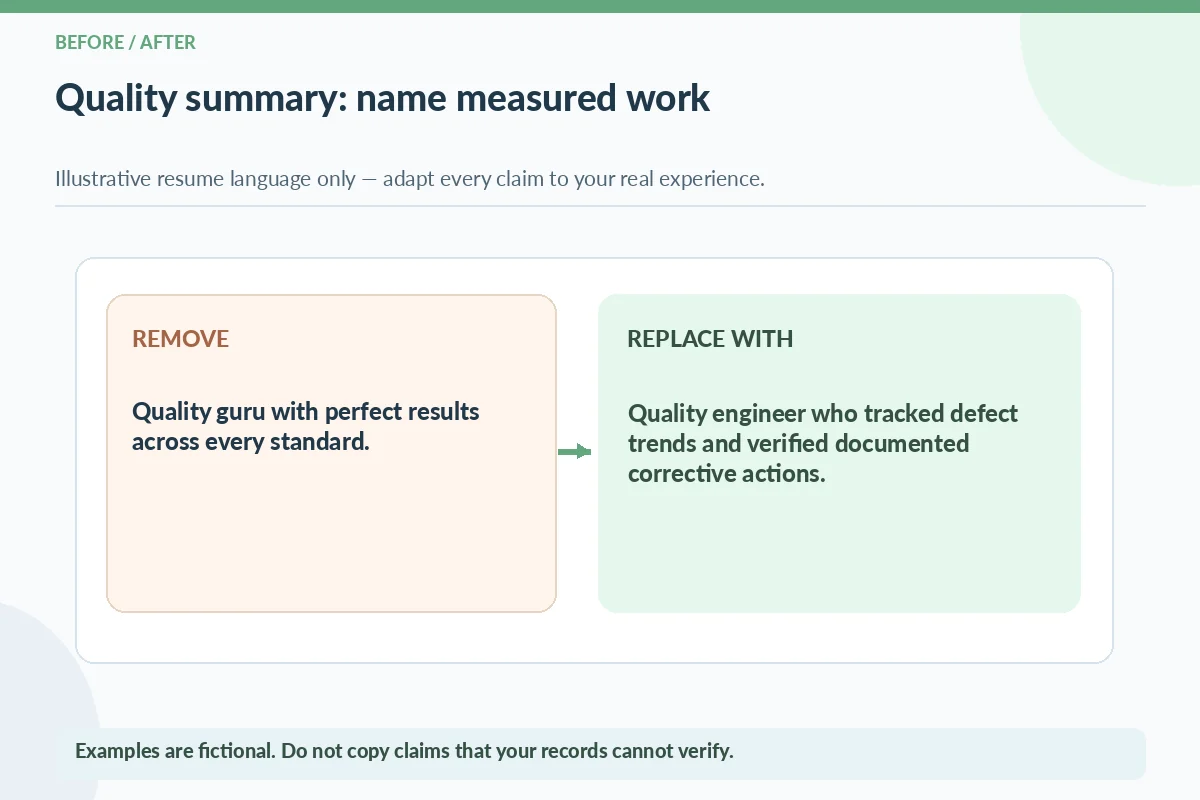
Illustrative experienced example: “Quality engineer focused on documented defect investigations, measurement trend review, and verification of approved process changes. Coordinates operators, suppliers, and engineering reviewers to track corrective actions within assigned decision authority.” Replace general language with the actual product family, standard, tool, and credible outcome where permissible. The example does not claim a Green Belt, a certification, a zero-defect record, or years of experience. Those claims belong only on a resume supported by a real credential or a traceable work record.

Choose process evidence more carefully than acronyms
If an advertisement mentions SPC, FMEA, CAPA, or MSA, verify which technique you personally used before adding it. A control chart you maintained is different from a process capability study you designed. Attending a meeting about FMEA is not the same as facilitating the assessment or authorizing a risk decision. Supporting root-cause analysis means you can explain your evidence and hypothesis checks, not just recite the phrase. When the terminology varies by industry, follow the employer’s specific role description rather than transplanting a regulated-medical-device vocabulary into an unrelated factory job.
A defensible achievement bullet identifies the starting process, measurement source, your intervention, and the verification method. Perhaps you tagged recurring defect codes, matched inspection records to lots, or prepared a recheck report after a revised work instruction. If the quality team implemented the change, attribute the work collaboratively. Avoid statements such as “guaranteed full compliance,” “eliminated all defects,” or “certified every product” unless they are literally true and defensible. You can display disciplined testing without a dramatic numeric claim.
Handle defect rates and improvement figures honestly
Numbers are valuable only when you know their definitions. A defect count might refer to inspected units, defects per unit, return claims, or out-of-spec measurements; these are not interchangeable. A percentage improvement needs a clear before-and-after window, comparable conditions, and evidence you can share. Never borrow another department’s savings estimate or round an unverified yield change into a headline. If quality outcomes were not measured, emphasize documentation and review: “Prepared trend summaries from inspection logs and flagged recurring nonconformances for engineering investigation.”
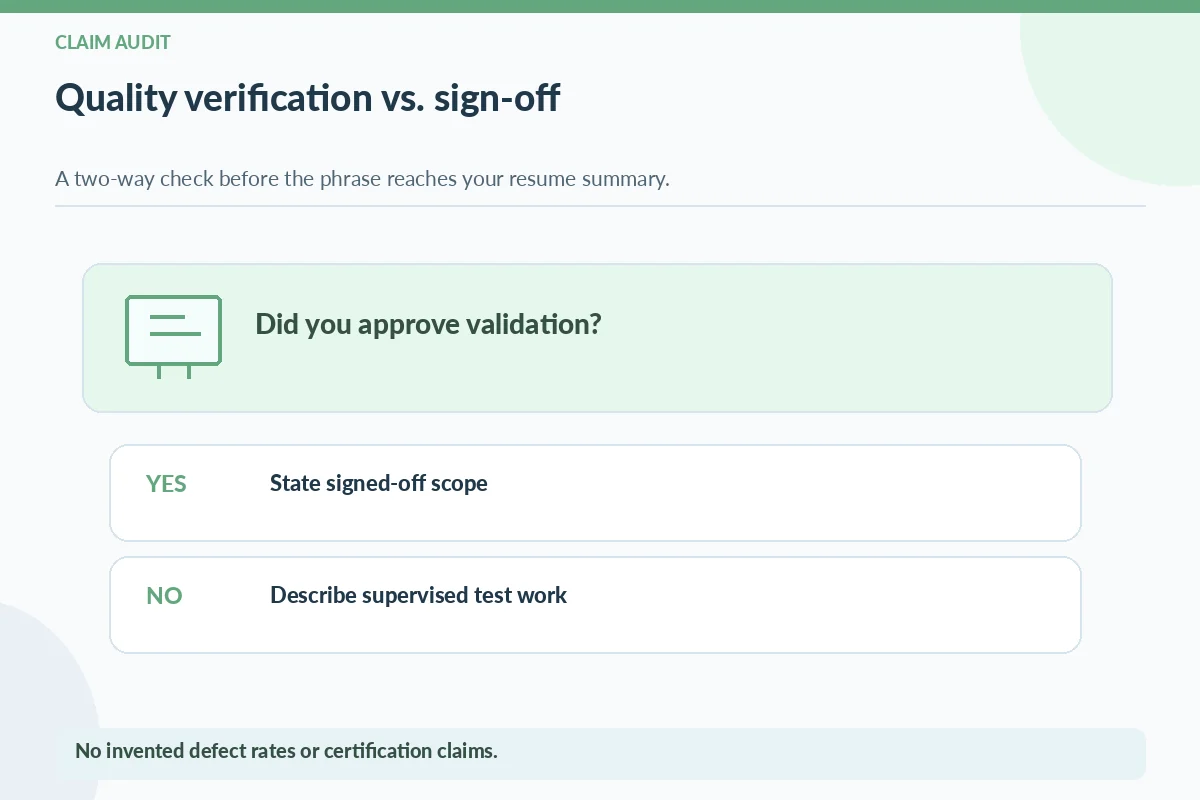
Differentiate conducting a test from approving a validation. Your organization may require prescribed protocols, independent review, controlled specifications, and formal sign-off. If you gathered validation data or executed steps under supervision, name exactly that. If you led the complete validation with delegated authority, show the actual scope, standard, and result. Where projects are proprietary, keep product names, tolerances, and confidential defect thresholds out of public resumes. A recruiter can understand disciplined quality practice through a general description of process, tools, and approved decisions.
Adapt the summary for supplier and production quality jobs
A supplier quality opening may care about incoming lots, supplier corrective-action follow-up, traceability, and escalation to approved buyers or engineers. A manufacturing quality position may care about process variation, line measurements, work instructions, and corrective-action effectiveness. A test or reliability role may focus on procedures, reproducibility, and reporting. Choose one or two process families that match your real experience. Even a very technical summary becomes less effective when it is a list of irrelevant quality acronyms copied from unrelated job ads.
For career changers from production inspection or operations, lead with concrete quality-adjacent work: maintaining calibrated-measurement records, checking sample labels, or documenting nonconforming material. Do not rename yourself “senior quality engineer” before you have held corresponding responsibilities. If a certificate or professional designation appears in the advertisement, show the exact credential and its status separately, and never claim affiliation with a professional body because you read its guidance. Use the summary as a focused bridge between documented work and the employer’s requirement.
Use a final evidence and confidentiality checklist
Read the summary line by line. Can you demonstrate each tool, method, and result? Does “led” mean you assigned work and approved actions, or that you contributed an analysis? Are stated certifications current and issued by the correct body? Is the metric derived from a traceable denominator, not an informal impression? Are process changes documented and approved where necessary? Remove unsupported claims before reducing the length. A short summary that names a validated activity is stronger than a broad boast about flawless quality.
Finally, compare the summary with three relevant experience bullets. One should establish the method or measurement, another should explain how you handled an exception, and a third may show a verified outcome. Avoid revealing proprietary tolerances, customer quality data, internal audit findings, or controlled procedures. Keep the language understandable to a recruiter without diluting the technical truth. A quality engineer summary works when the reader knows precisely what you measured, what you influenced, and what someone else approved.
How We Research Role-Specific Resume Summaries
We reviewed occupational profiles, official career guidance, and relevant professional or safety sources from onetonline.org; bls.gov; asq.org on November 4, 2026. Each sample summary here is fictional and must be adapted to actual skills, official role titles, and the employer’s requirements. No source endorses a particular candidate, and no hiring outcome, credential, metric, or ATS result is guaranteed. We do not claim a paid relationship with the sources. Read our affiliate disclosure.
More Resume and Cover Letter Guides
No. Include tools only when they were part of your actual work and the employer seeks them. Explain the relevant task and result rather than listing unproven acronyms.
Only if you genuinely held that responsibility. Otherwise specify the protocol steps executed, data gathered, or verification work performed under the appropriate reviewer.
Use a precise description of the measurement, investigation, documentation, or follow-up you performed. Do not invent or approximate a reduction.
Possibly, depending on education, job requirements, and experience. Describe your current inspection scope accurately and do not imply engineering qualifications you do not possess.
Describe the quality method, type of process, and permitted outcome at a general level. Exclude confidential product specifications, defect thresholds, customer details, and controlled records.