
A business analyst should connect strengths to gathering requirements, checking assumptions, mapping decisions, and making handoffs useful. Weaknesses can involve moving into solution ideas before confirming the problem, or using terminology stakeholders do not understand—provided you can explain a specific correction. Avoid portraying yourself as the person who approved every scope or budget decision. Interviewers need to know how you turned uncertain requests into verifiable information and who made the final call.
Use requirements evidence rather than buzzwords
Claims such as “excellent communicator” or “strategic thinker” tell the interviewer little unless you name the decision you clarified. Choose a requirement that had more than one possible interpretation. Explain how you identified the users, asked targeted questions, recorded conflicting views, and confirmed the next owner. If the requirements changed later, distinguish your documentation work from the change approval itself.
The strongest account can be checked through a real artifact: an anonymized process map, a list of acceptance questions, or a decision log you are permitted to discuss. Do not expose internal customer or employer documents. A sanitized description of the problem, your method, and how ambiguity was surfaced demonstrates practical analysis without disclosing sensitive information.
Choose a weakness tied to your analyst practice
A useful weakness might be jumping to a proposed solution before defining the problem, producing requirements that are too detailed for their readers, or delaying clarification because stakeholders are busy. Explain the signal that made you notice it and the new checkpoint you use. A generic answer such as “I care too much about stakeholders” sounds like avoidance rather than growth.
For instance, you may have drafted a feature idea after hearing one request and then learned that a second user had a different need. The correction is not “I never assume anything.” It is to verify the audience, document the uncertainty, and ask the decision owner to confirm scope before writing acceptance criteria. If this was a classroom example, identify it as such.

Describe tradeoffs without claiming authority
Analysts often present options that involve time, cost, usability, or policy constraints. An interview strength can be making those choices visible. Prepare an example showing what information you compared and how you expressed unresolved risks. Do not claim you “approved the roadmap” when the product owner, sponsor, or committee made the decision. Credibility increases when the roles are clear.
If challenged about a stakeholder who disagreed, explain how you captured the disagreement and brought it to the agreed decision process. The goal is not winning an argument. It is recording options, evidence and consequences so a responsible person can decide. Avoid dramatic stakeholder stories that assign motives you cannot know; stick to what each person requested or confirmed.
Translate user stories into acceptance checks
In a requirements conversation, a vague need like “make reporting easier” might mean faster retrieval, fewer manual reconciliations, or a different chart. Your story can show how you sought examples, documented the current behavior, and agreed on what would count as an acceptable result. Do not fabricate a software release or savings figure. If your involvement ended at specification, say that.
A good weakness improvement might involve replacing long prose with clear examples and edge cases. Explain how you learned to ask what should happen when information is missing or contradictory. Avoid claiming universal rules for agile, waterfall, or any named method. An interviewer wants proof that you can choose understandable artifacts for a real team, not recite a framework.
Provide an example from a project or job
For an experienced analyst, select a request with a known business owner and documented feedback. For a career changer, a classroom study, nonprofit process review, or supervised operational project may be appropriate. The introduction should label the context. Then state your task, what information you validated, the recommendation you prepared, and what was actually adopted or left unresolved.
When you describe outcomes, keep them measurable only if you have genuine records. “The team accepted the revised requirement wording” is specific enough when that is the result you know. “I increased productivity by 40%” without records is not credible. If the organization later delivered a system, do not imply you implemented it unless that was genuinely your responsibility.
Practice the skeptical interviewer follow-up
A hiring manager might ask “How did you know the requirement was complete?” A defensible answer explains review with the requestor, documented exceptions and agreed acceptance conditions. Another follow-up may be “Who signed off?” Identify the owner honestly. These questions test judgment and traceability rather than forcing you to declare perfection.
Prepare one strength answer and one weakness answer of roughly a minute each. Keep a second example ready that concerns difficult communication or unclear scope. If you lack a tool listed in the advertisement, say what similar method you know and how you would learn the tool without pretending to have used it professionally. Real ownership boundaries are part of a good analyst answer.

Build your personal evidence checklist
Before using a strength claim, write down the setting, your exact task, who reviewed it, and one observation you can defend in a follow-up question. For a weakness, choose a real, bounded development area and prepare the feedback or changed habit that demonstrates progress. Your examples must come from experience, not from the hypothetical scripts on this page. If a story involves a customer, colleague, patient, or employer confidential information, describe the work pattern without identifying anyone. Interview preparation is not permission to disclose restricted details.
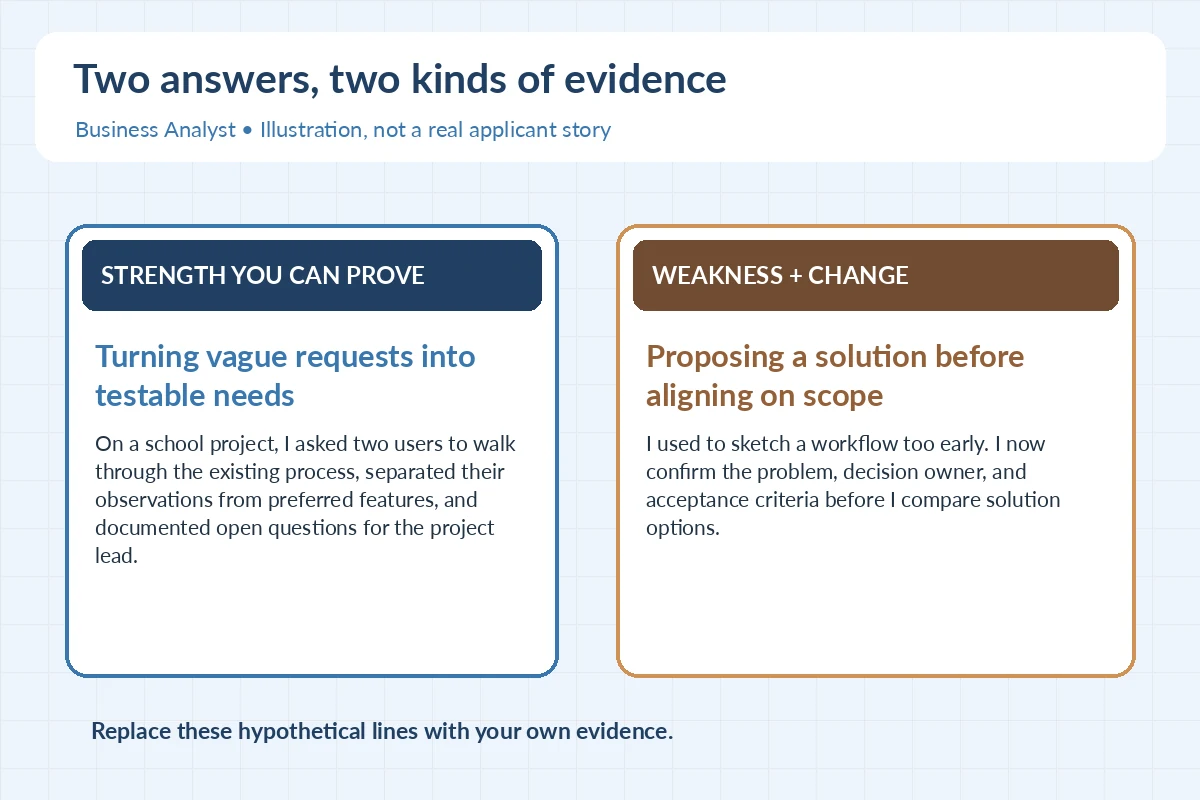
Illustrative strength answer (not a personal testimonial): “One strength I would bring is turning vague requests into testable needs. On a school project, I asked two users to walk through the existing process, separated their observations from preferred features, and documented open questions for the project lead.” This wording is a model; replace the situation with your own facts. Illustrative weakness answer: “I have worked on proposing a solution before aligning on scope. I used to sketch a workflow too early. I now confirm the problem, decision owner, and acceptance criteria before I compare solution options.” Never memorize these examples as achievements you did not perform.
How We Research and review interview advice
This guide uses O*NET’s description of the occupation to anchor the kinds of tasks an employer may assess and the U.S. Office of Personnel Management’s structured interview guidance for the principle that answers should provide evidence relevant to job competencies. O*NET describes occupations, not your personal work history or a universal license. OPM guidance informs interview assessment, not a guaranteed hiring outcome. All sample answers here are illustrative and must be adapted to the applicant’s actual experience.
We also consider the EEOC’s limits on pre-offer disability-related inquiries: job-relevant strength and weakness preparation should not pressure applicants to disclose medical diagnoses or other protected personal information. Verify the particular employer’s job description, authorization rules and interview instructions. Links or recommendations do not represent a paid endorsement. Read our affiliate disclosure.
More Interview Preparation Guides
Yes, when you explain the question you asked, the conflicting evidence you found and what decision the clarification enabled.
Starting solutions before the problem is agreed can be credible if you describe an actual correction and review step.
Only if you are authorized to share them. Otherwise use an invented or thoroughly sanitized example.
Yes. Identify it as academic and describe what you personally did, checked and delivered.
State who did. Your value may have been clarifying options and documenting evidence for that decision.