
A transition from construction to facilities coordination should emphasize knowledge of site conditions, materials, trade schedules and work-order communication—not claim that every former construction worker can approve or perform building repairs. Facilities roles vary from work-order support to managing vendors, maintenance schedules and budgets. Compare the actual vacancy with your own experience, identify where you observed, documented or coordinated tasks, and treat hazardous or licensed work as a separate responsibility for authorized personnel. The aim is an accurate bridge from field work to facility operations.
Distinguish Physical Work From Coordination Duties
Construction workers may handle materials, prepare sites, use tools, assist trades and work under specific safety procedures. O*NET describes facilities managers as people who oversee physical plant needs, building services and operations. A facilities coordinator may provide administrative support to that process, but titles and delegated authority differ widely. Experience carrying out repair tasks does not automatically establish vendor management, budget approval, code compliance or a facilities-management credential. Begin by identifying exactly which coordination activities you performed.
List one typical construction assignment from start to finish. Did you read a work order, verify material availability, report a problem, contact a foreperson, arrange access, or record completion? What document or system showed the step? Who decided the repair method or confirmed safe completion? A career-transition table should name the work you did and leave separate columns for supervisor approval, specialist inspection and closeout. This prevents a site experience story from accidentally becoming a claim of managerial authority.
Understand the Facilities Work-Order Life Cycle
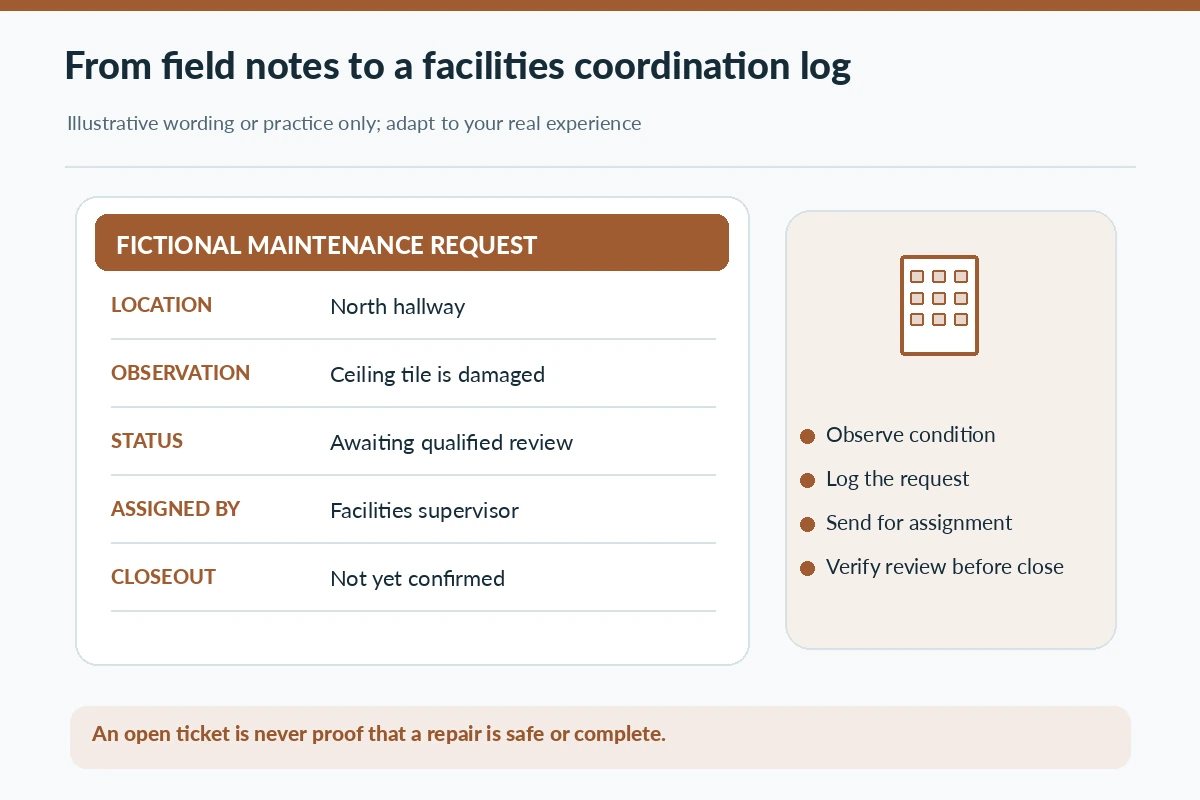
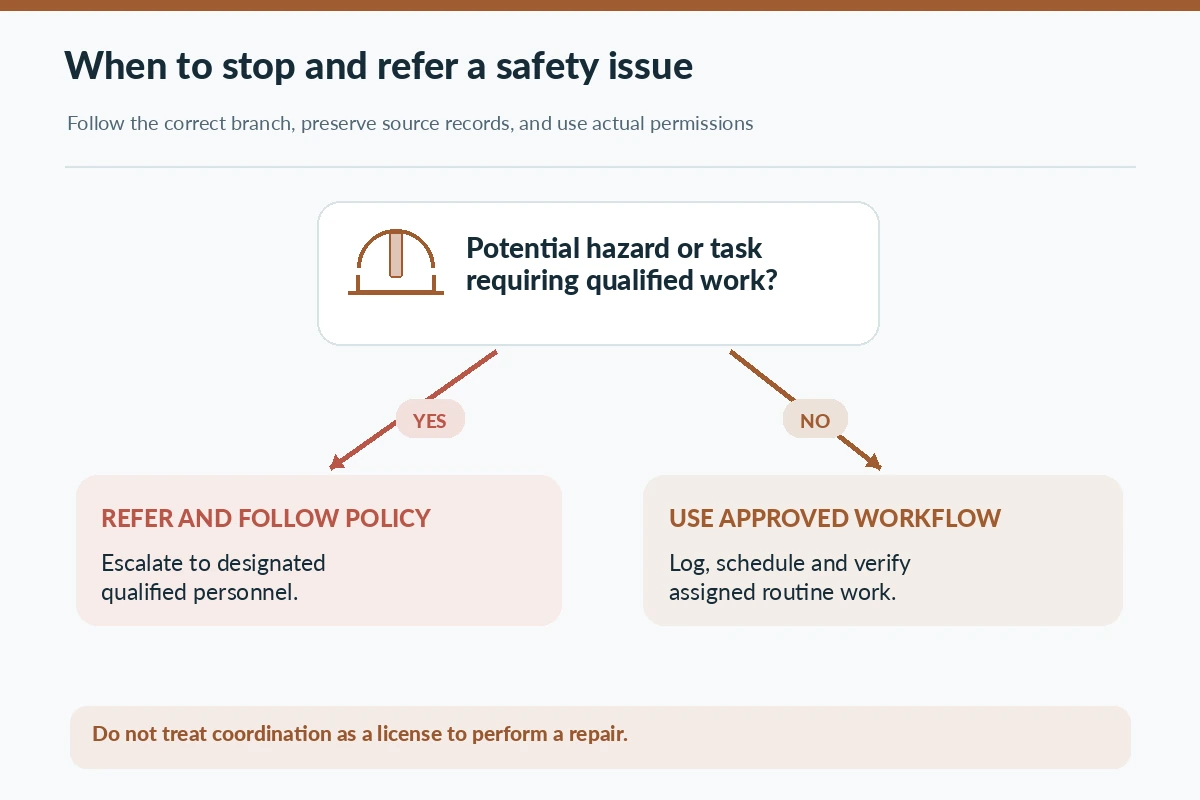
Facilities coordination often begins when someone notices a problem: a leak, broken light, access obstruction or equipment alarm. A useful workflow is request intake, initial description, urgency assessment under site policy, assignment to an authorized person, status communication and documented closeout. These are not merely boxes on a chart; each stage produces a different record and may be owned by a different role. A new coordinator needs to know when to stop and route the issue.
A hypothetical note could read: “Reported damaged ceiling tile in corridor B, logged the location, restricted the work request to the facilities queue and confirmed the supervisor received it.” That sentence is illustrative, not a record from a real employer. It does not state that the candidate certified structural safety or repaired electrical systems. If your construction background involved receiving and recording real work orders, say which tasks you actually performed. If it involved only hands-on labor, call coordination exercises training rather than a former job duty.

Match Your Trade Knowledge to Coordinator Tasks
Knowledge of materials and common site dependencies can help with supply tracking, preparing access for approved contractors and describing a reported fault accurately. For instance, you may understand why a particular work location cannot be opened until another team finishes. What needs proof is that you personally prepared a schedule, communicated with vendors, tracked preventive-maintenance tasks or reconciled completed tickets. Specialist knowledge by itself is not proof that you administered a building maintenance program.
Compare facilities postings that emphasize front-desk maintenance requests, vendor scheduling, parts inventories or computerized maintenance management systems (CMMS). Do not collapse them into one generic “facilities” job. A coordinator who enters work orders may never approve purchases or contractor payments. A more senior facilities manager may own budgets and policies. Target positions where the evidence column matches the actual administrative workload and identify any certification, driving, equipment or shift requirement separately.
Produce a Safe Sample Work-Order Register
Create a fictional facilities tracker with request time, location, issue category, work order ID, assigned team, current status and supervisor review. Include one case where the issue is outside normal routine maintenance and should be routed to a qualified person. Label the tracker as a practice project. The aim is to demonstrate that you can preserve an accurate issue history and communicate missing information, not to publish photos, security plans, access codes or real client work orders.
Test one scenario with a delayed repair: the requested date passes, the contractor has not confirmed availability, and building occupants need an update. Show how to keep the original due date visible, record the new information as a status update and refer any priority or safety decision to the designated owner. Do not mark work complete on the basis of a promised visit. A good exercise makes the handoffs visible and shows you know that closure requires whatever checks the facility’s policy specifies.
Explain Safety and Licensed-Work Boundaries
Construction familiarity can be an asset, but building safety is not a venue for improvisation. A report of exposed wiring, suspected structural damage, hazardous materials or unsafe equipment requires following applicable site procedures and involving appropriately qualified personnel. A coordinator can describe, isolate the request through approved channels or summon authorized help as policy requires. That does not automatically permit repair, testing, re-energization, inspection certification or entry into restricted areas. Requirements vary by jurisdiction and the work performed.
A truthful resume phrase is “Documented field defects and communicated repair priorities to the foreperson for review,” if that happened. Avoid “certified building safety,” “approved all maintenance,” or “performed licensed electrical repairs” without relevant qualification and evidence. When interviewing, ask which tasks are done by in-house trades, which by outside contractors, and who determines whether a work area can be returned to service. Precise questions demonstrate care rather than pretending that construction experience eliminates the need for building-specific procedures.
Write a Resume That Highlights Handoffs
Show transferable evidence such as material records, progress updates, trade coordination and accurate defect descriptions. Retain your real title—construction laborer, technician, lead or another actual role—and use bullets to explain coordination duties when they were part of your job. Sample wording: “Maintained assigned materials and job-status notes for supervisor review, flagging supply delays affecting scheduled tasks.” Add quantities only if they are verified and not confidential. Do not infer a management promotion from assisting the person who held it.
If you supervised a crew, be exact about what you supervised and which decisions you could make. A foreperson may assign daily tasks while project management approves scope or change orders. A facilities role may use similar distinctions for work orders and vendor agreements. An employer may ask for evidence of a mistake you prevented or a handoff you improved. Explain the observation, action and review without fabricating a safety record or claiming you prevented an accident that cannot be established.
Compare Roles, Training and Work Conditions
Read actual facilities-coordinator vacancies for software, recordkeeping, contractor communications, on-call coverage and physical site visits. A job that sounds like an office transition may still require walking buildings or responding to urgent maintenance calls. Ask about training on the work-order platform, how priority levels are set and who signs off completed work. If the posting requires a license or specialist qualification for certain tasks, verify that requirement separately with the relevant employer or authority rather than assuming your experience satisfies it.
Before paying for a certificate, determine whether the roles you target request it and what it teaches. Practical recordkeeping, clear written updates and safe escalation may be more immediate gaps. Use public or fictional data when practicing a CMMS-style tracker; do not upload your former employer’s plans or client materials. Also verify recruiters independently: the FTC describes fraudulent job offers that use employer impersonation and urgent requests for sensitive information or payments.
Choose the Closest Entry Point Based on Records
Use an evidence sheet with one row each for field observations, material tracking, scheduling updates and vendor contact. Only mark “performed” when a specific real assignment supports it. Mark “observed” when someone else made the decision, and “practice” for synthetic exercises. A role whose daily duties consist largely of tracking tickets and communicating status may fit a different background from one that expects major maintenance budgeting. The same title is not a guarantee of the same job level.
A successful switch begins with work-order literacy and defensible limits. You can use your understanding of the jobsite to produce accurate descriptions and better follow-through while learning administrative systems. The next step may be coordinating work inside an existing construction company, helping a facilities team with request logs or seeking an entry-level coordinator role. What matters is a documented chain of tasks, reviewer decisions and safety-sensitive boundaries—not the claim that all construction experience automatically transfers into management.
| Construction evidence | Facilities task | Useful document | Limit |
|---|---|---|---|
| Defect observations | Issue intake | Photo-free defect note | Not engineering approval |
| Trade coordination | Vendor scheduling | Work-order status log | Not licensed repair |
| Material staging | Maintenance inventory | Approved supply record | Not procurement sign-off |
How We Research and Verify Career Transitions
We compared the documented task descriptions for the starting and destination occupations, rather than assuming that similar job titles grant the same authority. The examples are fictional templates that readers must adapt to work they genuinely performed; they are not verified applicant outcomes, promises of employment, or licensing advice. Sources reviewed on 2026-11-05. Job requirements and permissions vary by employer, position and location. Read our affiliate disclosure for the site policy.
Source basis: O*NET occupational profile — Construction laborers perform site tasks with tools, materials and safety-related field activities.; O*NET occupational profile — Facilities managers oversee building systems, service providers, maintenance and building operations.; FTC job-search safety advice — FTC advises independent employer verification rather than reliance on unverified job contacts.. Review the actual vacancy and any credential rules before making a final career decision.
Explore Related Career Guides
It can provide familiarity with materials, trades and site conditions. Coordinating work orders also demands documentation, scheduling, communications and employer-specific systems.
Job scope varies. Specialized tasks can require qualified personnel, supervision, permits or licenses; coordination work does not grant permission to perform them.
Describe real assigned inspection lists, requests, vendor communications and completion records, or label a synthetic practice tracker as a project.
Only with authorization and appropriate privacy and client-property protections. A fictional diagram often conveys your process more safely.
No. Management titles may involve budgets, policy, supervision and major decisions. Compare actual postings and target a level supported by your experience.