
For a financial analyst interview, introduce yourself through the kinds of financial data you have examined, how you tested assumptions and how you communicated the result. Your answer should distinguish preparing analysis from approving investment, lending or budget decisions. Choose one true project, whether from work, an internship or coursework, and explain your part in plain language. Connect that evidence to the kind of analyst work described in the job posting.
Match the specific financial analysis context
Financial analyst is a broad label. A corporate budgeting role might compare spending patterns and operating forecasts, while an investment research role may evaluate company information and markets. The Bureau of Labor Statistics describes financial analysts as researching financial data, trends and recommendations, but it does not make every analyst role identical. Read the announcement for the type of information, expected tools and audiences before selecting your introduction example.
Do not open with a list of finance buzzwords detached from tasks. “I compared forecast assumptions against prior-period figures and summarized differences for my project lead” is more informative than “I am an expert in valuation, risk and strategy.” Be careful about claiming certifications or registered professional status. A finance class, model exercise and investment approval are different things, and the interviewer may ask you to explain the source of every calculation.
Select one traceable example of analysis
A useful example begins with an information question: what changed, what drove a difference or how sensitive was a projection to an assumption? State the sources you were permitted to use, what checks you completed and the type of output you prepared. Perhaps you cleaned a student case-study spreadsheet, reconciled a company report against earlier filings or tested how alternative cost estimates affected a model.
Do not invent a return on investment, a percentage forecast improvement or a business outcome. If your work supported a supervisor, say that it supported their review rather than claiming that you made the final allocation decision. If the project is confidential, describe its method at an appropriate level without disclosing restricted figures or naming clients. A clear chain from input to check to deliverable is enough to demonstrate analytical care.
Explain assumptions instead of showing off formulas
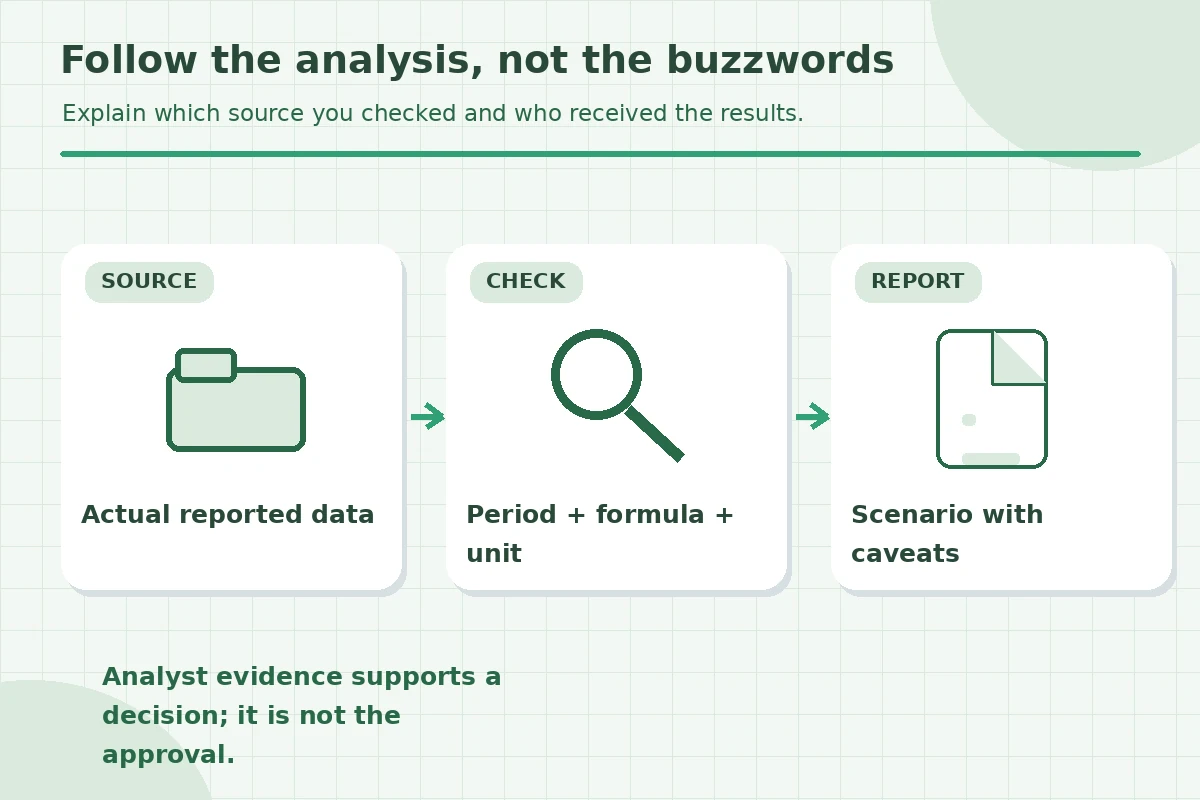
Strong financial analysis depends on knowing what the model assumes. In your opener, one short clause can show this: “I compared reported data with the forecast inputs and flagged assumptions that needed review.” If you worked with a spreadsheet, describe a real check such as tracing a source number, reviewing a formula reference or separating an actual value from an estimate. Use the exact term the employer uses only if you understand it.
Coursework can be valid evidence when labeled as coursework. An applicant might say, “In a finance class project, I modeled two scenarios using public company filings and documented the assumptions.” That is not the same as managing clients’ money or forecasting a company’s official results. Distinguish historical observation from projection and your own judgment from an approval issued by a licensed or authorized professional.
Connect your findings to a real audience
An analyst typically has to make information understandable to someone else. It could be a project manager, senior analyst, professor or team lead. Describe how you made the result usable: a comparison table, a sensitivity note, a short briefing or a report that named sources and caveats. Avoid claiming that your chart caused a decision when you do not know what the decision-maker ultimately did.
A useful introduction can mention uncertainty without undermining confidence. “I highlighted the inputs most sensitive to a change” shows the kind of disciplined communication an analyst might need. Avoid portraying a rough estimate as a verified audit or treating a classroom illustration as a client-ready recommendation. If you participated in a review process, explain your role in preparing and revising the analysis.

Draft an answer with a defined beginning and endpoint
One possible pattern is background, project, relevance. “My background is in accounting coursework and spreadsheet analysis. In a team project, I reviewed historical figures, checked formulas and documented assumptions before we presented two scenarios. I am interested in this financial analyst role because it involves careful data review and explaining differences clearly.” This is hypothetical and should be replaced with the applicant’s genuine training, role and result.
If you already have analyst experience, lead with the kind of work and scale you can verify rather than the number of years alone. If you are transferring from operations or accounting, describe the analytical task you actually did. You can say you built reports, but not that you performed regulated advisory services unless that was truly within your qualified position. Clarity about boundaries protects the credibility of the rest of the interview.
| You did | What it demonstrates | Avoid claiming |
|---|---|---|
| Checked historical data | Source and period awareness | Audited financial statements |
| Built a scenario model | Assumptions and sensitivity | Guaranteed a forecast |
| Prepared a briefing | Communication of evidence | Approved a financial decision |
Prepare for follow-up questions about data quality
Interviewers may ask where a figure came from, why you selected a method or what you would do when two sources disagree. Prepare to describe a real verification sequence: identify the reporting period and unit, compare source totals, inspect assumptions, and ask for review when you cannot reconcile the data. Do not present a made-up spreadsheet as proof of an employer’s results; use a permitted, anonymized work example or a clearly labeled practice case.
Know the limitations of the approach you mention. A forecast based on historical data has uncertainties; a simple spreadsheet check may detect a broken reference but not all errors. Explain what you checked and what remained to be reviewed. You do not have to claim that a formula was perfect. A credible analyst is transparent about evidence, assumptions and the audience who owns the final decision.
Test your introduction for role fit and honesty
Say the answer aloud, then ask: would a listener know my specific type of analysis, a check I performed and the practical reason I applied? If one element is missing, replace an adjective with a verifiable action. A concise answer of about a minute is a useful starting point, but let the interviewer set the pace. If asked to walk through a project, that is your opportunity to expand the explanation.
Review any confidentiality or professional requirements in the job description. Do not claim to have authority to place trades, authorize budgets or certify financial statements because you contributed to a report. If your preparation involved published financial statements, be ready to name the source and period. Keep the introduction short enough that the interviewer can ask about the exact piece of work that best matches the position.

How We Research and Verify Interview Guidance
JobAsk compared this role-specific question with the user-provided WordPress inventory, original content queue, relevant public search results and US occupational and career guidance on November 7, 2026. The sample responses are hypothetical writing models, not employee testimony or promised hiring outcomes. Follow the employer’s current instructions, describe your own verified experience and see our affiliate disclosure.
Source: cloudfront.careeronestop.org — CareerOneStop recommends researching the job and employer, practicing truthful examples aloud and asking informed questions.
Source: careerservices.fas.harvard.edu — Harvard career guidance describes a brief, job-relevant introduction with background, current strengths and a next-step connection.
Source: www.bls.gov — BLS describes financial analysts reviewing data, studying trends and presenting findings for decisions.
More Interview Preparation Guides
Yes, when you can explain the specific model, assumptions and your actual contribution without overstating what it proved.
Yes. Label it as coursework and use it to demonstrate real data checking, model construction and explanation.
No. Prioritize the financial problem and the checks you completed; mention tools only when relevant and true.
Explain that you prepared research or analysis for an authorized reviewer or decision-maker.
No. Preserve confidentiality and describe the method and scope of your work without restricted details.