
Initiative behavioral interview questions ask whether you notice useful work and take a responsible first step without needing every detail assigned. The best answer is not “I ignored the rules and fixed everything.” Describe a real gap, a small improvement you could propose or perform, who approved any change beyond your role, and what happened. You can show initiative in a classroom, volunteer project, support job, or professional role. Label the context accurately and avoid invented savings or promotions.
Understand what the interviewer means by initiative
The question may be “Tell me about a time you took initiative,” “Describe a task you started without being asked,” or “What did you do when you saw a recurring problem?” The interviewer is seeking evidence that you noticed something important, considered an appropriate response, and followed through. Being proactive does not require leading a department or bypassing approval. A modest improvement in the workflow you used can be an excellent story.
Avoid a vague tale about being “a go-getter.” Name the issue: unlabelled storage, duplicated scheduling requests, an unclear volunteer handout, or a checklist that omitted a non-sensitive step. Then explain what made it worth addressing. A real observation tied to a task is better than a grand claim that your organization was inefficient before you arrived.
Identify the part you could do on your own
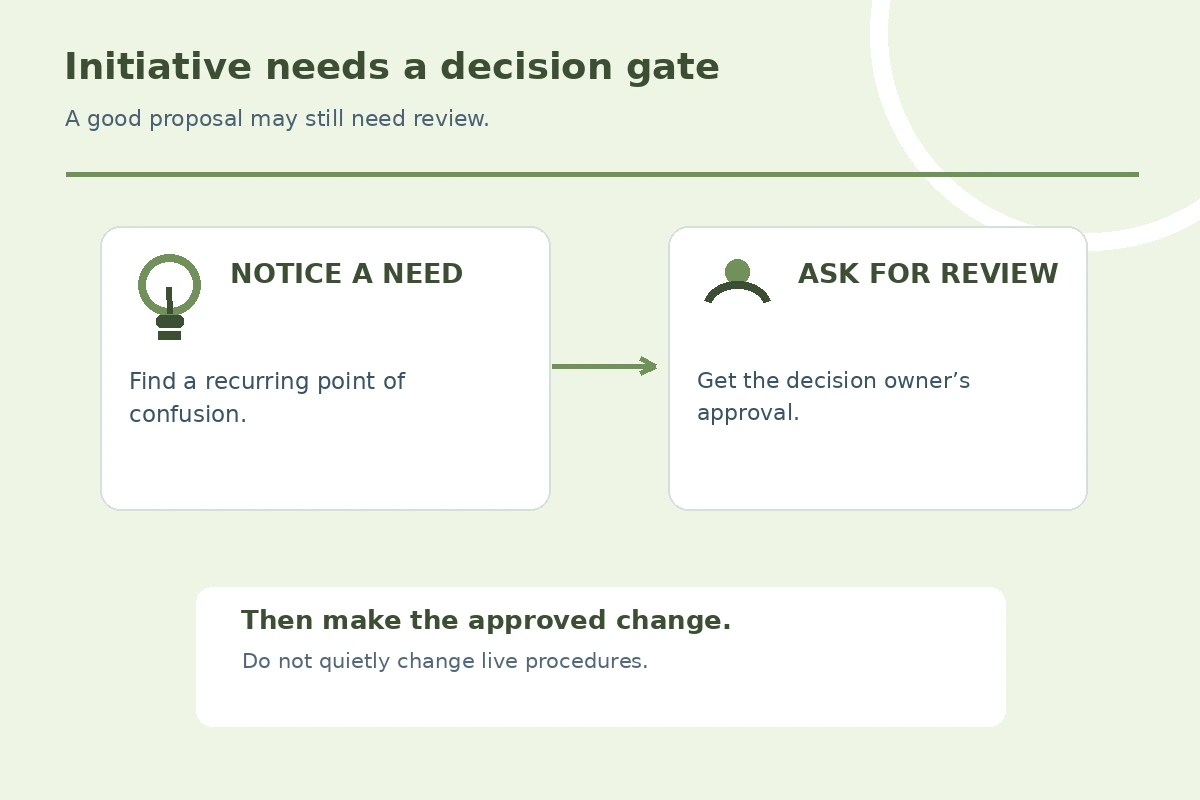
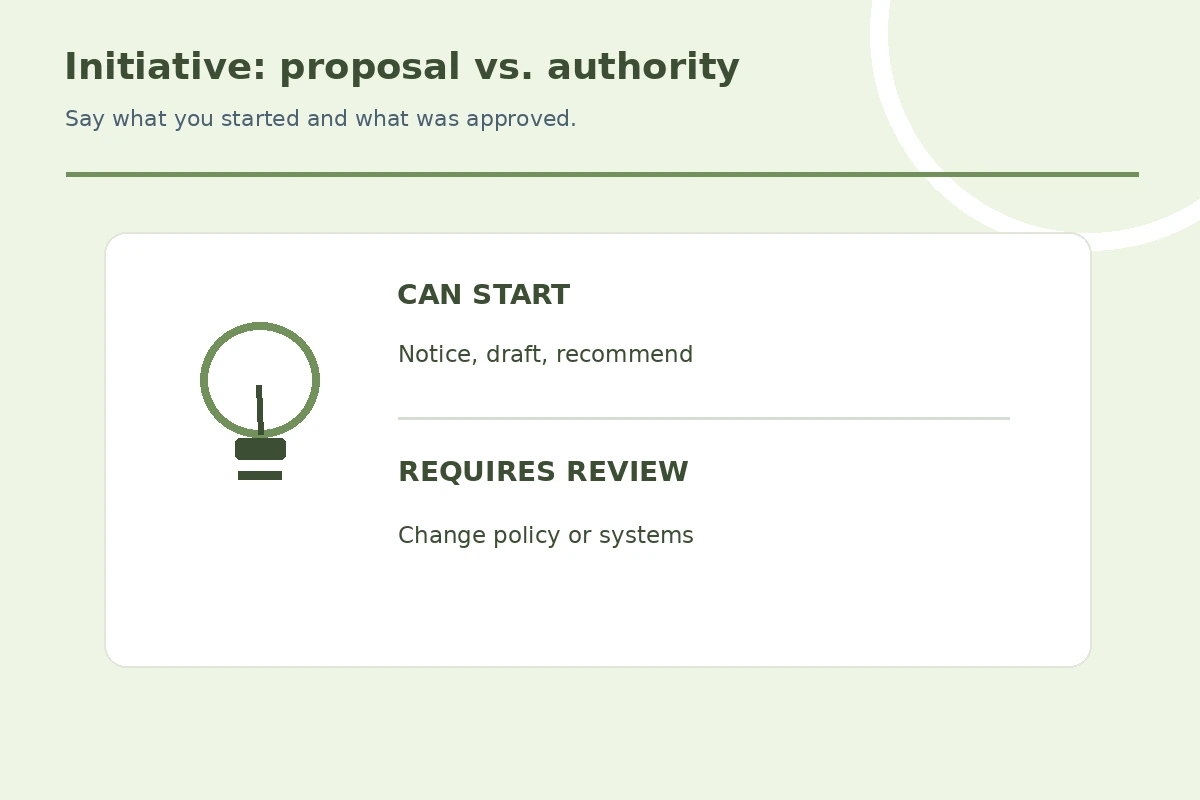
Start by distinguishing discovery and proposal from implementation. You may have authority to notice a pattern, assemble examples, or draft a suggestion. You may need a manager to revise a policy, grant software access, order equipment, or change employee schedules. State the boundary. The story is stronger if you can explain why you asked the responsible person before affecting other people’s work.
An office assistant who notices duplicate appointment confirmations could compare non-sensitive entries and draft a proposed check for the supervisor. That is initiative. It does not mean the assistant should secretly change the official scheduling system or disclose other clients’ calendars. Show judgment through the decision to seek feedback. Interviewers can assess a small, safe contribution more easily than a sweeping unsupported claim.
Frame the STAR story around your first responsible action
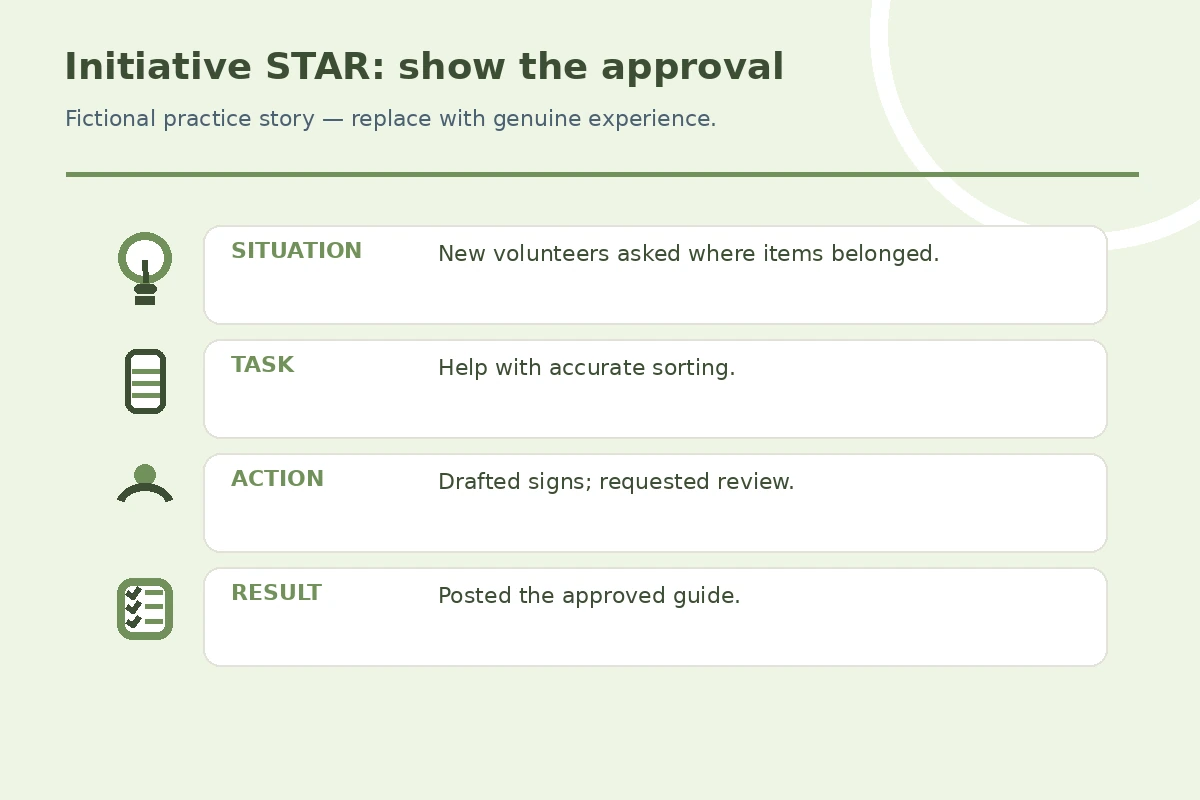
Situation: explain the gap and where you encountered it. Task: identify the legitimate goal, even if no one assigned a specific fix yet. Action: show what you noticed, checked, drafted, or suggested, plus any permission obtained. Result: explain what happened afterward and what evidence you know personally. If the idea was not approved, an honest result may be that the team documented a limitation for later review.
Do not treat the Action section as an opportunity to claim everyone else was careless. Use first-person verbs to define your own contribution, but acknowledge team participation and the reviewer’s decision. “I drafted a checklist and the volunteer coordinator tested it” is clearer than “I transformed operations.” The OPM framework treats competencies as relevant observed behavior, not a competition for the largest adjectives.
Use a concrete fictional initiative answer to practice
Hypothetical response for a student volunteer: “At a book drive, newcomers kept asking where to place donated books. I was responsible for sorting, so I drafted a one-page category sign using the existing sorting list. I asked the coordinator to review the labels before posting them. After approval, I placed the sign near the intake table and explained it to the next shift.” The action is useful and proportionate.
The example is intentionally fictional. It does not claim an exact percentage reduction in questions, an official policy change, or authority to reclassify donations. The result is the approved sign and handoff, not a fabricated efficiency figure. A candidate should use this only to understand the answer structure and substitute a real experience. If you have a measurable approved result, explain its source and what portion was yours.
Use this evidence and scope check before practicing
| Part of your story | What to verify | Boundary to keep |
|---|---|---|
| Problem spotted | Is it a real repeated issue? | Do not guess motives |
| Small proposal | Can you draft or test safely? | No hidden system changes |
| Approval | Whose work or data are affected? | Ask decision owner |
| Follow-through | What did you actually verify? | No invented savings |
Explain the trade-off between speed and permission
A common follow-up asks why you did not simply implement a change. Explain when consent, budget, quality review, safety rules, or data access made approval necessary. Distinguish a reversible suggestion from a decision with consequences for the entire team. Saying you requested authorization is not weakness; it demonstrates that you understand who owns the process.
If you moved ahead too quickly in the past, choose a story that includes what you learned and how you corrected course. Never invent a perfect history. A simple decision log can help you prepare: What could I change myself? What required sign-off? Who did I notify? What did I verify after the change? These questions distinguish credible initiative from unilateral action.
Show evidence without inventing performance outcomes
If a new handout, organized supply area, or documented issue was your result, say that directly. Do not make up hours saved or satisfaction scores. It is legitimate to say that coworkers used a reviewed checklist if you know they actually did. You can also acknowledge that the project ended before the impact was measured. A clear verified outcome is stronger than a speculative business benefit.
For analytical jobs, show how you tested an assumption before proposing a revision. For service jobs, show how you improved a handoff without changing policy. For students, show your own part in a club project while making the school context explicit. The job posting determines which competency is relevant. Do not add a credential, management title, or budget responsibility the experience did not involve.
Finish with a reflection tied to the new job
After describing the result, add one sentence explaining the lesson: observe first, check requirements, bring a small proposal, and invite review when other people are affected. Avoid generic statements like “I always go above and beyond.” Interviewers learn more from the control you applied than from praise of your own motivation. Think about which action you would repeat if the same issue appeared again.
Practice with a timer, then have someone ask whether you had approval and what actually changed. If the story fails either question, revise before using it. An initiative answer should make clear that you can begin helpful work independently while respecting safety, confidentiality, and the manager’s decision rights. It is not a promise that the employer will reward initiative in any particular way.
Try a safe, fictional practice scenario
Create a practice case where a library volunteer observes that donated books arrive without clear sorting labels. Draft a short option list: leave the area unchanged, propose a simple label draft, or change the entire collection system. Identify which choice fits a volunteer’s task, and who could authorize signage. Write a fictional STAR answer that includes the proposal, the coordinator’s approval, a simple implementation and a handoff. Then choose a similar event from your own experience. Note the difference between initiating an idea and having permission to change a procedure; do not claim the practice case happened to you.
How We Research Behavioral Interview Answers
For this guide, we reviewed interview-assessment resources and relevant professional or workplace guidance on November 7, 2026: www.opm.gov (OPM competency-based behavioral questions are built around relevant actions and results.); mylehigh.lehigh.edu (Lehigh includes initiative questions based on taking action that affects a result.); www.opm.gov (OPM defines decision-making and problem-solving competencies in terms of evaluating options and responsibility.). General guidance does not establish the procedures or authority of any particular employer. All example candidate stories and illustrative results in this article are fictional learning exercises, not personal testimonials. Adapt the framework only to genuine, shareable experiences and confirm applicable workplace procedures and job requirements.
This is independent interview preparation guidance; it does not promise interview performance, hiring, or any employer-specific outcome. Do not disclose private records or proprietary systems during an interview. See the JobAsk affiliate disclosure for site transparency.
More Interview Preparation Guides
No. It may mean spotting a need and making a useful proposal; decisions affecting safety, policy, budgets, or data may require approval.
Yes. Identify the genuine setting and your part in observing, proposing, and following through.
Describe the evidence you gathered, the review you requested and what you learned. Do not falsely claim implementation.
Only if you can genuinely verify it and your own contribution. A modest documented improvement is enough for an honest answer.
Use one sentence for the problem, a short description of your concrete actions and approval, and a factual outcome and lesson.