
Quick answer. When the last day is close, the most useful resignation message is one that does not overpromise. A short-notice departure differs from the usual two-week template because the remaining hours must be allocated to the most consequential handoff tasks. A useful short-notice resignation letter should make the decision, the actual final work date, and the handoff commitments unmistakable.
Decide What the Message Must Accomplish
To plan a departure on limited notice, start with a small triage board rather than drafting excuses. Mark commitments that would affect a customer or deadline within the next shift, tasks that another worker can take with a short explanation, and projects whose proper completion is simply impossible. This ordering clarifies what to ask the supervisor to prioritize. It prevents a common error: telling the employer that everything will be finished even though the hours remaining make the claim implausible.
Start with an inventory of the unavoidable date constraint and essential outstanding responsibilities. If a conversation with a manager can clarify a practical option, have it before announcing arrangements you cannot support. Do not calculate notice from a generic “two weeks” assumption.
An apology may be courteous, but it does not solve coverage problems. A credible short-notice letter pairs a clear effective date with one or two realistic actions the employee can complete before leaving. “My last working day is Friday” is less precise than a full calendar date when people work different shifts or across time zones. Use the day, month, and year and confirm which shift ends your employment. Can that reader accurately schedule coverage? If not, revise the workday line and remove extra background. Our guide “Retirement Letter to Your Employer” goes into more detail.
Set the Final Date and Recipient Correctly
The phrase “effective immediately” deserves care. It may be appropriate in some circumstances, but it is not a shortcut around a real agreement or a substitute for checking the administrative process. If the departure date is still being discussed, use a discussion request. If the date is definite, say so plainly and record the full calendar date. Avoid writing “tomorrow” in a late-night email when recipients could be in another time zone and read it the following morning.
Do not calculate notice from a generic “two weeks” assumption.
No single number of notice days applies to every worker.
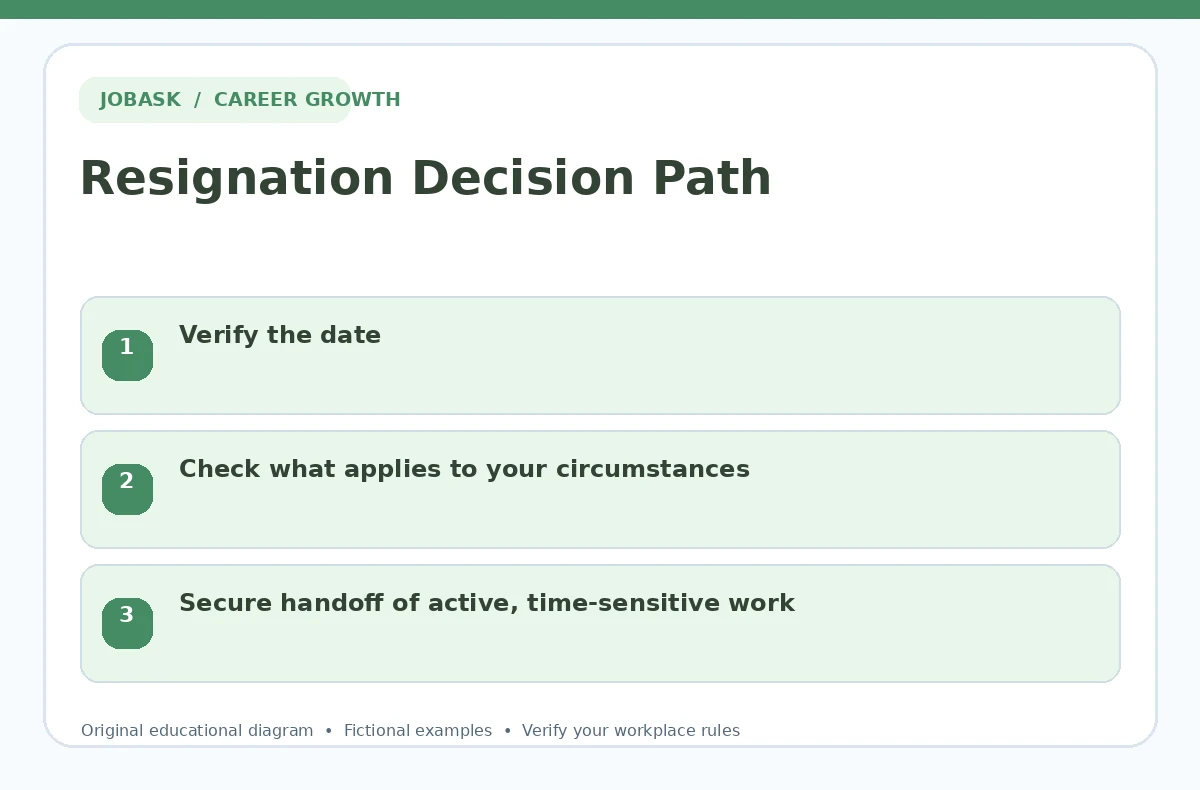
Use a Three-Part Departure Decision Matrix
With little time left, distinguish three urgent decisions: the employee can state the intended last date, the manager must allocate immediate work coverage, and administrative staff may need to review any applicable policy. This is not a contest to produce the most apologetic letter. A short status sheet showing the next shift, unresolved tasks and the person authorized to act is often the most practical supporting document.
| Decision point | Action to verify |
|---|---|
| Critical now | Secure handoff of active, time-sensitive work |
| Can defer | Document lower-priority items for the next owner |
| Outside scope | Avoid promising extra shifts or future access you cannot provide |
Only send facts that are already accurate.
Adapt This Clearly Hypothetical Resignation Example
Suppose a fictional shift coordinator has two more shifts and a recurring handoff that normally requires a full week. The coordinator cannot responsibly promise complete successor training. A better offer is to update the shared schedule, list the unresolved assignments and explain one high-risk deadline to the person designated by the manager. What makes the offer professional is not the impressive number of tasks mentioned but the accuracy of what will actually be left available when coverage changes.
Fictional example — not a real employer, employee, or outcome: Dear [Manager Name], I am writing to resign from my position as [Role], with my last working day on [Exact Date]. I understand that this provides limited notice, and I apologize for the disruption. During my remaining time, I can document the status of [Project] and brief the person you designate on its next deadline. Thank you for the opportunity to work with the team. Sincerely, [Name]. For a step-by-step method, see how to resign from a remote job with a clear digital handoff.
The sample is hypothetical: it does not assume the employer must accept the date, that no contract applies, or that a verbal conversation changes formal notice obligations.
Compare the two. When the last day is close, the most useful resignation message is one that does not overpromise.

Keep Sensitive Details and Unsupported Claims Out
Give only a reason you can stand behind. “Due to a change in personal circumstances” is more accurate than inventing a dramatic story to justify fewer days. Ask whether the notice recipient actually needs that information. Confidentiality and accuracy remain relevant even during a departure.
Avoid claiming an emergency you did not experience, demanding a guaranteed positive reference or including grievances that cannot be addressed through the notice. Do not destroy or copy organizational records when leaving. No single number of notice days applies to every worker.
Document the Work Handoff Without Overpromising
A short-notice apology should acknowledge disruption without turning into a confession about motives, fault or legal responsibility. One short sentence is usually enough for the writing exercise. Follow it with the concrete work handoff rather than repeating the apology across several paragraphs. If your reason is private, you can keep the explanation limited; if you are considering leaving because of an urgent safety issue, obtain situation-specific help rather than relying on a resignation template to resolve it. Our guide “Resignation Due to Relocation” goes into more detail.
Prioritize tasks with safety, customer impact or imminent deadlines. Flag unresolved issues, identify the designated owner and use company-approved documentation. Never transfer credentials, security codes or sensitive files through personal email.
Hypothetical handoff scenario. A fictional scheduling assistant has three days remaining. They identify one customer booking that needs reassignment, prepare a status note for the supervisor and explicitly exclude a month-long cleanup project they cannot finish.

Check the Final Draft Against Reality
In the final review, audit the dates against the rota or shift calendar and flag any work that extends beyond the proposed last day. Check which person is authorized to take over the tasks; do not nominate a coworker just because that person is friendly. An accurate status log, appropriate manager notification and secure return of workplace items may be more valuable than a sentimental paragraph. This guidance cannot determine possible consequences under a contract or workplace policy.
Read the draft from the receiving manager’s perspective: can they tell when coverage stops, what is open and whom to contact about it? If not, improve the task handoff before adding more appreciation.
Test the short-notice draft against the next two or three actual shifts. If a handoff needs several days of training, replace an impossible offer with a brief walk-through or a reliable written update. Make sure the manager receiving the resignation can identify which items remain open at the proposed deadline. Do not use a fictional emergency to justify the schedule or pretend the writing guide determines the effects of contractual notice terms. Our guide “Resignation Letter for Personal Reasons Without Oversharing” goes into more detail.
How We Research These Departure Scenarios
Our short-notice guidance draws on Indeed’s short-notice resignation guide for the distinction between explaining limited notice and giving a realistic date. UNLV’s career correspondence examples informed the concise professional tone. Sources checked 2026-10-20. Neither establishes that a particular shortened notice period is acceptable under every contract.
Read the site-wide affiliate disclosure. This guide contains no affiliate links.
Explore Related Career Guides
- Resignation Letter Due to Relocation: Explain the Move Without Oversharing
- One-Month Resignation Notice Letter: Dates, Sample, and Transition Plan
- One-Week Notice Resignation Letter: Confirm the Date and Prioritize Handoff
- Immediate Resignation Letter: Short Notice With Clear Next Steps
- Immediate Resignation Letter: What to Say When You Cannot Give Notice
No universal rule can be inferred. Employer rules, contracts and laws differ, so check the applicable policies or qualified guidance before relying on a particular period.
A short accurate explanation may help, but avoid unnecessary private facts or invented emergencies. Clear dates and a usable handoff are more important than a lengthy defense.
That depends on your real circumstances and applicable obligations. This writing example cannot decide whether a proposed date is permitted or what consequences may follow.
Offer only something you can actually complete, such as a short walkthrough or a documented task list. Do not promise comprehensive training that cannot happen.
Use the organization’s designated channel and keep the notification professional and traceable. Confirm who is responsible for receiving the written notice.