
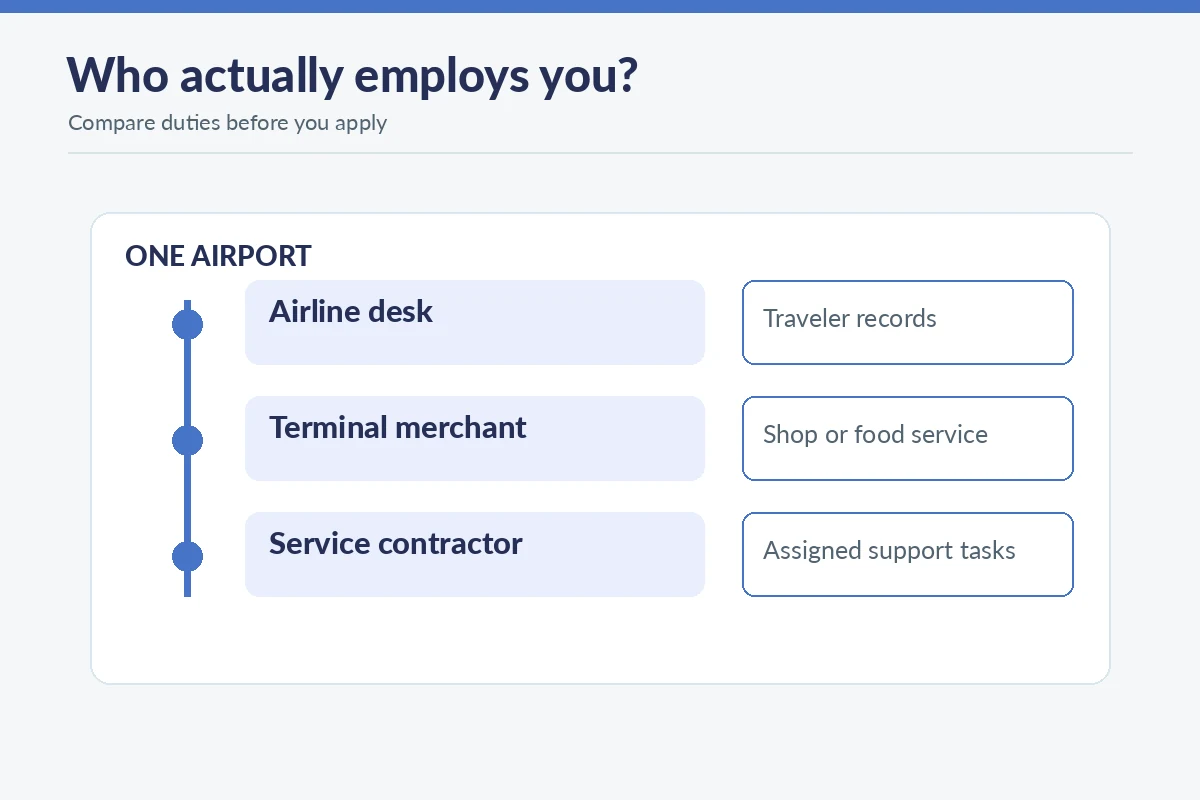
Part-time airport jobs for students are not one job category. A terminal café may hire through a retail operator, a ticket desk through an airline or contractor, and baggage assistance through another employer. Each has different customer tasks, physical demands, hours, and access rules. Before applying, identify who would employ you, where the work is performed, and whether you can reliably arrive for an early departure or late arrival shift while attending class.
Start with the employer, not the airport name
An airport is a workplace shared by airlines, concession companies, service contractors, and public authorities. A posting that uses an airport name does not tell you who issues the offer or manages your schedule. Search official airline and concession career sites, airport employer directories if available, and clearly identified contractor careers pages. A role listing should tell you the employer and enough duties to distinguish customer service from physical handling.
Some “airport jobs” search results are training programs or job-search services rather than openings. A course may be relevant to a career plan, but it is not an employment offer. Verify any vacancy directly. The FTC warns that fabricated recruiters may use familiar company names or ask for payments and personal information before a legitimate hiring process exists.
Compare terminal desk, concessions, and baggage support
Transportation ticket or reservation clerks may answer schedule questions, check travel details, and help customers using employer systems. Retail and food-service employees in the terminal have merchant-specific customer and stock duties. Baggage support may involve attaching claim checks, moving luggage, and assisting travelers, as described by O*NET. These are not interchangeable roles even when all appear under a general “ground staff” search.
Ask for the actual job description and any stated physical requirements. Customer assistance does not automatically grant authority to change bookings, issue security clearances, operate specialized ground equipment, or direct airside activity. Those responsibilities require separate employer-defined qualifications, training, or authorization. Compare roles by tasks you can perform, not by an appealing title.
Build a realistic trip-to-shift timeline
Airport access time starts before the clock-in moment. Measure the travel path from class or home to the actual terminal or staff entrance; account for transit frequencies, terminal distance, and required check-in. A shift starting very early may be unworkable if public transportation does not run then. The BLS notes that transportation establishments operating around the clock may require evenings, weekends, and holidays.
Make a sample week containing lectures, required study blocks, commute, and sleep. Ask whether shifts are fixed or rotating, when rosters are posted, and whether a schedule could include an overnight or holiday. Do not infer a flexible college-friendly schedule solely because a listing uses “part time.” The right comparison is the full door-to-door time and reliability of each shift.
Understand access and training boundaries
The posting or recruiter should explain whether the position requires a worksite credential, screening, employer training, or specific authorization for restricted areas. Requirements differ across employers and tasks, so avoid treating a generic airport badge as automatic permission to enter every area. Only the employer and responsible access authority can confirm the steps that apply to a particular assignment.
If a role includes baggage or equipment handling, ask about training, approved work zones, and who supervises new staff. Never present yourself as cleared for restricted-area tasks or trained on machinery until that is true. A role may be a good match on hours but a poor match on prerequisites or physically demanding tasks.

Use student experience without inventing aviation skills
For passenger-facing work, you could cite actual experience giving clear directions, handling customer questions, checking records, or de-escalating a misunderstanding. For a concession role, use legitimate retail, food-service, or stock examples. For baggage support, dependable attendance and compliance with procedures are relevant, but do not state you have ramp experience merely because you worked at a busy venue.
Write a small evidence matrix: requirement, real example, and what you still need to learn. A hypothetical response might be: “In a campus event I verified attendee names against a registration list and referred exceptions to the organizer.” Label that as a practice example unless you actually did it. Emphasize accuracy and willingness to follow the employer’s process.
Check the offer before sharing sensitive details
Verify the employer’s legal name, worksite, expected hours, pay and scheduling process. Some legitimate hiring procedures require identity or eligibility documentation, but timing and collection methods must be independently verified. Treat unexpected messages asking for fees, account credentials, or payments to release an offer as warning signs. Never use a contact number supplied only by a suspicious recruiter as your sole verification path.
A useful question is: “Which company is the employing entity, and who manages shift assignment and onboarding?” Ask how to reach an official HR channel and where required training occurs. Record the answers alongside the original posting so you do not confuse separate airline, terminal, and contractor applications.

Choose the role with a workable class schedule
Compare opportunities on four dimensions: who employs you; where the entrance and shift actually begin; what duties and training apply; and how consistently the rota fits classes. For example, a terminal sales role may have more familiar entry-level tasks but still demand early starts. A desk role might require software training and difficult holiday coverage. Neither is automatically “better” without the actual listing.
Before accepting, ask whether exams or mandatory class sessions could ever conflict with scheduled work and what the process is for requesting time off. Give honest availability. Applying for fewer suitable roles with confirmed conditions is more useful than responding to many vague “airport staff” advertisements.
How We Research and Verify These Job Options
We reviewed role descriptions and training boundaries from the U.S. Bureau of Labor Statistics, O*NET OnLine, the Federal Trade Commission. The sources describe occupation tasks or hiring safeguards; they do not confirm that any particular employer currently has an opening. Check live employer requirements, shifts, credentials, and pay before applying.
Examples are illustrative unless explicitly described as documented experience. We do not guarantee hiring outcomes or recommend paying to obtain work. Review our affiliate disclosure; no paid partner, employment placement, or affiliate relationship is asserted in this guide.
Related Job Search Guides
Some employers offer part-time roles, but availability, required credentials, training, and shift patterns differ. Verify the specific posting.
No. Airport terminals contain airline, concession, contractor, and other employers. Confirm who signs the employment agreement.
Not necessarily. Transportation sites may operate across mornings, evenings, nights, weekends, and holidays; the listed role determines the roster.
Requirements depend on the workplace and tasks. Check the employer’s stated screening and access requirements rather than making assumptions.
Verify the employer independently and avoid recruiters demanding fees or payment information to secure a purported opening.