
Part-time lab jobs for students range from keeping supplies organized and documenting observations to trained research assistance. Do not treat a student science class, a research lab aide, and a clinical laboratory technician as equivalent. To choose a suitable opening, identify the type of lab, the supervisor, the authorized tasks, and the hours when the work must happen. Experiments and sample schedules may not align with a short gap between lectures.
Read the lab setting before the job title
A university teaching laboratory might need help preparing materials, checking equipment lists, or restoring stations after class under staff direction. A research group may need assistance with observation logs, inventories, authorized procedures, or data organization. A clinical diagnostic laboratory has different responsibilities and potentially formal qualification requirements. A job label such as “lab assistant” does not settle what you are allowed to do.
Read the lab’s department, project description, and worksite. Ask whether the work involves research, instruction, quality checks, or medical patient specimens. BLS descriptions of biological technicians include helping scientists with equipment, samples, and documentation, generally under scientific direction. That broad occupation description is not a license for an untrained student to perform every listed procedure.
Draw a line around clinical testing
Clinical laboratory technologists and technicians perform tests linked to patient diagnosis and care. BLS describes associated education pathways, certification preferences, and licensing in some states. A student who has taken introductory biology should not claim the same qualifications as a credentialed clinical technician. Clinical roles can have privacy, infection-control, and formal supervision requirements distinct from an ordinary research-support position.
If a posting mentions patient specimens, diagnostic results, or medical records, compare every qualification with what you actually hold. Ask whether the title is clerical support, specimen reception under training, or a licensed technical position. If the role is not suitable, look for teaching-lab preparation or nonclinical research administration rather than assuming you can learn restricted work immediately.

Identify which tasks require prior instruction
Equipment setup, waste handling, chemical storage, and sample processing all depend on local safety procedures. Even a familiar classroom technique may be governed by a different protocol in an employer lab. Ask what safety orientation occurs, who demonstrates tasks, which protective equipment is provided, and what you must do when a procedure is outside your authorization. Do not improvise procedures from internet advice.
Record-keeping can be an important contribution: label observations accurately, enter information into approved records, and flag missing or inconsistent details. Never silently correct data to make an experiment look complete. A good application example distinguishes what you personally recorded from what a professor, researcher, or technician verified.
Fit research hours around class obligations
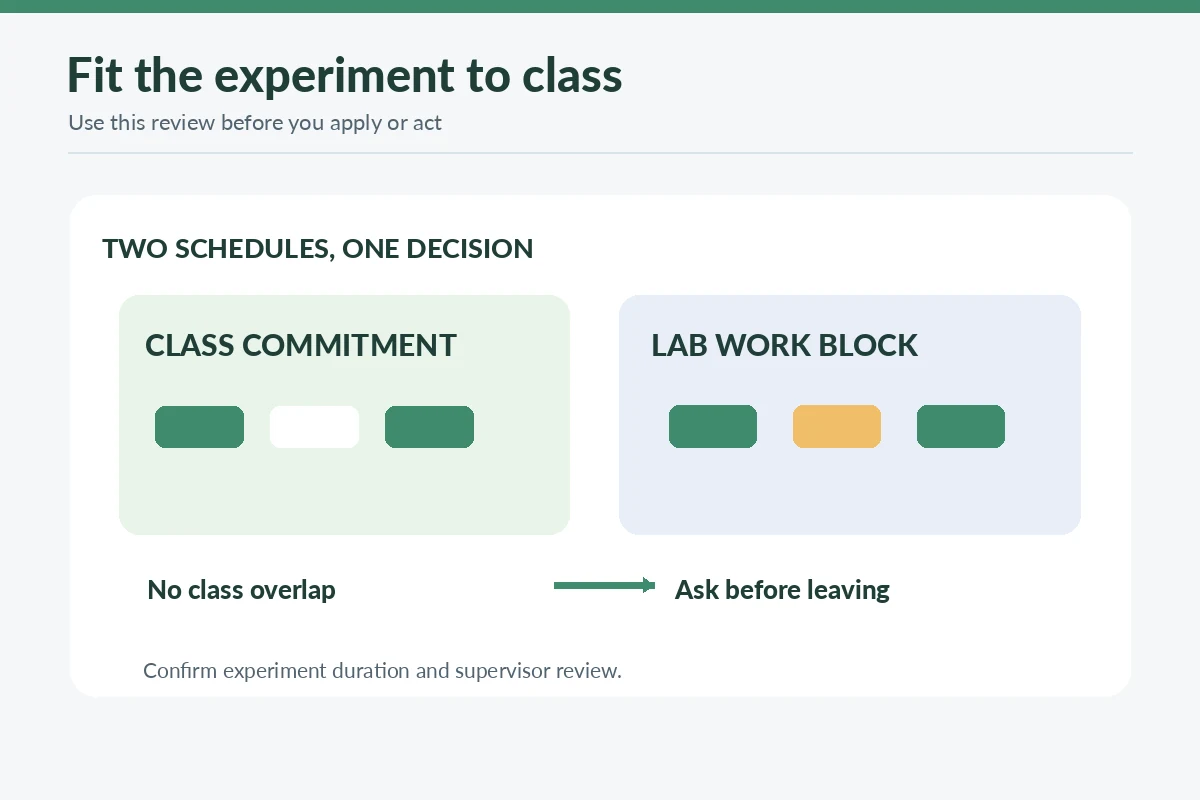
Research tasks may be tied to a sample collection window, equipment booking, or experiment duration. A posting that says ten hours a week may still need a specific continuous block rather than flexible fragments. Ask whether the role expects morning preparation, evening checks, or attendance during a multi-hour session. Also check whether travel between buildings makes a short shift unrealistic.
Make a weekly grid showing lectures, labs, exams, transit, and the longest uninterrupted time you can offer. Tell the supervisor when your class timetable changes each term. Do not accept a task that depends on staying late if you must reliably leave for an unmissable class or transportation connection.

Show what your coursework proves and does not prove
A completed coursework exercise can show following instructions, maintaining a lab notebook, organizing data, and reporting an unexpected observation. It does not prove industrial instrument certification, independent experiment design, patient testing, or employment in a research program. When writing your resume, name the course or project and explain the steps you completed under supervision.
An illustrative statement would be: “Recorded observations and maintained a labeled sample log during a supervised undergraduate biology project.” Use it only if accurate. If the posting needs unfamiliar methods, show a willingness to follow training rather than claiming to have performed those methods before.
Screen the listing for legitimate supervision
The posting should name a lab, school, employer, or principal investigator’s organization clearly enough to verify. Check the institution’s own student jobs or employment page. Look for who supervises the work, whether access training is provided, and whether the position is paid employment, academic credit, or volunteer work. These are materially different arrangements.
Avoid vague listings that promise remote “lab testing” earnings without specifying duties or ask for equipment payments. Research work may be organized by universities, hospitals, and private firms, but each genuine opening should have a verifiable employer and a defined application procedure. You should not have to guess which organization holds responsibility for safety and record integrity.
Use a task-by-task decision before applying
For each advertised task, mark one of three statuses: “already completed with evidence,” “trainable only under the employer’s supervision,” or “requires credentials I do not have.” The third category is a reason to check eligibility, not an invitation to stretch your resume. Your schedule should then be evaluated separately, since fitting hours does not resolve a qualification gap.
Before accepting, confirm expected weekly hours, any fixed experiment times, training schedule, permitted equipment, and reporting route for an unusual result or safety concern. A modest, supervised position with a clear learning plan can be a better fit than a job title with ambiguous independence.
How We Research and Verify These Job Options
We reviewed role descriptions and training boundaries from the U.S. Bureau of Labor Statistics, the U.S. Bureau of Labor Statistics, the U.S. Bureau of Labor Statistics. The sources describe occupation tasks or hiring safeguards; they do not confirm that any particular employer currently has an opening. Check live employer requirements, shifts, credentials, and pay before applying.
Examples are illustrative unless explicitly described as documented experience. We do not guarantee hiring outcomes or recommend paying to obtain work. Review our affiliate disclosure; no paid partner, employment placement, or affiliate relationship is asserted in this guide.
Related Job Search Guides
No. Clinical laboratory testing may require specific education and licensing. Read the setting, duties, and qualifications.
A class can support claims about supervised coursework, but not every professional lab task. Compare the posting with your actual training.
Sometimes, but experiments, equipment bookings, and preparation often require continuous time blocks. Confirm exact expectations.
No. Label it as coursework or an academic project, and describe your own contribution truthfully.
Ask whether it is included in training and who supervises it. Do not perform or claim independent competence without authorization.