
For an assistant manager interview, choose a strength that shows how you help a team deliver work without pretending to own every management decision. A convincing answer might describe coverage planning, clear task handoffs, or a timely escalation. A credible weakness is a real habit you are improving—such as trying to solve too many routine problems personally—paired with a boundary-aware change. Avoid the rehearsed claim that you “care too much.” The employer needs evidence of what you actually did, how teammates were affected, and which decisions still required the manager.
Match the strength to the job you actually seek
Assistant manager titles differ by employer. Some positions oversee shifts and assignments; others support a senior manager without hiring, disciplinary, purchasing, or scheduling authority. Read the posting before you choose a strength. Mark each duty as personally completed, supported, or requiring approval. That distinction will help you answer honestly if an interviewer asks how you handled a staff shortage or a customer exception.
Use shift coverage as evidence of a real strength
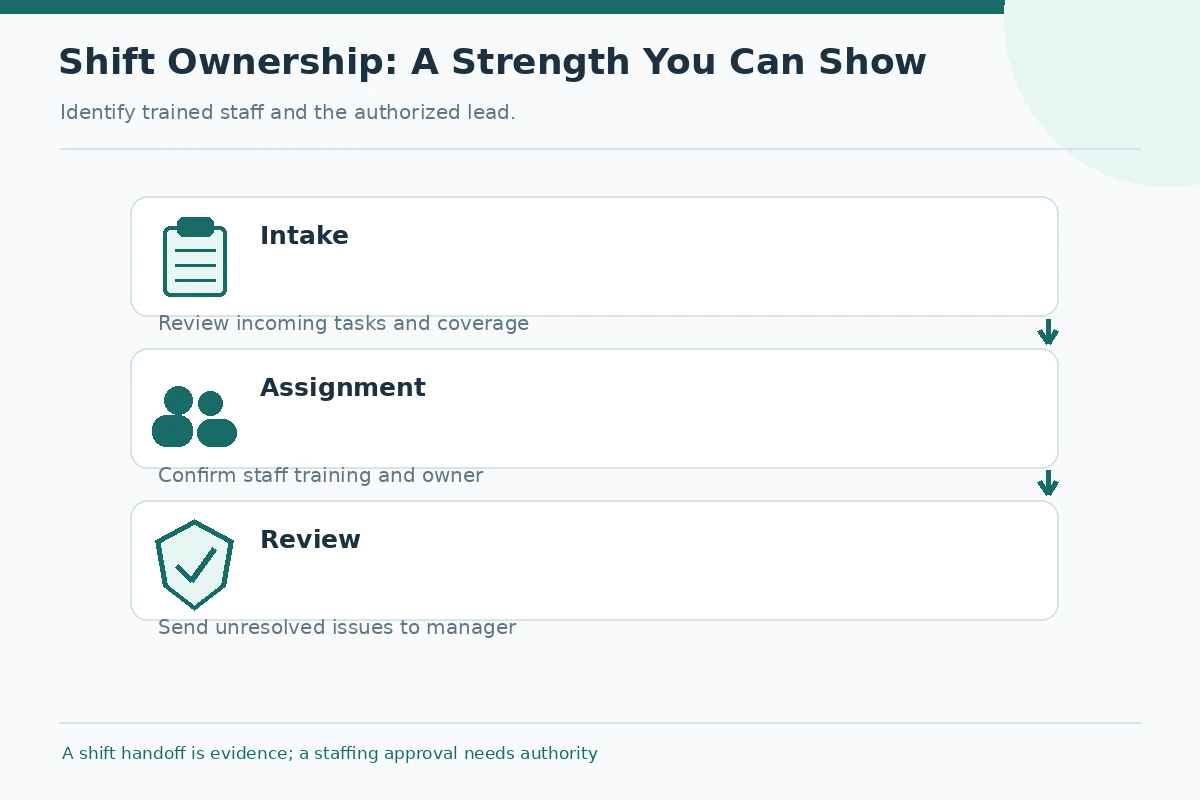
A stronger claim than “I am organized” is a short account of a crowded shift. Explain what changed, how you checked the coverage plan, which staff member could handle each task, and how you communicated the gap to the responsible lead. If you updated a schedule only after approval, say so. The result might be that the next shift received an accurate handoff, not that you single-handedly prevented every delay. Be ready to explain how you avoided assigning duties to someone who was not trained.
Show delegation without claiming unlimited authority
Delegation is not just giving instructions. In your example, identify the task owner, the expectations you explained, and how you confirmed the result. When a new colleague needed training, you may have demonstrated a routine task and asked the authorized trainer to sign off before independent work. This demonstrates judgment and respect for boundaries. Do not describe yourself as approving timesheets, discipline, or staffing decisions unless those functions were explicitly yours.
Choose a weakness that does not undermine basic supervision
A useful weakness could be spending too long checking ordinary updates instead of letting trained colleagues finish routine tasks. Describe one practice you changed: defining acceptance criteria, arranging a check-in, or using the team’s existing handoff log. Avoid choosing a failure to follow safety rules, intimidation, or dishonest reporting as a harmless “growth area.” If the weakness concerns a core requirement in the vacancy, assess whether you can already meet that requirement before presenting yourself as ready.
| Interview focus | Verifiable evidence | Boundary to keep |
|---|---|---|
| Coverage planning | Confirmed shift tasks and communicated gaps | Do not claim to approve staffing changes |
| Delegation | Assigned eligible work and checked handoffs | Do not claim unauthorized disciplinary authority |
| Growth area | Reduced unnecessary rechecking | Show a repeatable review habit |

Answer a follow-up about urgent customer complaints
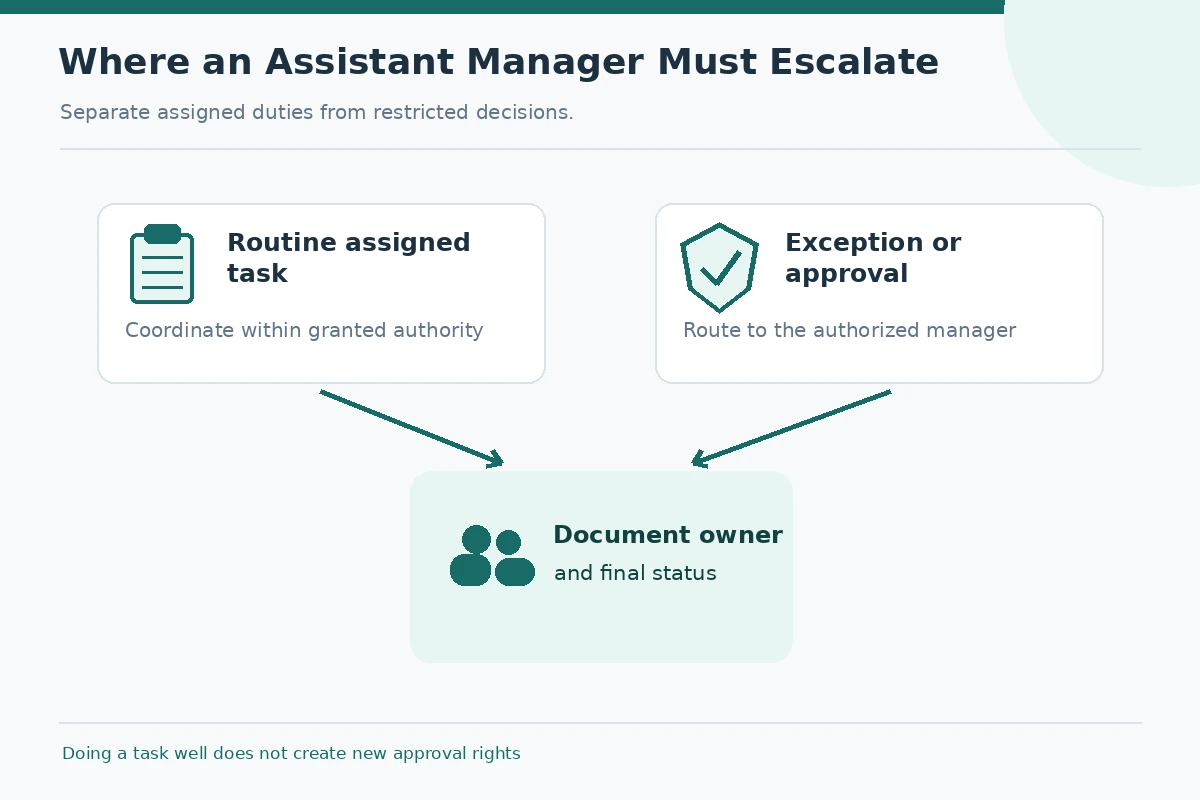
Suppose the interviewer asks what happened when an upset customer wanted an exception. Begin with what you listened to and verified, then say what policy and escalation route you used. An illustrative response is, “I recorded the issue, explained what I could confirm, and referred the exception to the shift manager rather than promising a refund I could not authorize.” If you have no comparable work history, use a truthful volunteer or project example and say that the setting was different.
Pair the weakness with observable correction evidence
A correction story needs something more concrete than “I am working on it.” You might say that you now write task owners and review checkpoints before a peak period, then check open issues at shift change. Name how you know the habit improved: feedback from the person receiving the handoff or fewer questions about which item is pending, if that is truly documented. Do not invent percentages, promotions, or a manager’s endorsement. A specific routine can demonstrate learning even without a numerical outcome.
Practice two lengths of the same answer
Prepare a short answer suitable for a screening call and a longer version for an interviewer who asks for details. For the strength, use context, your action, the verified outcome, and the role you seek. For the weakness, name the behavior, why it mattered, what you changed, and what you are still monitoring. Time yourself, but do not force a memorized speech. The goal is to answer naturally and allow the interviewer to ask about the approval path or a team member’s responsibilities.
Two hypothetical answers to adapt, not memorize
Illustrative strength answer: “My strength is keeping task ownership clear during a busy shift. In a previous support role, I listed pending requests, confirmed who was trained for each assignment, and passed exceptions to our supervisor. The next team had a clear status record.” Illustrative weakness answer: “I used to take over too many small follow-ups instead of stating who owned them. I now agree on the task and check-in point first, then review only exceptions. I am still practicing how to give clear instructions without micromanaging.” These examples are invented teaching examples, not employer testimony. Never copy one unless the responsibilities, setting, and outcome are genuinely yours. You can replace the context with a school project, volunteer work, or another job if you accurately name that context.
Run a fact check before practicing aloud
Write a three-column note for the assistant manager interview: claim, experience that supports the claim, and boundary of your authority. For a strength, underline your actual action rather than the team’s entire accomplishment. For a weakness, describe one change you have already tried and how you tell whether it is working. Ask a practice partner to challenge any sentence that sounds like a guarantee or a senior manager’s decision. Avoid invented percentages, fabricated praise, or private coworker and customer details. If the answer sounds too polished to be yours, simplify it until you can explain every step.
How We Research These Interview Examples
We reviewed the role-specific occupational description alongside the U.S. Office of Personnel Management’s structured interview guidance and its guidance on competency examples, checked November 16, 2026. These sources establish typical responsibilities and interview-evidence principles, not any individual employer’s hiring rules. We wrote fictional examples for illustration, kept supervision and privacy boundaries explicit, and checked the site’s existing interview topics to avoid another generic strengths-and-weaknesses list. Internal links are editorial navigation, not endorsements. See our affiliate disclosure for information about relationships. Review the actual job posting and employer policies before relying on any example.
More Interview Preparation Guides
Usually it is too vague to show self-awareness. Choose a specific, nonessential habit and explain a real change you have made.
Use an accurate example from coordinating volunteers, a class project, or a busy workplace. Identify which people you actually supervised, if any.
Only if you have dependable evidence and can explain your own contribution. A clear handoff or verified review is also a useful result.
Yes, if you can perform required duties now and are improving a bounded habit such as over-checking routine work. Do not frame unsafe or unauthorized delegation as progress.
Follow the wording of the question. One well-supported strength can be better than a list of unrelated adjectives.