
Put the most relevant, defensible resume bullet first under each job, even if that task was not the first thing you did chronologically. Bullet order and job order are different decisions. Keep employers and dates in a truthful, readable sequence, but prioritize the work that most clearly matches the vacancy inside each role. A reviewer scanning quickly should see your strongest evidence before generic routine duties. This guide gives you a simple way to rank examples, break ties, and avoid putting your least important sentence at the top merely because it was easiest to write.
Separate chronology from bullet priority
Most resumes use reverse-chronological work entries within a section; that makes an employment timeline easy to follow. Inside a particular job, however, you do not have to list routine duties in the order they occurred. You can lead with a relevant project or process while leaving title, employer and dates in their correct places. This distinction prevents a common editing mistake: moving a past employer above your current role simply because one earlier bullet is more relevant.
If older work is substantially more relevant, a clearly labeled relevant-experience section may sometimes help, but it must not disguise dates or omit information that the application requests. Start with the simpler change: reorder bullets within their existing job entries. It preserves the reader’s timeline while moving useful evidence higher in the space they are already scanning.
Score each bullet for relevance and proof
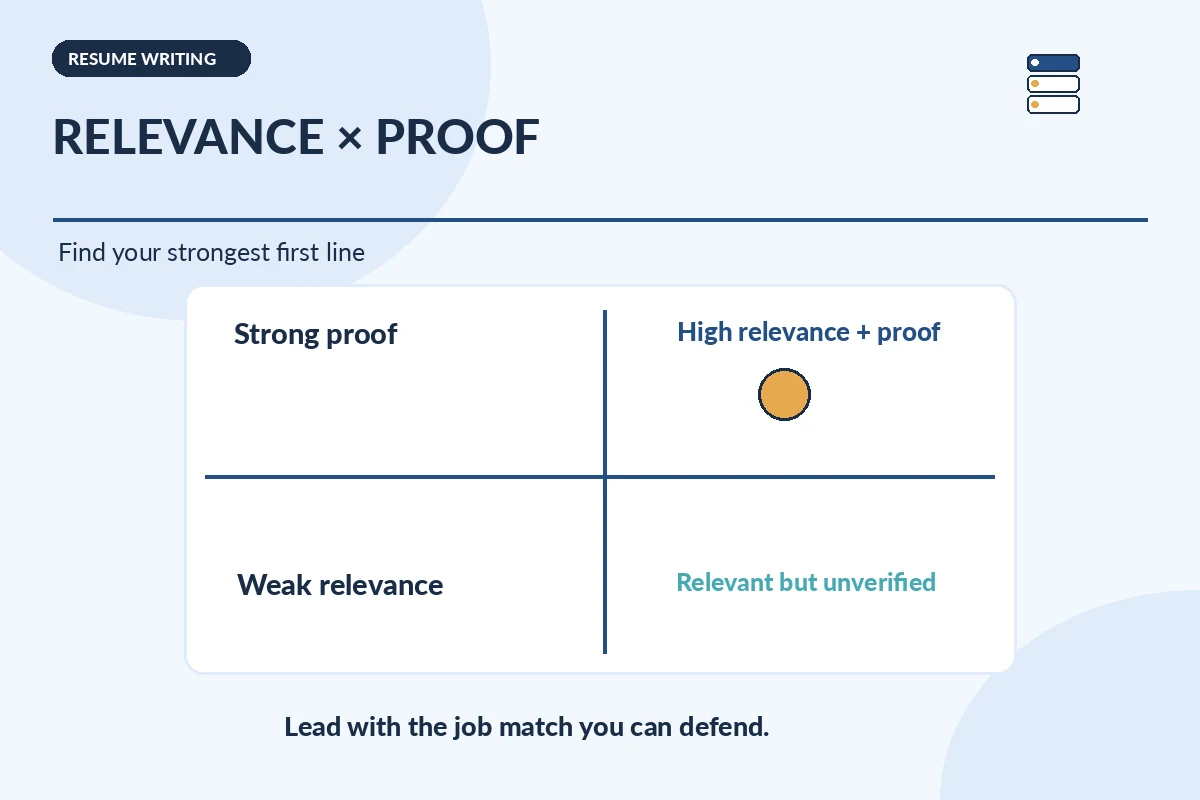
Create three informal columns for each candidate bullet: job relevance, strength of evidence and personal ownership. Relevance asks whether the sentence matches an actual requirement. Proof asks whether you can explain what occurred and support any metrics. Ownership asks whether you performed the action or are borrowing a team accomplishment. You do not need fake numerical scores; high, medium and low labels are enough.
A line about preparing error reports may be more relevant than a general customer greeting bullet for an operations role. But if the report line depends on invented savings or implies you approved results you only prepared, the greeting line may be stronger until you rewrite it. Prioritization is not a license to exaggerate. A slightly less glamorous sentence with clear evidence can deserve the first position.
Put the strongest matching activity at the top
Suppose a fictional administrative assistant applies to a scheduling-intensive role. Three draft bullets mention greeting visitors, updating shared calendars, and filing old documents. If calendar work was real and substantial, put that sentence first and describe the actual actions: ‘Updated shared appointment calendars and flagged booking conflicts for the office coordinator.’ The example is hypothetical, and an applicant should replace it with their verified tasks and authority.
For a fictional service role, the vacancy might emphasize issue escalation. A bullet about identifying unresolved requests and giving clear handoff notes would lead over a line about routine stock checks. The order can change for a different job application; the historical facts cannot. Maintain a saved master version so that tailoring changes priority and relevant detail without changing the actual work you did.

Use distinct first, second and third bullets
The first bullet should be the clearest direct match or strongest relevant result. A second can add complementary scope, such as a tool used, a different stakeholder group, or a recurring responsibility. A third can demonstrate a supporting skill that does not duplicate the first two. There is no universal requirement for exactly three bullets; allow more or fewer based on the job’s importance, available evidence and document length.
Avoid three versions of ‘worked with customers’ stacked together. That makes the first line compete with close paraphrases rather than showing a range of contributions. Ask whether each bullet answers a different question: What did you deliver? How did you work? What did you coordinate or check? If two lines answer the same question, merge, replace or remove the weaker one.
| Candidate bullet | Matches job? | Proven? |
|---|---|---|
| Scheduling conflict handoff | High | Yes |
| Generic visitor greeting | Medium | Yes |
| Claimed 40% time savings | High | Not verified |
Break ties using specificity rather than excitement
Two bullets can both match the job. Place the one with clearer evidence, stronger individual role or more concrete output first. Specificity matters: ‘Prepared weekly handoff notes for the maintenance lead’ can be more useful than ‘Made exceptional contributions to operations’ even without a big number. A verified result can move the line higher if it is related to the vacancy, but an unsupported claim should not win simply because it contains a percentage.
Also consider reader context. An internal acronym or project nickname can make a very impressive task look unclear. Translate the work into understandable language before deciding it deserves the top position. If the bullet has to be explained with two paragraphs, shorten it or move a simpler, more direct example to the top. Ranking should reward clarity, not buzzwords.

Recheck the entire page after reordering
Once you have sorted the bullets, read each job from top to bottom as a recruiter unfamiliar with you would. Does the first line justify why this role matters? Are the later lines still worth the page space? Did the order accidentally imply that you performed a task throughout the entire employment period when it was only a short project? Add context where needed without altering dates or the underlying assignment.
Finish with a consistency check: maintain true employer names, job titles, employment dates, section headings and a readable text-first layout. Verify your saved file after export and compare the final attached version with the actual posting. Keep the master list of all truthful bullets separate from each tailored copy. Future applications can use a different order while the evidence remains stable.
How We Research This Resume Advice
We reviewed practical resume guidance from UC San Diego Career Center, UC Berkeley Career Engagement, University of Michigan Career Center and University of Pennsylvania guidance on resume length. We used those sources for the principles of task specificity, honest ownership, reader clarity and relevance. The worked examples here are hypothetical: use only facts you can personally verify, and follow the specific employer’s application instructions. We do not claim a particular format guarantees interviews or passes an applicant tracking system. Read our affiliate disclosure for the site’s relationship policy.
More Resume and Cover Letter Guides
Not usually. Prioritize the most relevant and well-supported examples inside each job while keeping the employment history itself clear and accurate.
No. Relevance, personal contribution and the reliability of the figure matter more than the apparent size of a metric.
Yes, if the underlying duties, dates and outcomes stay accurate. Tailor which verified facts receive the most attention.
Lead with a relevant specific task, work object and audience or deliverable you can explain, without fabricating impact.
No. Use the amount of detail that the position merits, keeping less relevant work concise and the overall resume easy to scan.