
A professional reference list is a document naming people an employer may contact after they have agreed to be references. A recommendation letter is a written endorsement prepared by a person who knows your work, often for a particular program or opportunity. The two are not interchangeable. If a job application asks for three references with telephone numbers, do not upload three generic letters instead. If it asks for a signed recommendation letter submitted by a faculty member, do not provide only a phone number and hope the employer will call. Read the exact instructions, ask permission, and submit the requested item through the designated channel.
USC and UC Davis career guidance distinguish contact references from recommendation letters. Employers often request contact lists during late hiring stages, while some jobs, training programs, academic opportunities or scholarships request written letters. One employer may use an automated reference questionnaire rather than either document. Your job is to determine the deliverable, who owns it and how it reaches the recipient. Different institutions may have confidentiality or portal rules. The candidate should not claim to have written or submitted a recommendation that the referee has not approved.
Tell a Contact List From a Written Letter
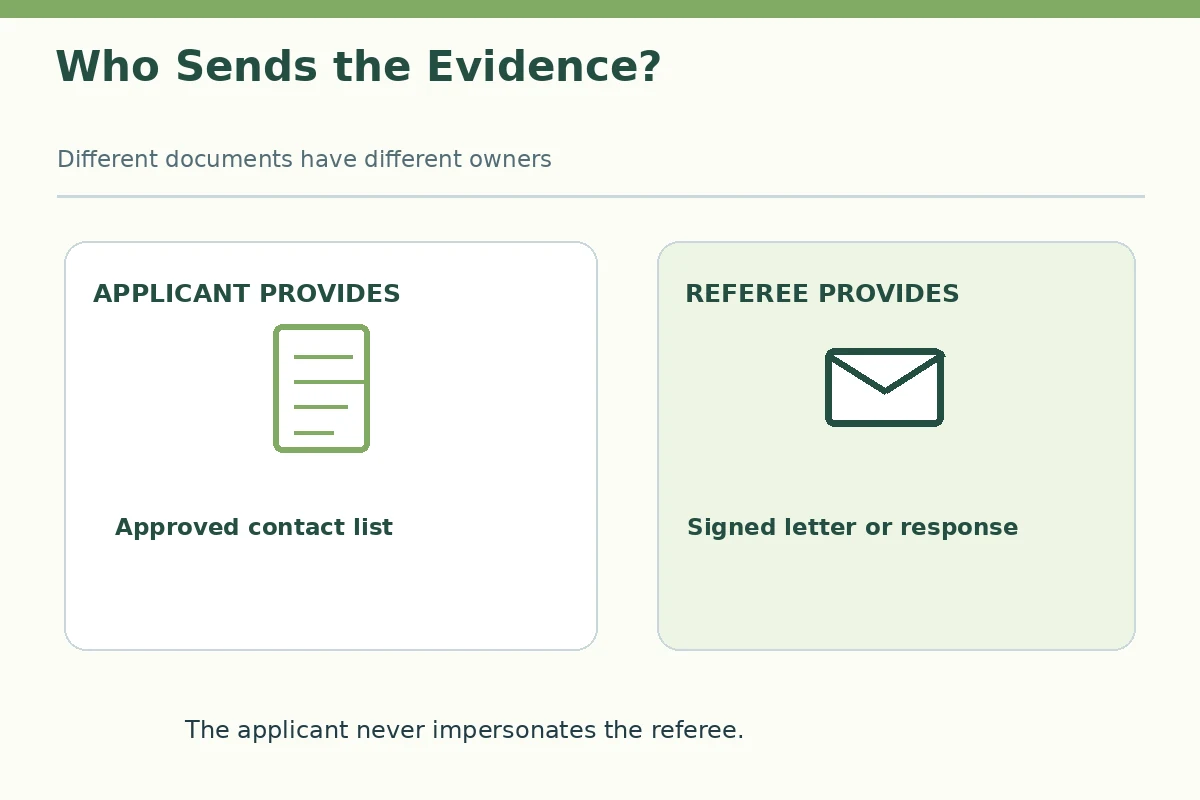
For each request, record four facts: what is being requested, who supplies the content, where it must be sent, and when it is due. A reference list is usually prepared by the applicant using approved contact information. A recommendation letter is authored by the referee, sometimes addressed to a specific role or sent directly. An online evaluator form may come from the hiring system and must be completed by the referee, not the applicant. Asking “Do you need a contact list, a written letter, or a completed questionnaire?” can resolve ambiguity before someone spends time creating the wrong document.

Four Steps to Match the Application Instructions
Step 1: Identify the exact document the employer needs
Read the posting and application portal rather than relying on the phrase “references required” alone. Look for individual contact fields, a separate PDF upload slot, sealed letters, email instructions or a referee questionnaire invitation. A list often shows a name, current title, your professional relationship and approved email or phone. A letter may require an addressee, signature and evidence of the applicant’s work.
Important boundary: Do not assume the employer will accept a different format or upload someone else’s letter to a field intended for a list.
Step 2: Ask the right person for the right task
A supervisor who can speak briefly to your reliability might be happy to take a phone call but unable to write a tailored letter. A professor who can write about a research project may need a deadline and submission instructions. Explain precisely what is requested before they agree. A letter carries more preparation work than permission to share contact details, so give realistic notice and allow the writer to decline.
Important boundary: Do not write a letter in someone else’s name or imply the referee has endorsed language they did not approve.
Step 3: Prepare a reference list with consent and privacy
Keep the list as a separate document with a header consistent with your résumé. Include the correct relationship, current role and the referee’s chosen contact details. Verify spelling and whether the referee wants a work or personal address used. Do not publish the list on a public résumé site. When the employer wants a certain number of people or a particular category, follow those instructions and ask if you cannot comply.
Important boundary: Do not add non-consenting contacts, private home addresses or false supervisor titles.
Step 4: Manage written letter deadlines and ownership
If the employer requires a letter, confirm who uploads it: you, the referee or an institutional system. Give the writer the role description and examples of work they personally observed, not a fabricated success story. Check submission deadlines early enough for a thoughtful letter. When a portal marks a confidential letter, do not ask to log in as the writer or see private submissions. Follow up courteously on schedule and thank the writer after the process.
Important boundary: Do not confuse a completed reference form with a letter, or override a confidentiality designation.
Compare Who Writes and Sends Each Item
| Situation | Appropriate action | What to verify |
|---|---|---|
| Reference list | Applicant, with permission | Employer contacts listed people |
| Recommendation letter | Referee writes and approves | Follow upload or portal instructions |
| Automated reference form | Referee responds directly | Applicant only supplies approved contact |
Choose a Realistic Submission Route
Illustrative comparison: A retail employer requests “two supervisory references.” Prepare a consent-based list with accurate names, job titles, relationships and chosen contact information. A graduate fellowship requests “two recommendation letters uploaded by the recommenders.” Contact each prospective writer, provide the program brief and deadline, and let the writers submit their own materials. If you receive “please upload references” without more detail, ask which format the employer needs rather than sending both types and exposing unnecessary private details.

A contact list is often short and factual. A recommendation letter usually explains the writer’s relationship to the applicant, describes selected observed examples and gives a considered assessment. Those are not promises of hiring success. Even a strong letter should not contain invented awards, grades, employment dates or confidential client information. The applicant can offer the referee a résumé or project summary for context, but the referee decides what they are prepared to say. Professional honesty applies equally to written endorsements and telephone reference checks.
The timing differs, too. A phone reference may occur after interviews with relatively little notice once the person has agreed. A tailored written letter may take weeks, particularly in an academic setting. UC Davis advises early contact for formal letters. A candidate should avoid imposing a same-day letter request on a busy professor, and an employer should not receive an unapproved file as a substitute. If deadlines conflict, ask whether a different writer or an extension is possible; do not use forged signatures or edited past letters.
Check Deadlines and Contact Permissions
Make one final document check before submission: list or letter, exact recipient, responsible sender, required fields, deadline and access permissions. If you prepared a contact list, verify that each person knows which employer might reach them. If you requested a letter, confirm the writer agreed and knows the official submission route. Sharing more private contact data or extra letters than requested is not automatically helpful. Give the hiring team exactly the evidence it asks to evaluate.
How We Research and Verify Reference Advice
This guide was researched against university career guidance checked on 2026-11-14. careers.usc.edu explains uSC distinguishes a list of reachable references from formal letters and advises providing only requested application documents. careercenter.ucdavis.edu explains uC Davis explains that supervisors, mentors, faculty and other work contacts may act as references after permission, and separates a reference list from a recommendation letter. careers.fortlewis.edu explains fort Lewis College describes differences between an employment reference and a written recommendation and the need for advance consent. All message examples are fictional and must be adapted to real work, relationships, consent and employer instructions. The sources explain common university career-advising practice rather than a universal hiring rule. See our affiliate disclosure.
More Resume and Cover Letter Guides
No. A reference sheet provides approved contact details; a letter is a written evaluation prepared by a referee.
Someone who has observed relevant work and agrees to write a truthful assessment. Follow the employer’s rules about relationship or professional position.
Only if the employer explicitly agrees to accept that alternative. Otherwise follow the listed document and submission requirements.
No. Follow the specified confidential submission process, which may require the writer to upload it themselves.
Ask well in advance because a tailored letter takes time. The feasible notice period varies by person, institution and deadline.