
For a dental assistant interview, a useful strength is a specific action you can demonstrate, and a useful weakness is a real job-related skill you are actively improving. For this role, try reliable room preparation and instrument accountability as a strength and explaining unfamiliar dental terms to an anxious patient as a possible development area—only if those statements fit your experience. Interviewers need to understand the work you actually performed, the result you could observe, and what you would handle differently now. This guide gives role-specific answer models rather than one-size-fits-all adjectives. Every example is illustrative; do not present a sample incident as your own history.
What strengths matter most for dental assistant work
Start with the employer’s posting and mark tasks that repeat across the duties. In dental assistant work, those might include clinic reception, supervised chairside preparation, patient reassurance, sterilization workflow, and protected patient records. The strength should match a task the employer needs, not simply a favorable personality trait. O*NET and the Bureau of Labor Statistics describe occupations, but a particular organization may divide responsibility differently. A convincing answer links a claim to a visible routine and an authorized action. For example, setting out the items requested by the clinician, checking the room setup against the practice checklist, and flagging missing supplies before a patient enters. Explain the check that kept the work reliable and who would be asked to handle an exception.
A dental assistant’s strongest answer often comes from the moments before the clinical procedure begins. Was the room prepared for the appointment shown on the schedule? Were instruments processed under the practice’s approved protocol? Did you identify a missing item early enough to bring it to the trained staff member? These are small steps, but they connect organization to patient safety without claiming the dentist’s judgment. If the interviewer asks about infection-control routines, describe only procedures you learned and performed with appropriate supervision. In particular, never suggest that a class exercise proves authorization to perform radiography or expanded duties in another state.
A strength answer you can adapt truthfully
Illustrative strength answer: “During supervised training, I noticed that the instrument tray did not match the scheduled procedure. I checked the setup list and alerted the supervising assistant before the room was used. The team corrected the tray in time for the appointment, and I kept using the checklist rather than relying on memory.” This example includes the task, your own action, how another person reviewed the work, and an outcome that does not require an invented metric. Rewrite it using your own actual setting. If you did not use a formal checklist, do not add one to sound rigorous. If you did not personally change the process, say you noticed, documented, or escalated the issue instead of taking credit for the final approval.
For a new dental assistant, the most useful practice event may be a simulated chairside setup rather than patient care. Say which tray checklist the class provided, how you verified the required items, and what your instructor corrected. For an experienced assistant, a real room-turnover handoff may work better if it can be described without identifying patients or clinic records. Try one practice answer about preparation and one about patient comfort. Keep the clinical explanation with the dentist or hygienist, and let your own contribution be accurate setup, calm communication, and timely escalation.

How to choose an honest weakness in dental assistant
The weakness question is not a request for a confession or a medical history. Choose an improvable professional habit that is genuine but does not mean you are unwilling or unable to perform a core safety-critical duty. A useful choice for this context is explaining unfamiliar dental terms to an anxious patient, provided it is true for you. Name the problem narrowly; explain when you noticed it; then describe a change you have already practiced. A promised future training course is weaker than a small, real behavior already underway.
Illustrative weakness answer: “I have sometimes given explanations that sounded too technical. Now I use approved plain-language descriptions, pause for questions, and refer clinical explanations to the dentist or hygienist instead of improvising.” The wording does not claim the weakness has vanished. It does not expose anyone’s private information, and it places judgment with the appropriate reviewer where required. A candidate who says ‘I have no weaknesses’ removes an opportunity to show self-awareness. Equally, a candidate who says they ignore safety or confidentiality in a high-stakes role is describing a major job concern rather than a sensible development area. The right answer is accurate, bounded, and actionable.
A quick evidence and authority check
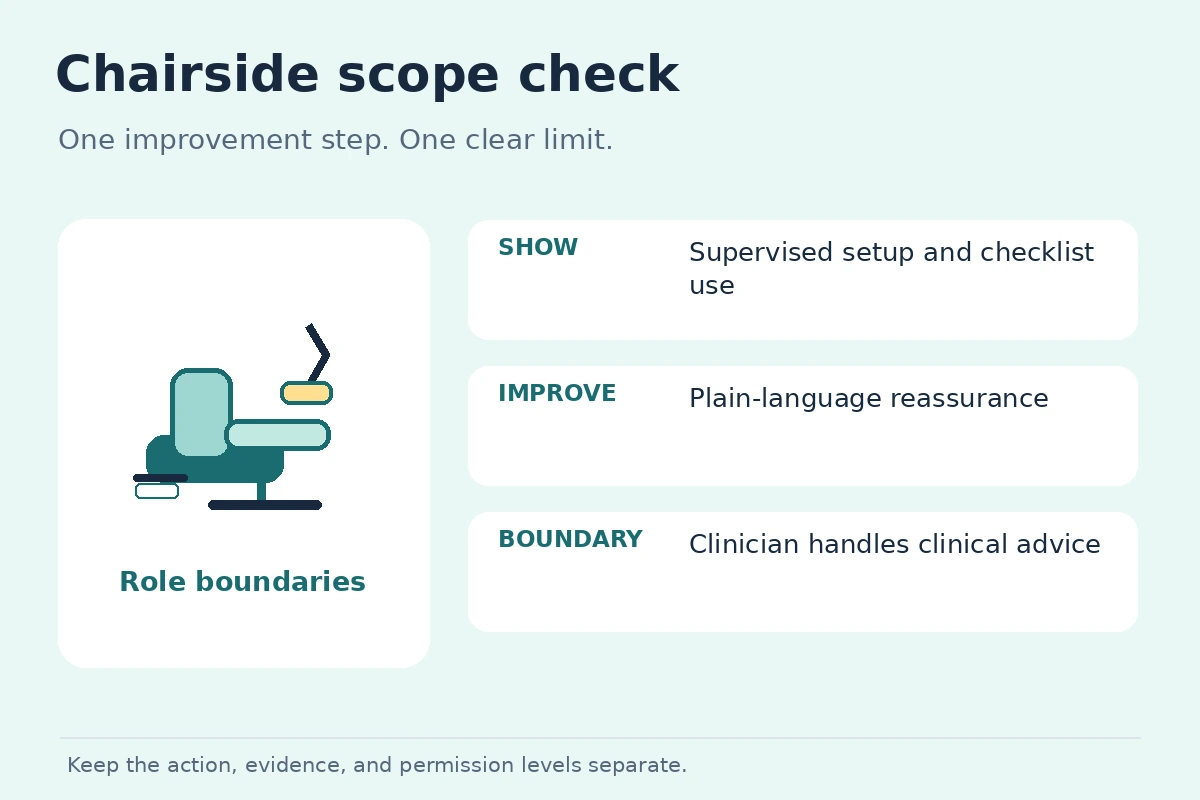
Before speaking, distinguish proof of skill from proof of permission. Your example can show that you noticed a problem, explained facts, and followed an approved process. It should not imply that you made a decision assigned to a licensed professional, manager, or system owner. For dental assistant applicants the practical safeguard is simple: Never suggest that being comfortable with instruments authorizes an untrained assistant to diagnose, take radiographs, apply sealants, or give independent clinical advice. Duties and credentials vary by state and practice. This matters because an interview statement that exaggerates authority can contradict the actual job description later. Review wording from your resume and application so the level of responsibility stays consistent.
| What to test | Weak or unclear wording | Better evidence |
|---|---|---|
| Strength | “I am dependable and detail-oriented.” | Setting out the items requested by the clinician, checking the room setup against the practice checklist, and flagging missing supplies before a patient enters. |
| Weakness | “I work too hard.” | I have sometimes given explanations that sounded too technical. Now I use approved plain-language descriptions, pause for questions, and refer clinical explanations to the dentist or hygienist instead of improvising. |
| Scope | “I solved everything independently.” | Explain the review, approval, or escalation boundary. |
| Outcome | “I always achieve perfect results.” | Describe the specific correction or next step you observed. |
A role-specific answer compared line by line
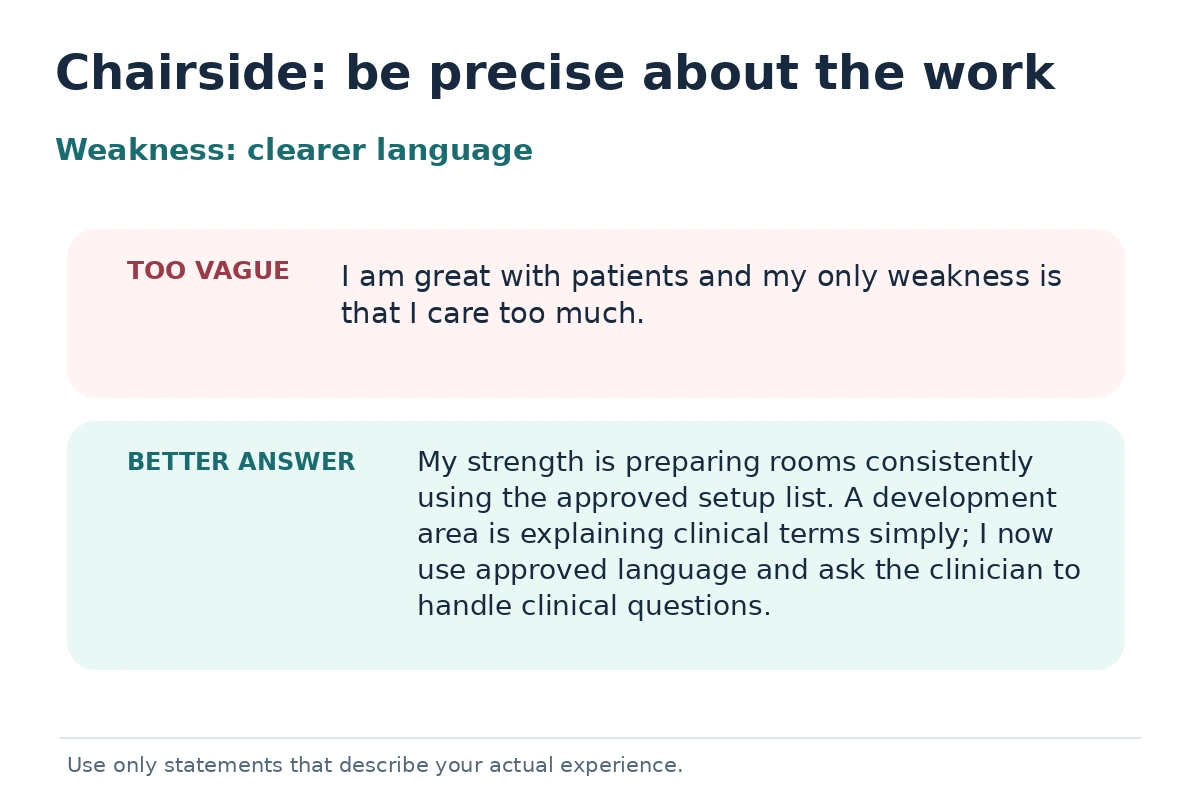
Vague response: “I am great with patients and my only weakness is that I care too much.” More credible response: “My strength is preparing rooms consistently using the approved setup list. A development area is explaining clinical terms simply; I now use approved language and ask the clinician to handle clinical questions.” Notice that the revised answer names an action, a process, and a development plan. It does not ask the interviewer to accept a personality label as evidence. Rehearse it in your natural speaking voice. You are not required to memorize a paragraph; you should be able to explain every phrase when asked ‘What did you do?’ or ‘Who checked that?’ A quiet, accurate example is better than a polished but fictional one.
Practice the answer with three prompts
Ask yourself the following questions and answer them aloud using a real event: What strength helps you prepare a room reliably? Describe a weakness you are working on without jeopardizing patient safety. When would you stop and ask the dentist or hygienist for help? Keep the story short enough to follow, but give enough detail to separate your action from the team’s action. A useful order is situation, task, action, and result—often called STAR. The US Office of Personnel Management recommends developing behavioral questions around job-relevant examples and observed actions. This is a preparation tool, not a mandatory script or guarantee of interview success.
When rehearsing the weakness answer, test the boundary between explaining a process and giving a clinical opinion. A patient might ask whether pain after a procedure is normal. It would be misleading to turn that story into evidence of your diagnosis. A better interview example describes how you listened, provided only approved information, and brought the concern to the licensed clinician. If terminology was your development area, explain whether you practiced plain-language phrases from the clinic’s materials. Your improvement can be credible without claiming that your communication skill removes the need for clinical supervision.
Adjust the example for entry-level and experienced candidates
An entry-level applicant can discuss coursework, supervised practice, volunteering, or a small independent project. The example should identify the source of instruction and the limits of that experience. An experienced applicant can choose a less dramatic example from ordinary work; routine quality is often more credible than a story involving extraordinary heroics. Neither group should claim licenses, approvals, supervision, or system permissions they did not hold. If the vacancy lists an essential skill you have not used, acknowledge the gap and distinguish a realistic learning plan from existing competence.
If you are changing industries, translate the process rather than renaming your former job. For example, careful checking in one service setting might help explain why you would verify records in another setting. But it does not automatically qualify you to perform its regulated, technical, or confidential activities. In your response, use the phrase ‘a transferable habit’ when appropriate, name what still requires training, and explain how you follow instructions when you encounter a boundary. Interviewers can see a realistic transition instead of a fictional credential.
Avoid common mistakes in this interview question
Avoid saying a strength is simply ‘hard work,’ describing an unapproved decision as your own, claiming that a weakness is completely cured, or giving an unnecessarily personal explanation. Do not reveal client, patient, guest, employer, or customer identifiers. Do not invent names, numbers, certificates, or an employer endorsement. Check the exact posting rather than assuming all employers use the same software or procedures. A practical answer is not defensive: it accepts that improvement happens through feedback, accurate records, and better routine choices.
When discussing a weakness, do not choose an unsafe practice as a personality quirk. If your real example included an error, explain the proper reporting and correction process rather than making it entertaining. If you would rather not share a sensitive event, choose a different authentic learning example. Keep the person affected by your work out of the story unless you have permission and can protect privacy. For dental assistant positions, a measured explanation of how you request help may be evidence of judgment rather than a sign of weakness.
Your final answer rehearsal checklist
Read your answer once without notes and ask: Can I point to a real event for every major claim? Did I explain what I did, not what a whole department did? Is the improvement step something I already use? Have I kept any privacy, safety, and scope restrictions intact? Can I answer a follow-up without altering the story? If one statement fails that test, cut it or make it more precise. The purpose of preparation is to choose a truthful example quickly when a recruiter asks, not to invent a perfect version of yourself.
How We Research Interview Strengths and Weaknesses
We reviewed the U.S. Office of Personnel Management’s structured-interview guidance, which emphasizes job-related competencies and actual behavior. For this role we checked the occupation-specific source for its work tasks and responsibility context. BLS describes dental assistants as supporting dentists with patient care, instrument preparation, records, and scheduling; state rules control certain expanded functions. These sources describe general occupational duties, not the policies of a particular employer. Examples in this page are original illustrations, not statements by real applicants or promises about screening decisions. Official source pages were consulted on November 7, 2026.
Sources: OPM structured interviews; OPM STAR guidance; occupation reference; additional occupation or practice reference. JobAsk explains editorial and affiliate relationships at our affiliate disclosure. This article does not imply that any external agency reviewed or endorsed its example answers.
Frequently asked questions for this role
More Interview Preparation Guides
You may discuss coursework, simulations, or supervised practice accurately. Distinguish a training demonstration from responsibility for a live clinic protocol.
It can be a genuine development area if you explain how you practice calm introductions and seek support. Do not imply that fear has led you to disregard safety procedures.
Only if you really have that experience and satisfy the applicable state and employer requirements. State rules vary, so avoid universal claims.
Use a verified training-room or service example and name your supervised scope. Then explain how you would follow the office checklist and learn under direction.
No. Use a de-identified, generalized situation or an explicitly hypothetical training example without sharing health information.