
A start-date mismatch can turn an otherwise good offer into one you cannot accept. First check the proposed date, the deadline to respond and any required training or onboarding schedule. If a later start would resolve the conflict, ask before the deadline and get any agreed change in writing. If the employer needs you on the original date and you cannot begin then, decline promptly with a short email. Do not promise to start and hope that existing obligations will disappear. This guide addresses a date conflict before acceptance, not resigning from a current job.
Locate all three dates before sending a response
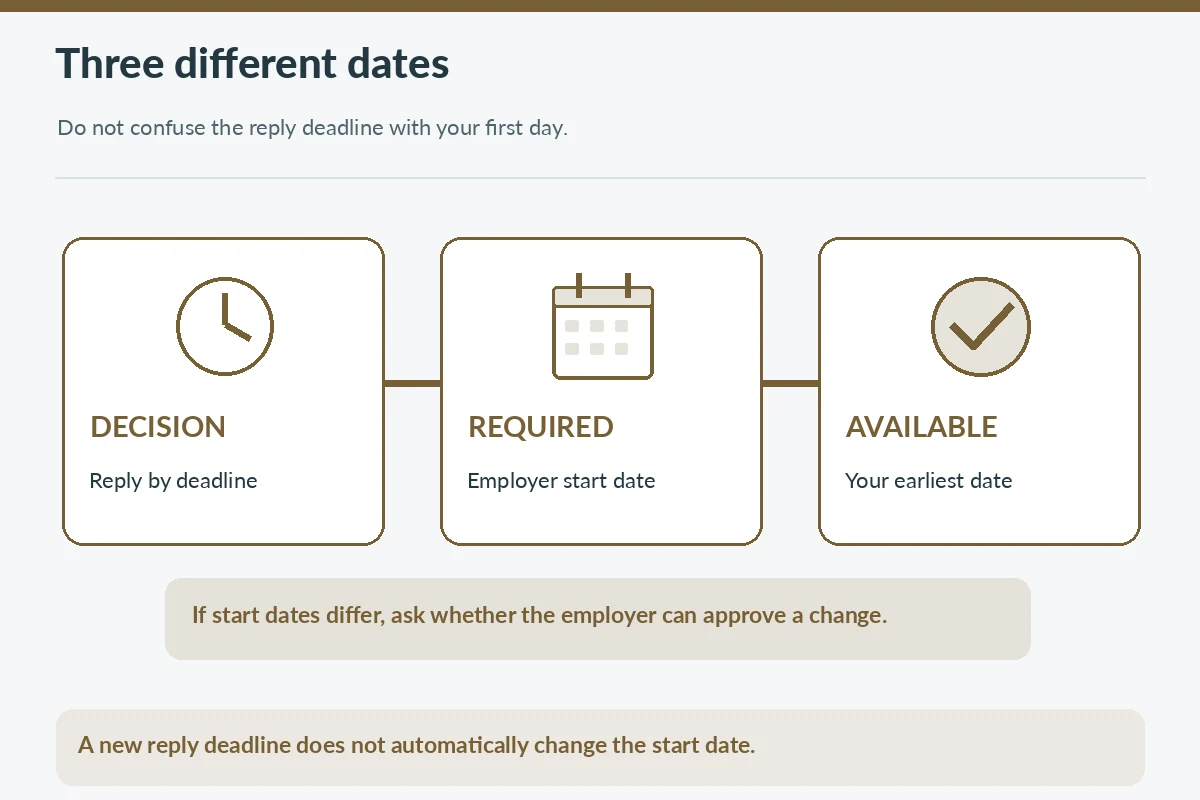
Mark the deadline to answer the offer, the proposed first workday and the date you can genuinely begin. Add required orientation or background-check steps only when the employer has actually specified them. It is easy to confuse a requested reply by Friday with a requirement to start by Friday. Ask whether the stated start date is fixed, preferred or contingent on completion of an onboarding process. UConn’s offer guide emphasizes written terms that include the job title, schedule, compensation and start date; use the actual offer, not assumptions drawn from a job board listing.
If an email says ‘expected start early next month’ and a contract gives a specific date, the discrepancy deserves one direct question. Preserve any promised relocation date or notice period only if it is relevant to this particular decision. Do not supply fictional clearance timelines or guarantee that a screening will finish by a particular day. Your private worksheet should show the earliest reliable date, not the most optimistic date. This keeps the employer from building an orientation plan on a commitment you cannot meet.
Understand the difference between a constraint and a preference
Some dates are preferences: you would rather finish a class project first but could realistically join earlier. Others are hard conflicts, such as a previously committed job notice period, travel arrangements you cannot move or a required academic program. Decide privately which is true before proposing a change. You do not need to provide supporting documents or intimate details to justify availability. State the earliest date you can honor and allow the employer to decide whether that timeline fits its operational needs.
Be respectful of the company’s scheduling constraints. A department may hold one orientation cohort or need staffing for an upcoming busy period; the recruiter may have no authority to change those dates. Do not treat silence as approval. If the employer approves a later start, ask for an updated written confirmation before accepting. Berkeley recommends that offer terms be clearly defined in writing. If you cannot meet the confirmed date and the organization cannot accommodate a change, decline rather than promising a start that is not feasible.
Request a date adjustment before deciding to decline
Illustrative clarification: ‘Thank you for offering the [Position] role. I can begin on [real date], while the offer lists [offered date]. Is there an approved later start date for this position? I can respond by [deadline] once you confirm.’ This is a question, not an acceptance or refusal. Use it only if you sincerely want to join under the later date. If the employer gives a counterdate, check your calendar before replying. A sequence of shifting requests can undermine trust even when each request is polite.
If you need more time to review the whole offer, ask for a decision extension separately. The University of Wisconsin–Madison advises contacting the HR department or offer contact promptly to discuss the timeline. An extension to answer is not the same as a later start date; never conflate them. You can ask both questions clearly, but the employer may approve one and not the other. Confirm precisely which change was authorized and where it is recorded.
Write the final start-date decline email
Illustrative email — Subject: [Position] Offer — Decision. Dear [Recruiter], Thank you for the offer and for discussing the expected start date with me. I understand that the position needs someone available by [confirmed date]. I cannot commit to that start date, so I must decline the offer. I appreciate the team’s time and consideration and wish you well with the search. Sincerely, [Name]. If there was no discussion, remove that phrase; this model must not suggest a conversation took place when it did not.
This email should not sound as though the employer failed to cooperate simply because it could not move its onboarding schedule. Avoid saying you accept ‘subject to a later start’ after the organization said no. Also avoid telling the recruiter that you have already resigned when that is not true. The short note establishes the outcome and reason without assigning blame. If you prefer not to mention the date conflict, you may decline simply because you cannot accept the offer as presented.

Account for mandatory orientation and role readiness
A role may involve an assigned training session, a credentialing process, a cohort start or customer support coverage from the first week. These elements are not always flexible. When the offer names a mandatory orientation day, check whether missing it makes later onboarding unavailable. Do not assume a professional license, security clearance or medical credential can be expedited. The organization must set its own conditions, and regulated requirements depend on the exact role and jurisdiction. Ask a question if a rule seems unclear; do not send legal interpretations through a decline email.
Consider an illustrative candidate who can start on July 15 but whose employer needs them for mandatory July 1 training. The correct comparison is between July 15 and the organization’s confirmed onboarding plan. If the company cannot add another training date, a polite decline may be the most accurate answer. The candidate should not claim to have finished required training or ask the recruiter to certify a requirement as complete without evidence.
Notify the right person promptly after deciding
Address the recruiter or hiring manager responsible for the offer. If the official portal asks you to select Accept or Decline, use that channel as directed and retain its confirmation. A personalized email is especially useful if there was a specific discussion about alternate dates. Career-center guidance from Berkeley and UConn favors prompt clarity rather than letting employers wait until the deadline. If you made the decision, send it rather than asking another question solely to avoid an uncomfortable reply.
Keep the email subject specific enough for the hiring team to route: ‘[Role] offer — decision.’ Do not copy multiple managers unless they are part of the established offer process. Never provide an old employer’s private resignation documents or other unrelated personal records to justify the timing. If someone from the company calls afterward, repeat the same answer without re-litigating dates. Save the final response for your records.
Avoid confusing a refusal with a withdrawal after acceptance
This guide applies when an offer has not yet been accepted. If you have signed the agreement, confirmed acceptance by email or already started onboarding, the situation is different. Read the agreement and any applicable employer policies, and obtain appropriate advice if legal or financial commitments are involved. Do not use the pre-acceptance template to claim the prior acceptance never occurred. A good-faith, documented conversation is better than ignoring the employer after commitments have been made.
Review your final note for accuracy: correct employer and title, correct confirmed date, clear decline, a professional thanks and no invented reason. If the hiring team unexpectedly proposes a workable new date after your refusal, you can consider it only if you genuinely wish to reopen the discussion. There is no guarantee the role remains available. Your clear answer lets the employer adjust recruitment plans and helps you avoid an unreliable start-date promise.

| Question | What to verify | Decision boundary |
|---|---|---|
| Offer deadline | When you must respond | Not the same as day one |
| Required start | First work or training date | Confirm whether fixed |
| Earliest available | Date you can honestly begin | Ask once if a change is possible |
How We Research Offer-Decline Guidance
We reviewed current official and university career guidance, distinguished general offer etiquette from role-specific employment and tax questions, and checked this topic against the supplied WordPress inventory and previous JobAsk batches on 2026-11-05. Sample emails, dates and candidates are illustrative, not actual employer statements. This article is educational, not legal or tax advice. Follow the exact written offer and any applicable agreements. For potential commercial relationships, see our affiliate disclosure.
Sources reviewed on 2026-11-05: University of Connecticut Career Center — UConn identifies start date as a written-offer term and recommends clear, courteous decisions.; University of Wisconsin–Madison Career Center — UW–Madison recommends prompt contact with the HR or offer contact when offer timing requires discussion.; UC Berkeley Career Engagement — Berkeley recommends clear written conditions and not holding offers when you are unwilling to accept.. These references support general evaluation principles, not a conclusion about your specific contract or workplace.
Related Workplace Guides
If you would accept the job on that date, ask whether the employer can approve it. Do not present a date you cannot actually meet.
No. An offer can have a response deadline and a separate expected start date. Read both fields in the written offer.
Yes, if you wish, but the exact private details are unnecessary. Explain the earliest date you can reliably begin.
Request an updated written confirmation from an authorized contact before treating the change as agreed.
Do not use a pre-acceptance decline email as though no commitment existed. Review the terms and address the changed situation directly.