
Employee appraisal form example: An employee appraisal form works when each field answers a different question: what was expected, what happened, what evidence supports it, what needs improvement and what support comes next. The fictional completed example below uses an administrative coordinator. It is a teaching model, not a universal employer form or a real personnel record. Use your employer’s required headings and rating definitions rather than copying an example score.
Start with the review period and actual responsibilities
A form normally identifies the employee, job title, evaluator and period. These fields should match the employer’s system; the form should not silently include a different role or months worked outside the review cycle. For this example, imagine an administrative coordinator called Alex, who schedules meetings, maintains request records and prepares handoff notes. Alex is a fictional person with no real employer or performance rating. The sample shows how to build a complete record without fabricating statistics that could be mistaken for a genuine accomplishment.
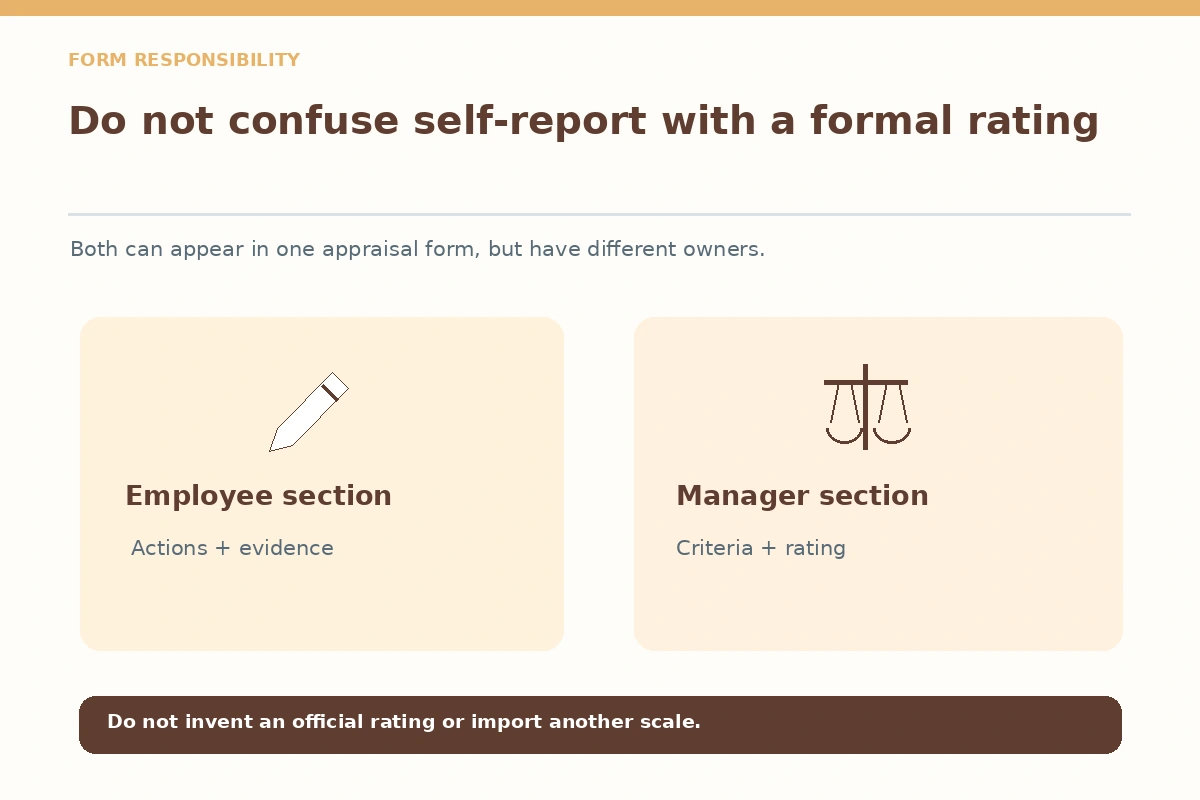
First write the role scope: “Schedules approved meetings, updates the shared request tracker and routes incomplete submissions to the appropriate owner.” Then list the agreed goals or responsibilities. Do not add duties the employee never performed to make the appraisal sound senior. UC Berkeley recommends that managers prepare with the job description, standards, goals and relevant work samples; that distinction helps each field stay grounded. If the employee and manager write separate portions, label who completed each one.
Fill the accomplishments field with observable actions
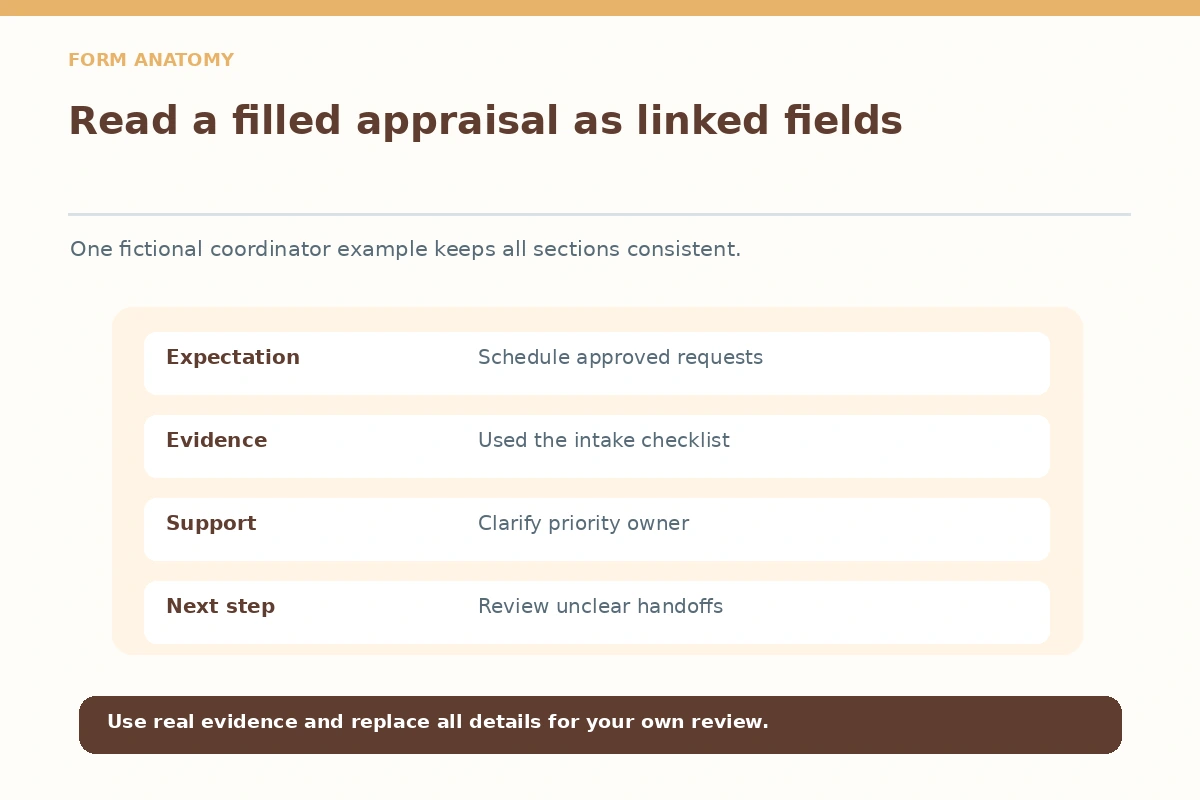
A weak accomplishment box says “I was organized and helpful.” For the fictional coordinator, a more informative sample reads: “Maintained the meeting-request log and used the approved checklist to flag incomplete requests before scheduling.” This does not imply a particular volume or error reduction. The employee can explain which log, which checks and what handoff occurred. Where real evidence exists, cite an authorized work sample or supervisor feedback in appropriate general terms rather than attaching confidential records.
If the form asks about results, distinguish completed tasks from organizational impact. “Sent a clarification request before approval” is an action; “reduced the department’s approval time” is an outcome that would need supporting records. A good entry contains the work, your role and the observed or verified result. In a real appraisal, you would use actual names of tasks and dates permitted by policy, but this teaching example deliberately does not assign a made-up success rate. Keep examples short enough for the field while retaining meaningful evidence.
Complete improvement and support boxes honestly
Development sections are not an invitation to insert a negative trait. A useful fictional answer is: “When multiple departments changed meeting priorities, I sometimes needed a clearer escalation route. I plan to confirm the owner at intake and ask for guidance on conflicting requests.” It identifies an action within the coordinator’s scope. It does not invent discipline, complaints or a severe performance problem. A manager can respond by clarifying who sets priorities, rather than telling the employee to work harder without changing the process.
Support requests belong in the appraisal because an employee may not be able to solve a process problem alone. For Alex, an illustrative request is: “Please confirm the approval path for schedule changes after a calendar invite is accepted.” This is different from promising to redesign company policy. Cornell’s performance dialogue framework covers both development needs and the support needed to address them. If the form uses a separate learning or training field, put the proposed coaching there and keep the accomplishments field focused on the past period.
Understand who writes the rating and what it means
Many forms contain a self-rating, a manager rating or both. These are not automatically equal. The organization defines its own scale and may require explanation for each category. Do not copy a “4 out of 5” from an online sample when your employer uses a different scale or none at all. For the fictional Alex record, a safe demonstration is “Employee self-assessment: evidence attached for discussion; manager rating: to be determined under employer policy.” That avoids pretending an invented case has an official employment result.
If the real form asks for an overall comment, summarize the strongest verifiable contributions and one open development item. For example: “My documented work centered on accurate scheduling and request handoffs. I would like more guidance on priority conflicts before the next cycle.” A manager’s response should use their own review standards and actual evidence. OPM describes appraisal as a continuing cycle of planning, monitoring, development and rating; the final rating is only one stage in that process, not a substitute for communicating expectations throughout the period.
Use the next-cycle goal field to describe a checkable action
A future goal should say what action will be taken, how the employee and manager will know it happened and what support is required. For the hypothetical coordinator, a suitable direction is: “Use the authorized intake checklist for each new request and review unclear ownership during scheduled check-ins.” This is an illustrative behavior-based goal without an invented percentage target. If the employer has a real measurable standard, use it verbatim and confirm its definition. Goals should reflect the employee’s job scope, not a promotion the manager cannot promise.
A separate field can record a manager action, such as confirming the escalation contact or approving checklist training. Keep the employee’s responsibility separate from the employer’s support commitment. Do not turn every open issue into an employee deficiency. A form is more useful when the next reviewer can tell what was promised, who owned the action and how progress would be discussed. Dates should be drawn from the organization’s review schedule, not generic online milestones. The filled example is a structure, not a mandatory timetable.
Review sign-off, privacy and the completed example
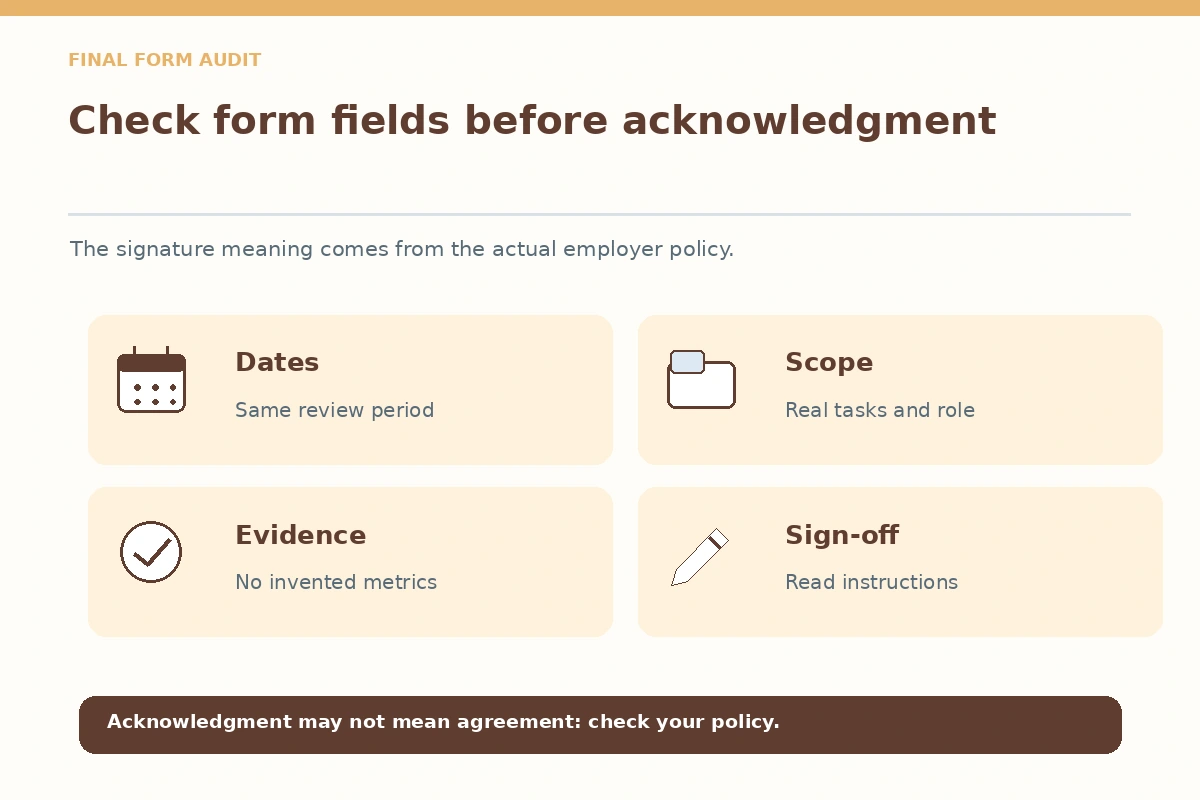
A signature or acknowledgment may mean the employee received the appraisal, discussed it or agreed with its contents; meanings differ by employer policy. Never assure readers that signing always means agreement or never affects their rights. Read the actual instructions and ask HR if the meaning is unclear. If the form includes an employee response field, use it to add missing facts or questions rather than secretly rewriting the manager’s assessment. Keep the review inside the approved personnel system and avoid sharing anyone else’s information.
Final fictional example, summarized: Role—Administrative Coordinator; Expectations—accurate scheduling and tracker updates; Accomplishment—used the approved request checklist and recorded handoffs; Development—clarify conflicting priorities sooner; Support request—confirm escalation owner; Next step—use a standard intake procedure with regular check-ins; Manager rating—pending authorized review. The point is consistency across fields. Before submitting a real form, check that every section uses the same review period, evidence standard and work scope, and that no invented performance figures have slipped into the text.
How We Research Performance Reviews
JobAsk reviewed these authoritative workplace and occupational sources on November 4, 2026: UC Berkeley: Preparing for the Review (UC Berkeley discusses using the same form for self-appraisal and manager draft, supported by work evidence). Cornell: Performance Dialogues (Cornell review dialogue categories cover behaviors, goals, development and belonging). OPM: Performance Management Cycle (OPM describes performance planning, monitoring, development and periodic rating). The guidance identifies useful review practices, but none of these sources verifies an individual reader’s work performance or employer-specific review procedure.
Every sample comment and illustration above is hypothetical, including references to employees, managers and projects. Use your organization’s real expectations, review period and authorized evidence. For commercial and editorial context, see our affiliate disclosure. This article does not claim paid endorsement, legal advice or a guaranteed appraisal outcome.
Explore Related Career Guides
Use the structure only; replace the fictional actions with your own verifiable responsibilities and employer’s required fields.
Only if the employer form requires a self-rating. Follow its definitions and do not import an outside scale.
Follow your employer’s instructions. A realistic next learning or support need can be useful even when past performance was strong.
The meaning varies by policy and jurisdiction. Read the form carefully and ask HR or an appropriate adviser about your specific process.
A concise summary of actual contributions, evidence, one relevant improvement area and a clear next step or support request.