
In a contract or fixed-term job, the first 90 days may cover nearly the whole assignment—or the assignment may be shorter or much longer. Begin by confirming its actual dates, deliverables, reporting contact, and review process. The word ‘contract’ can describe different working arrangements, so do not infer tax status, benefits, or legal rights from the label alone. This guide is about practical task management rather than employment classification. Use the 30/60/90 checkpoints only where they fit the assignment schedule, and move the handoff earlier if the end date comes sooner.
Read the assignment terms before setting goals
Find the written offer, assignment statement, or approved scope summary. Confirm the client or team you support, start and expected end dates, scheduled hours, work location, required tools, deliverables, and named contact for questions. If the documentation conflicts, ask the authorized representative to clarify before accepting extra duties. A contract listing may mention a project goal without specifying who can accept the work; that missing reviewer matters. Keep a personal summary of nonconfidential terms without copying employer or client records into an unauthorized location.
Turn each deliverable into an acceptance question
A deliverable is not complete merely because a file exists. Ask who reviews it, what evidence makes it acceptable, which format is required, and where the approved version is stored. For example, ‘draft operating procedure’ may require a subject-matter check, an accessibility review, and manager approval before staff can use it. Write each output as a task, review gate, and handoff. Avoid promising a client result you cannot control. If the acceptance criteria are unclear, propose a short example and request confirmation rather than inventing a quality threshold.

Identify tools and permissions for the actual scope
Contract staff may need temporary accounts, data access, facility credentials, or a narrowly defined workspace. Ask the designated team how permissions are requested, reviewed, and removed. Do not assume that a colleague’s access is transferable or that your personal device is allowed. If an account arrives late, document the dependency and notify the named contact. An accurate update is ‘waiting for access to the approved workspace; outline ready for review,’ not ‘project blocked by the client’ unless that conclusion has been confirmed.
Map the first 30 days to a tangible draft
Aim to learn the workflow, validate requirements, and produce one small reviewed sample early. A sample can surface mismatched expectations before the bulk of the work begins. For a hypothetical event-data cleanup assignment, show a few records with proposed labels and ask whether the team accepts the definitions before processing the full file. Do not edit the official dataset without permission. Capture reviewer feedback in the approved project space, then revise the workflow. This may matter more than a generic promise to build relationships across the entire company.
| Checkpoint | Deliverable question | Evidence without overclaiming |
|---|---|---|
| Start | Who owns and approves each output? | Written scope and acceptance contact |
| Mid-assignment | What is drafted, reviewed, or accepted? | Correct status and review notes |
| Final handoff | Who retains work and open issues? | Approved inventory and next owner |
Control scope changes through one decision route
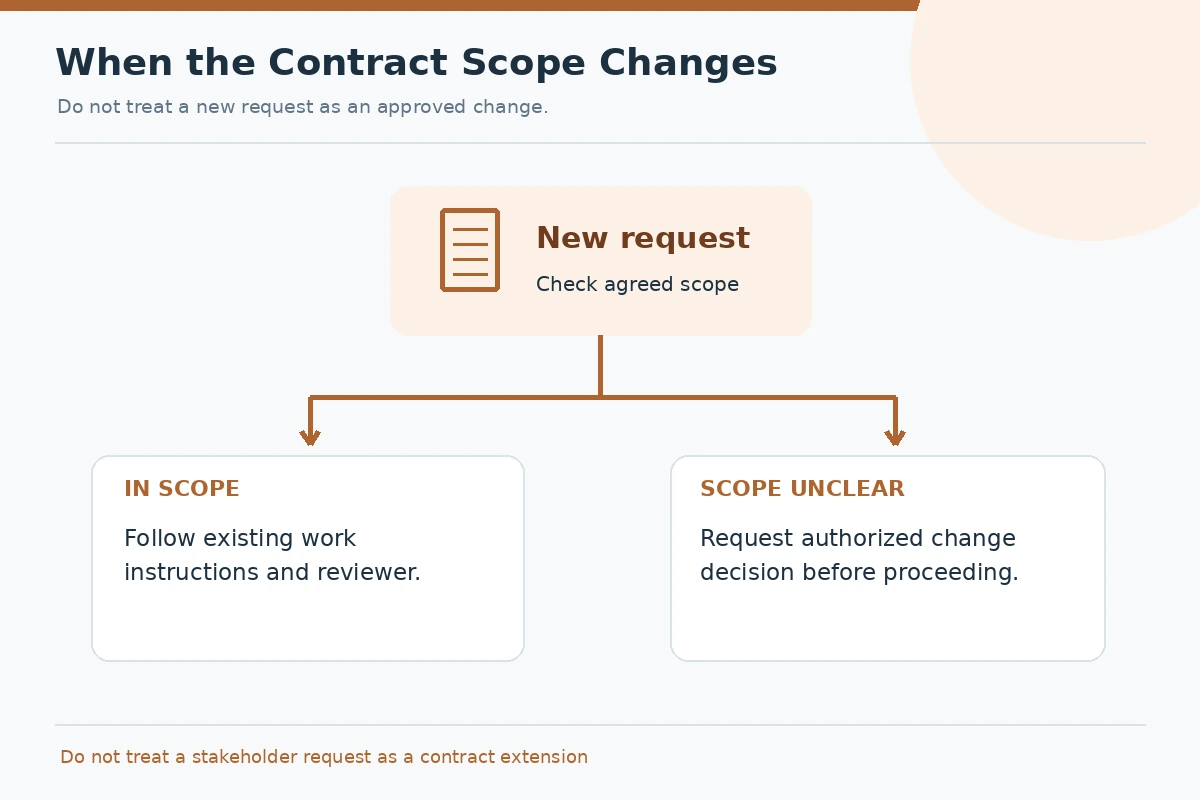
Extra requests often sound minor: another report column, a different client group, or a new version of the deliverable. Ask whether the request is within the agreed scope and who can authorize a change to priorities, schedule, or resources. Do not negotiate an unofficial extension with someone lacking that authority. Record the request, decision-maker, revised instructions, and any unresolved impact. This is operational discipline, not legal advice. If an issue changes your terms, direct it to the correct manager, agency contact, or contracting party.
Use days 31 to 60 for reviewed progress
By the middle of the assignment, review completed outputs against agreed acceptance criteria. Separate ‘submitted for review’ from ‘approved’ and ‘rejected with revisions.’ Present an issue log that names the next responsible person and due date where known. A good update might read: ‘Version two submitted for reviewer feedback; diagram labels remain open pending owner confirmation.’ Avoid fabricated completion percentages. If work is waiting on information from another team, ask the designated contact about the correct escalation path, not an unauthorized shortcut.
Protect a clean handoff even if renewal is possible
Do not postpone documentation because someone informally suggests the project may be extended. Maintain a clear inventory of agreed deliverables, versions, approvals, unresolved questions, and owners. Use only systems the organization specifies; sensitive information should not follow you to a personal portfolio. When an extension is actually approved, update the dates and the accepted scope. Until then, organize work as though the stated assignment end date stands. This is especially important for work a permanent team must operate after you leave.
Prepare the end-of-assignment inventory early
Before the final stretch, ask the reviewer which materials must be retained, transferred, archived, or deleted under the organization’s policy. Include links to approved workspaces, not copies on an unapproved drive. A handoff inventory may list deliverable name, latest approved version, reviewer, open issue, and next owner. Confirm who revokes access and who answers questions after your departure. Never promise indefinite availability or disclose client details in a public case study without explicit permission.

Hold a 90-day or final-date acceptance meeting
Use whichever checkpoint comes first: the contractual end date or the planned 90-day review. Compare outcomes with the agreed scope, confirm what was accepted, note what remains open, and identify the person responsible for next steps. Ask for accurate performance feedback while details are fresh, but do not invent renewal, conversion, or future work. If the contract is longer, set a later review cadence. Keep the final summary factual, with no unsupported claim that the assignment achieved a business outcome merely because your deliverable was submitted.
An example you can adapt without inventing evidence
Illustrative deliverable record: ‘Assignment: create a staff-facing process guide. Draft: version two in the approved folder. Review: operations lead to confirm the escalation language. Status: awaiting acceptance, not published. Handoff: records owner to retain final copy.’ This invented scenario does not imply a client, outcome, or guarantee of contract renewal. Notice that submission, approval, and use are separate events. Preserve those distinctions in your own status messages and do not substitute this example for the actual contract terms.
How We Research and verify this guidance
We compared onboarding advice from university human-resources teams with relevant project guidance and federal telework materials, where applicable. These sources describe structured training, feedback and communication practices; they do not establish your employer’s specific rules. The resources reviewed on 2026-11-16 are ucdavis.edu guidance umn.edu guidance vt.edu guidance apm.org.uk guidance pmi.org guidance. We also checked overlapping JobAsk topics so this page addresses a distinct situation. All sample messages and work records are illustrative. For editorial and commercial relationships, see our affiliate disclosure. No product purchase is required for these steps.
Related Workplace Guides
No. Contract length and employment arrangements vary; check the actual terms and avoid treating 90 days as a universal legal rule.
Use the named supervisor, agency, or contracting contact with authority over scope and schedule. Do not assume every stakeholder can approve changes.
It means the authorized reviewer confirmed the deliverable against agreed expectations, not simply that you sent a file.
No. Prepare for the written end date until an authorized extension is confirmed.
Only when the organization or client permits it and all confidentiality and intellectual-property restrictions are respected.