
If you have no references for a job application, do not fabricate names, use a friend under a false title, or claim that you had a supervisor you never worked for. Start by identifying people who directly observed tasks relevant to the job. They may include an instructor who graded a substantial project, a coordinator who saw your volunteer contribution, or someone who supervised a documented part-time assignment. Ask each person whether they can give a truthful professional reference before giving out their contact details. If the form requires more references than you can honestly provide, follow the employer’s instructions or ask the hiring contact what alternatives they accept.
A reference is not a second résumé or a guarantee of employment. An employer might ask whether you reliably completed tasks, followed directions, communicated appropriately, and showed up as scheduled. UC Davis lists supervisors, campus advisers and faculty among potentially suitable people when they actually know the applicant’s work. The quality of their firsthand knowledge matters more than a prestigious job title. A neighbor who likes you personally cannot substitute for a person who observed your performance. If a posting specifically requests previous supervisors, academic contacts may not meet that requirement until the employer agrees.
Identify Real Observers of Your Work
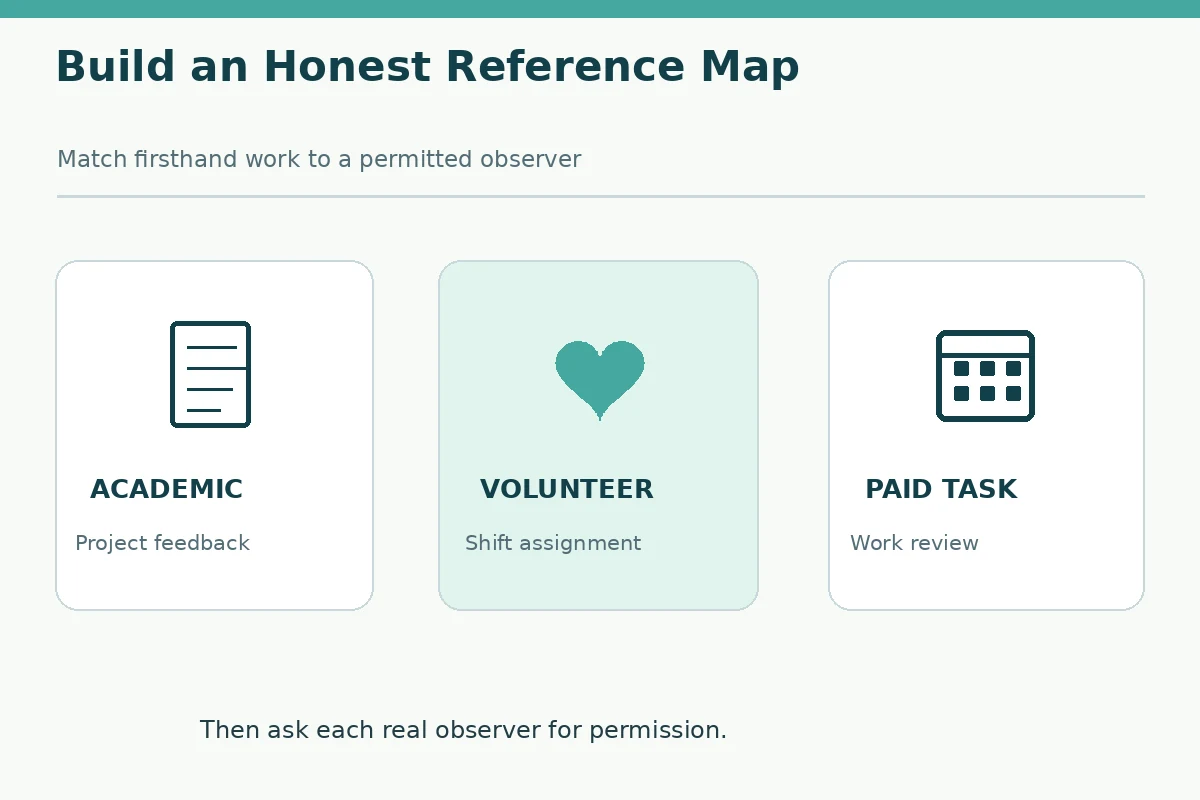
Make a private evidence map with three columns: the person’s professional relationship to you, the actual task they watched, and what they could verify without guessing. For example, a course instructor might verify that you researched sources, submitted drafts and revised a group report. An activity coordinator might verify event check-in records and a shift lead’s feedback. The map is only a planning tool; it is not a reference list yet. Never circulate another person’s phone number or private email until that person has agreed. When possible, keep more than one suitable observer in mind so an unavailable contact does not block an application.
Four Steps When You Have No Job References
Step 1: Find observers of work, not just friends
Review paid work, campus employment, projects, volunteer shifts and substantive classes. Write down who supervised, reviewed or assessed your contribution and when it happened. If a student club adviser watched you organize a real event, the adviser may have better evidence than someone who simply belongs to the same club. Prioritize recent, relevant work where the observer could answer specific questions about reliability or quality.
Important boundary: Do not call a peer a manager, imply paid employment where there was none, or ask a social acquaintance to invent professional observations.
Step 2: Make a specific permission request
Contact the strongest person individually, remind them of the task and the period when they knew you, and say what type of work you are applying for. Ask whether they would feel comfortable serving as a positive, truthful reference. Offer an updated résumé and a brief job description without pressuring them to endorse abilities they did not observe. If they decline or sound uncertain, thank them and move to another observer.
Important boundary: Do not submit contact information while the answer is pending; silence is not permission.

Step 3: Handle a mandatory reference field honestly
Read the field labels. Some ask for an employer reference, some accept an academic adviser, and others specify a minimum number or an online form sent to the reference directly. If you cannot satisfy a required field, contact the hiring organization through its verified channel and request approved alternatives. You can explain briefly that you are a first-time applicant and have a professor or project supervisor who knows your work.
Important boundary: Do not type invented names, dummy email addresses, or a friend’s details merely to bypass validation.
Step 4: Prepare for a real reference check
After permission is confirmed, record the person’s chosen title, current organization, relationship to you and preferred contact method. Send them the position description and a concise reminder of the relevant work. If the employer indicates contact is imminent, notify the reference again. Keep the contact sheet separate from your résumé unless the application requests it. Thank the person regardless of the hiring outcome.
Important boundary: Do not promise a favorable reference, ask the contact to misstate dates, or post a reference sheet publicly.
Match Each Reference Type to the Requirement
| Situation | Appropriate action | What to verify |
|---|---|---|
| No paid work | Professor who reviewed a substantive assignment | Label the relationship as academic |
| Volunteer event | Coordinator who assigned and checked tasks | Explain the unpaid scope |
| Required prior manager | Ask hiring team for accepted alternatives | Do not mislabel another observer |
Make Your Permission Request Specific
Illustrative message: “Hello Professor Lee, I took your applied research course and completed the community survey analysis under your feedback. I am applying for entry-level research assistant positions. Would you be comfortable serving as an academic reference who can discuss that project? I can send the job description and résumé. Please feel free to decline if this would not be a good fit.” Replace every detail with a true relationship. A specific request is more respectful than asking someone to be a reference for every future job indefinitely.

A common mistake is treating “professional reference” as synonymous with “former full-time manager.” Hiring teams differ. For a new graduate, faculty members or internship supervisors may be reasonable choices, but an application for a regulated position could have a formal verification process. Read the employer’s actual wording. If it says two supervisors from paid positions, do not quietly substitute two family friends. Ask whether academic, volunteer or apprenticeship supervision qualifies, and preserve the reply for your records.
If your strongest evidence is a group project, identify which pieces you performed and what the instructor directly observed. A professor who saw only the final group presentation may describe its quality but may not know which student completed a specific analysis. Avoid scripting the referee’s answers. Your role is to refresh accurate context and make it easy to decline. An honest but narrower statement about a project is more credible than a broad claim about leadership or productivity that no one witnessed.
Check the List Before You Submit
Before submitting, confirm that each reference knows you, has clearly agreed, recognizes the described work, and has provided a current preferred way to be contacted. Check that every relationship label is accurate and each contact addresses a skill the job actually needs. When you do not meet an explicit reference requirement, tell the hiring team before the deadline rather than hoping a fabricated entry will go unnoticed. References should support the application’s evidence, not replace that evidence.
How We Research and Verify Reference Advice
This guide was researched against university career guidance checked on 2026-11-14. careercenter.ucdavis.edu explains uC Davis explains that supervisors, mentors, faculty and other work contacts may act as references after permission, and separates a reference list from a recommendation letter. myusf.usfca.edu explains university of San Francisco recommends obtaining permission, sharing job context and protecting references’ contact details. careerservices.cns.utexas.edu explains university of Texas career services advises permission first, accurate relationships and current preferred contact information. All message examples are fictional and must be adapted to real work, relationships, consent and employer instructions. The sources explain common university career-advising practice rather than a universal hiring rule. See our affiliate disclosure.
More Resume and Cover Letter Guides
You can often still apply, but employers set their own requirements. Ask the verified hiring contact what alternative observers or documents they accept rather than inventing references.
Often yes for entry-level applications when the professor knows your work well, but a requirement for previous employment supervisors is different and may need employer approval.
No. Do not misrepresent the relationship. Only use someone as a professional reference when their real role and firsthand observations support that description.
Ask the employer whether an academic or volunteer contact is acceptable or whether you can supply a third name later. Do not insert a fictional contact.
Usually keep a separate reference sheet ready and supply it when requested or when the application instructions specifically call for it.