
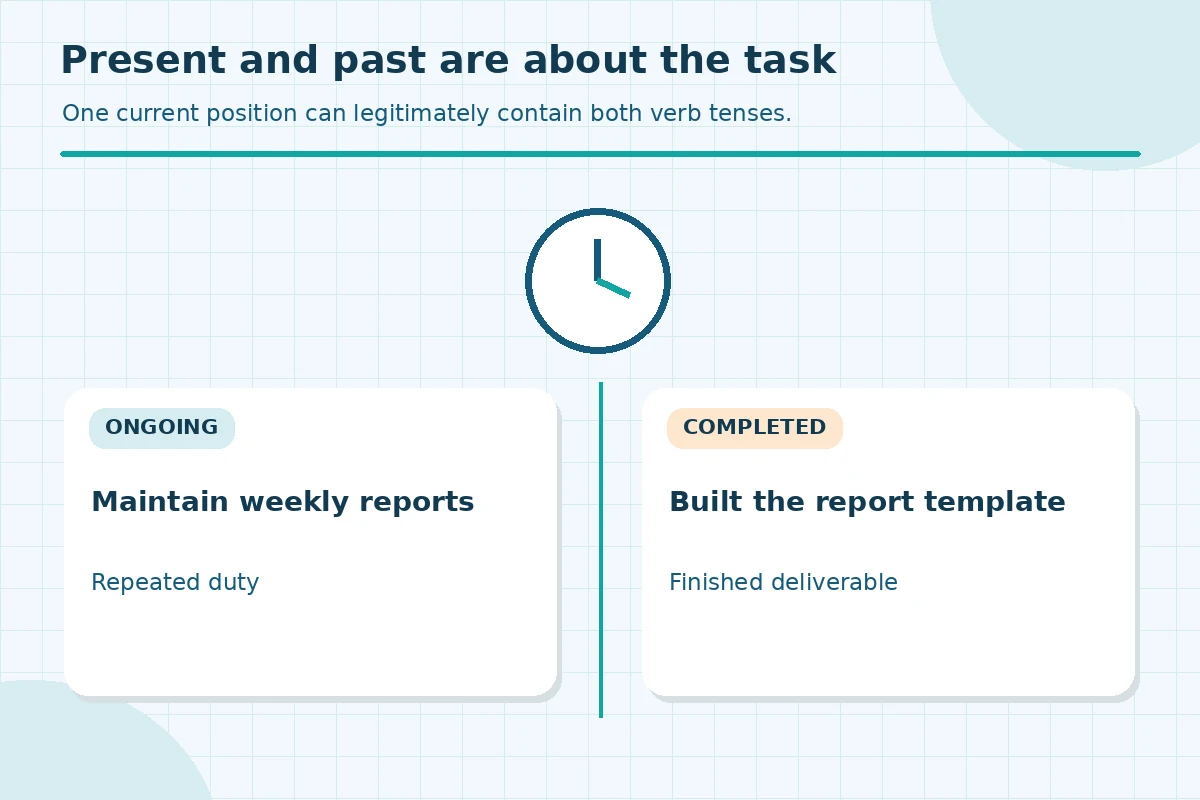
Use present tense for duties you still perform and past tense for work you have completed. That distinction applies even when both kinds of tasks appear under one current job. ‘Coordinate weekly schedules’ can describe a recurring responsibility, while ‘Redesigned the scheduling template’ is a completed change. A verb should accurately show what you do now or what you did, not make a finished accomplishment appear ongoing.
Look at the action, not only the job dates
A job marked ‘Present’ can contain both recurring responsibilities and completed projects. Ask what happened in the particular bullet before choosing the verb. If you still prepare a weekly report, ‘Prepare weekly status reports’ is reasonable. If you created the first report template last spring, ‘Built the reporting template’ gives a more precise account of the completed action. You need not force those two contributions into the same tense.
For an ended position, past tense is usually the default. ‘Review daily invoices’ under a job that ended two years ago may confuse the timeline; ‘Reviewed invoices and flagged missing approvals’ is clearer. Do not change actual job dates to accommodate a preferred writing style. The date range provides context, while the first verb tells a reader whether a particular responsibility or achievement continues.
Separate ongoing tasks from one-time achievements
Imagine a current office coordinator who books meeting rooms each week and previously introduced a new booking request form. Two bullets could read ‘Maintain a shared room calendar for three departments’ and ‘Created a request form with clear approval fields.’ These are hypothetical examples, not employee results. They demonstrate a distinction that matters: maintaining a process today differs from building that process in the past.
A finished deliverable does not become present tense merely because coworkers still use it. If you set up a dashboard last year and no longer modify it, ‘Configured the dashboard’ remains accurate. If you continue to maintain the dashboard every month, ‘Maintain monthly dashboard updates’ describes a separate ongoing action. Use two lines when combining them would blur what you completed and what you now own.
Rewrite mixed-verb statements into clear bullets
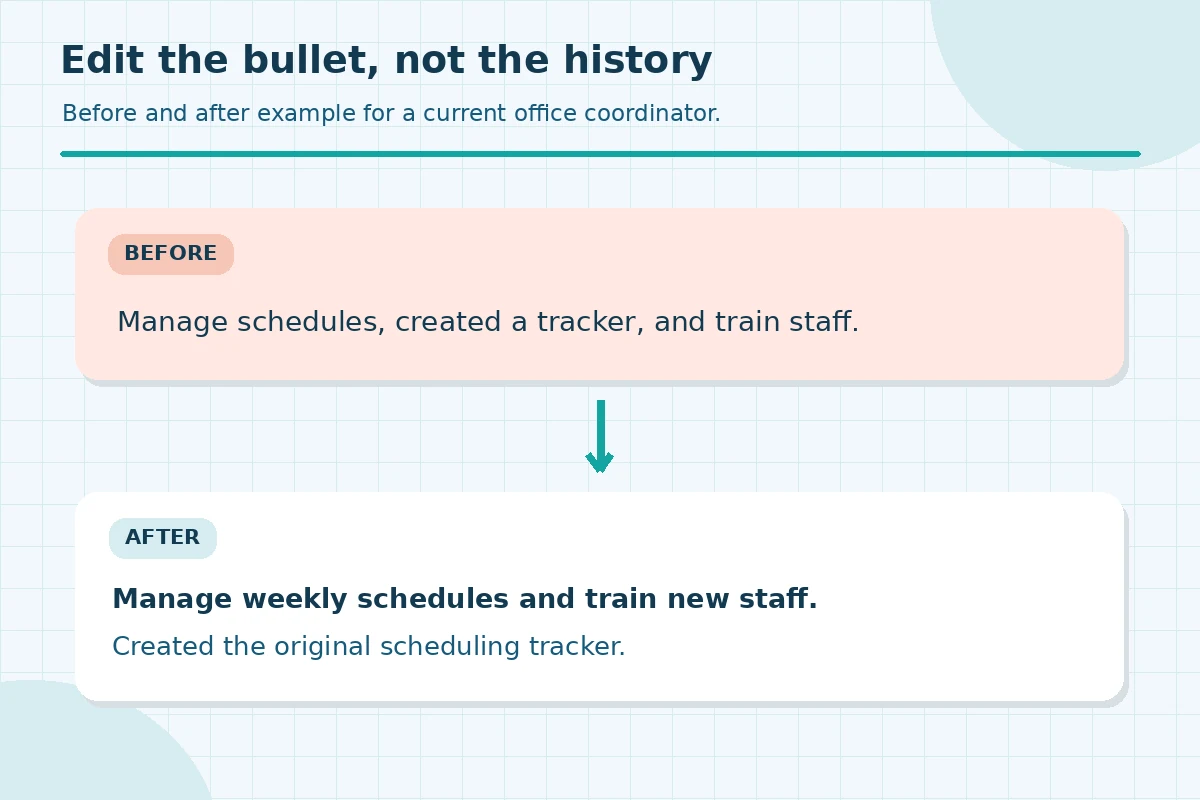
A line such as ‘Manage schedules, created a tracker and train new workers’ joins actions that happened at different times. This is not automatically incorrect grammar, but it is awkward resume communication. Split it into ‘Manage weekly schedules and train new staff on approved checklists’ and ‘Created the original scheduling tracker.’ Each bullet should have one controlling verb and a defined object. This also helps readers distinguish routine scope from project ownership.
Preserve the evidence when you split a line. ‘Created a tracker’ may still be thin if the applicant can describe a more specific purpose such as documenting shift changes. However, do not append an invented improvement percentage or claim a formal approval role that did not exist. Accurate action, context and result when known are better than a dramatic statement that cannot be defended in an interview.
Treat project, internship and volunteer timelines honestly
An internship completed in an earlier semester normally uses past tense, even if the participant still uses skills gained there. A student project that is finished can say ‘Analyzed survey data’ rather than ‘Analyze survey data.’ If the project is still underway, describe the work currently being done and do not announce a final report that has not been delivered. Distinguish progress from finished outcomes using the real status of the work.
Volunteer activities follow the same basic principle as paid employment. Someone who still coordinates weekly community deliveries can use a present-tense verb for that duty. A one-day fundraiser they staffed last year should be described in past tense. Use an appropriate heading that tells the reader whether the work was volunteer, school-based or paid. Changing the verb does not turn an unpaid assignment into formal employment.
Choose verbs that match your actual authority
Tense does not fix an overclaim. If you assembled materials for a manager-led meeting, ‘Prepared briefing materials for manager review’ is safer than ‘Directed executive strategy.’ Similarly, ‘Compiled invoice documentation for approval’ does not imply that you authorized payments. Select verbs based on what you really did, even when a stronger verb appears in the posting. A resume should support qualification review, not decorate tasks with powers you did not hold.
If confidential work is involved, preserve privacy while remaining specific: ‘Prepared monthly project summaries for internal reviewers’ can describe legitimate work without revealing restricted clients. Avoid claims of guaranteed savings, employee ratings or audited performance outcomes when those numbers were not tracked. The verb, supporting object, audience and limits of responsibility should form a claim you can explain from genuine work records.
| Situation | Verb | Why |
|---|---|---|
| Recurring duty at current job | Coordinate | Work continues |
| Finished project at current job | Coordinated | Specific project is over |
| Previous job duties | Coordinated | Position has ended |
| In-progress volunteer duty | Organize | Task continues |
| Completed internship task | Organized | Assignment ended |
Check punctuation, irregular verbs and parallel lines
Resume statements often omit ‘I’ and begin directly with a verb. Within one group of ongoing-duty bullets, use comparable shapes such as ‘Coordinate meetings,’ ‘Maintain records’ and ‘Prepare reports.’ Watch irregular verbs: ‘lead’ becomes ‘led,’ ‘build’ becomes ‘built’ and ‘write’ becomes ‘wrote’ for completed work. A spellchecker may not flag a tense mismatch when both verb forms are real words, so a manual pass is necessary.
Consistency applies to punctuation as well. Georgetown’s career guidance recommends a consistent choice about periods at the end of bullets. Neither adding nor removing a period changes the actual evidence, but unexplained variation distracts the reader. Check the final PDF rather than trusting only the word processor: line breaks and text wrapping can change during export or after a portal converts the document.
Perform an evidence-first tense audit
Review every date range before the bullets. Under each current position, highlight actions that repeat today and accomplishments that are over. Under prior positions, examine lines that still begin with present-tense verbs. Then check projects, volunteer experience and training separately using their own end dates. Finally, split bullets containing two actions from different periods unless the relationship is already unmistakable from the grammar.
Read each edited claim against documents and your recollection of the actual work. A tense tool cannot tell whether a committee still meets or whether a project was actually finished. Ask a knowledgeable reviewer whether each line describes your present duties or a completed deliverable. Correct factual mistakes first; only then make stylistic changes. Keep the reviewed document as a distinct, identifiable submission version.

Give special formats and job instructions priority
Some employer systems require more detail than a concise private-sector resume. USAJOBS currently describes a federal resume that includes job titles, employment months and years, hours per week and specialized experience aligned with the announcement. Its current guidance also imposes a two-page maximum. Those requirements should be checked at application time; they cannot be replaced by a generic tense rule or a convenient resume template.
There is no evidence that a particular verb tense alone guarantees passage through an applicant tracking system. The useful goal is to make the reader’s timeline unambiguous, distinguish ongoing work from completed projects and show truthful qualifications. If a specific employer supplies writing or form instructions, follow them. Tense consistency is one editorial tool, not a substitute for the substance of your experience.
How We Research and Check Resume Guidance
JobAsk compared this question with the supplied WordPress article list, public search results and primary career guidance on November 7, 2026. Examples are hypothetical and do not represent actual applicants or promise any ATS or hiring outcome. Follow the current employer instructions and verify your own facts. Read our affiliate disclosure.
Source: careers.ucsd.edu — UC San Diego Career Center describes tense for current and past duties and evidence-based work bullets.
Source: careercenter.georgetown.edu — Georgetown Career Center recommends concise claims, consistent punctuation and appropriate tense.
Source: www.umass.edu — UMass Amherst Career Center describes what/how/why evidence and verb choice for work bullets.
Source: help.usajobs.gov — USAJOBS explains current federal resume length, month-and-year work dates, job-specific qualifications and plain language.
More Resume and Cover Letter Guides
No. Keep present tense for duties you perform now and past tense for projects or changes already completed within that job.
Yes. Clear mixed tenses can accurately distinguish regular duties from finished achievements under an ongoing role.
Past tense is generally appropriate for duties and deliverables from an internship that has ended, with the actual dates.
Use verbs that reflect your actual responsibility. If the supervisor led, “assisted,” “prepared” or “coordinated” may be more accurate.
No universal outcome can be promised. Focus on truthful details, readable language and the instructions for the particular position.