
Typing speed belongs on a resume when the actual vacancy values keyboarding: records processing, data entry, transcription support, reception, or a clerical role with a stated typing assessment. It is rarely useful in a job that instead prioritizes analysis, management, or specialized credentials. A convincing line records a measured result, identifies what the score measures, and avoids substituting “quick typist” for evidence. Start by reading the posting: if it asks for a typing certificate or an employer-administered test, that instruction takes precedence over a self-reported score.
A typing score is not a personal trait. It is an observation made under particular conditions, with a duration, errors, and a scoring method. On some platforms, words per minute is gross speed; on others the displayed result may be adjusted for mistakes. Typing.com explains its gross-speed formula using five characters as a standard word and separately measures accuracy. You should use the definition reported by the exact test you took rather than silently labeling any result “net WPM.” A score from a two-minute passage is not automatically equivalent to one from a longer employer test.
Identify When a Keyboarding Score Adds Value
Begin with the evidence you already have: a test report, a dated assessment record, or a course result that contains the measured score and its conditions. If nothing is documented, take an appropriate repeatable assessment rather than estimating from memory. Record the platform, date, length, displayed WPM, accuracy, input device and any test restrictions. Do not photograph or publish a test containing confidential customer information. An employer may require its own test regardless of a prior score, so a self-administered practice run is useful preparation, not an official credential.
A short skills line could read, for a hypothetical applicant: “Keyboarding: 58 gross WPM, 97% accuracy, 5-minute practice assessment (October 2026).” The numbers here are illustrative only, not a benchmark and not the result of a real candidate. If the platform does not report whether its WPM is gross or net, write “58 WPM as reported by [assessment name]” rather than inventing a calculation method. A formal verified test can be named when the employer permits disclosure; otherwise stick to a clear source description.
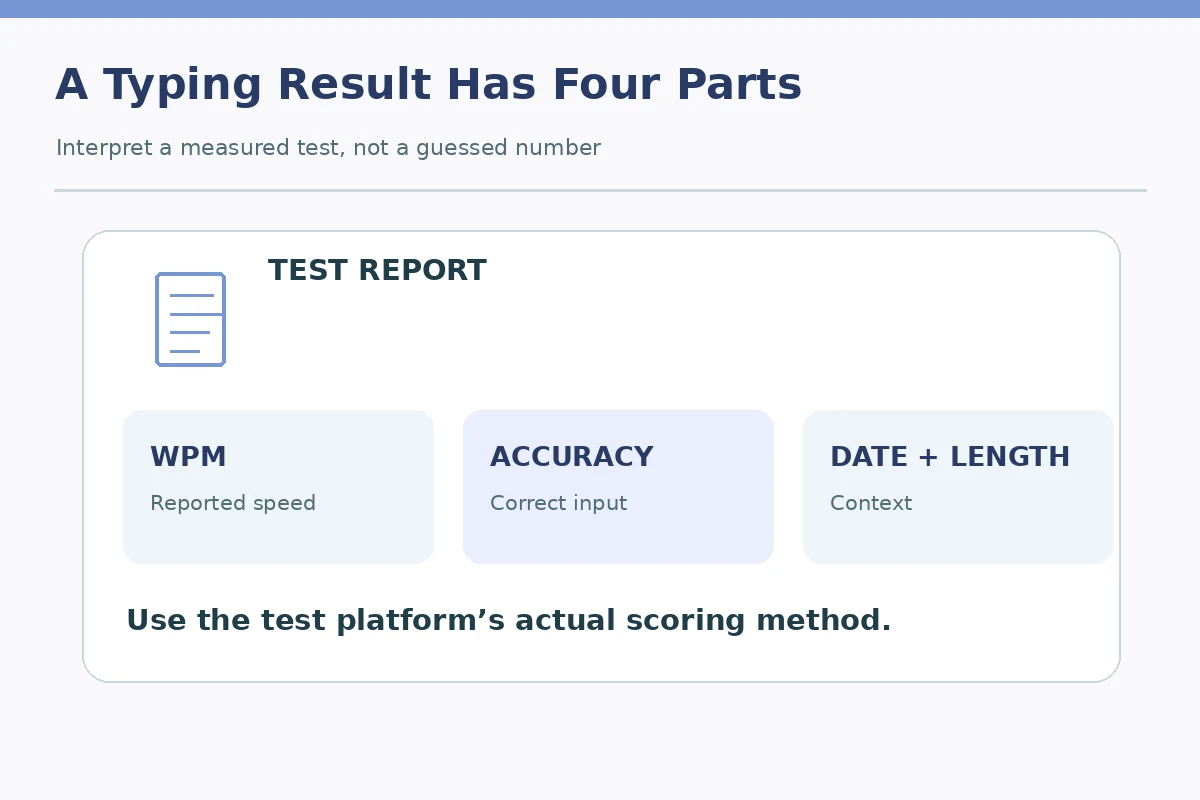
Separate WPM Measurement From Accuracy
Distinguish typing speed from records accuracy. A fast typist can still miskey identifying numbers, dates or addresses. Many office jobs require validation against originals, consistent field formatting and careful handling of personal information. If you have actual experience with an input-and-verify workflow, it may support an additional accomplishment bullet more strongly than a typing speed alone. For example, a candidate might describe comparing keyed records with source documents and flagging discrepancies under a supervisor’s process. Do not invent a low error rate if you did not measure it.
Keep the skill in a simple readable location. On a resume for a clerical position, a Skills entry can sit near proven office tools and recordkeeping tasks. If an employer lists a typing assessment under application requirements, include the result only in the requested field or attachment as directed. For a candidate applying to several roles, make two tailored versions: a clerical resume with a measured keyboarding result and a different resume that gives space to job-relevant projects. The placement matters less than whether the information answers the employer’s actual question.

Write a Precise Skills Entry
Do not use a fabricated screenshot or a paid “certificate” whose reliability you cannot explain. A typing trainer’s report may be a legitimate description of practice, but it should never be represented as an employer proctored test. If an assessment reports both speed and accuracy, report both rather than selecting only the flattering number. If you repeated tests several times, choose a defensible recent result and be ready to reproduce similar performance during an official assessment. Avoid quoting a one-off personal best as typical sustained speed without that context.
Accuracy claims require special care when work involves sensitive records. Type only approved test content; do not practice with exported patient details, employee lists or private account records. A resume can describe experience with controlled data-entry procedures without displaying the actual data. When the job involves transcription or specialized legal or healthcare records, typing speed does not establish subject-matter competence or authorization to process protected information. Keep separate evidence for terminology, training, confidentiality and document-review tasks.
| Evidence you have | Accurate resume treatment | Do not claim |
|---|---|---|
| Employer specifies a typing test | Complete the named assessment | A practice score replaces a required test |
| Practice result has speed and accuracy | Report source, duration and date | Gross WPM means zero mistakes |
| Role does not emphasize keyboarding | Use the space for relevant evidence | Every resume needs a typing score |
Protect Records and Assessment Evidence
Use a practical three-way check before adding the number: the job asks for it, the test is documented, and the result is written precisely. If only the first condition is true, make an assessment plan rather than presenting a guess as fact. If the test is real but the role never needs keyboarding, prioritize stronger skills. If the employer mandates a particular test, follow its process even when you have another certificate. A clear limitation is more credible than an impressive but unexplained speed claim.

A small evidence folder helps after an application. Keep a dated test report you may share, the version of the resume that includes it, and a note about how the testing service calculates WPM. Protect the folder as you would other job-search records. If a recruiter asks whether your result is proctored, answer directly. You can say it was a practice assessment and offer to complete the employer’s test; you do not need a story about a certificate that was never issued.
Review the Final Resume Claim
Before sending the final resume, check that the test date is consistent, no private data appears in the attachment, and the number has not been copied from a different duration or platform. Read the line at normal document size; one concise line is enough. The strongest claim is not necessarily the largest WPM. It is a result the employer can interpret, with enough context to know what was actually measured and whether the applicant can repeat the work accurately.
Where a role mentions a speed threshold, do not infer that it is a universal industry standard. A number in a posting may apply only to the employer’s particular test or working conditions. Read its instructions for duration, permitted corrections, language, and whether accuracy is considered. If the test method differs from your own assessment, present your older result as context, not as proof of passing a new requirement. Keep the test in a separate folder so you can distinguish a screenshot, completion certificate and official employer result.
A careful application can also use a work example to establish what typing speed does not show. Explain how you reconciled source entries, flagged an unclear field, or checked document formatting in an authorized school or office task. This makes the resume more resilient when employers prioritize quality over raw speed. Remove a typing score if it crowds out a clearer example of how you handled records responsibly.
How We Research and Check Sources
We checked the following authoritative references on 2026-11-14 for the specific occupational, assessment or resume-writing points described here: support.typing.com — Typing.com explains its gross WPM measurement and accuracy calculation; other platforms may use different scoring rules. careercenter.umich.edu — The University of Michigan Career Center recommends tailoring a resume and showing skills through concrete evidence. www.onetonline.org — O*NET describes data entry keyer tasks involving entering information and verifying data accuracy. Examples in this guide are hypothetical, not actual candidate test scores, qualifications, credentials, endorsements or employer decisions. Verify the current job posting and any institution-specific requirements before submitting. Read our affiliate disclosure for editorial transparency.
More Resume and Cover Letter Guides
No. Include it mainly when the actual role values keyboarding or the employer specifically requests a WPM figure.
Words per minute. The exact formula and whether errors are deducted depend on the platform or employer assessment.
Not automatically. Label a practice assessment accurately and follow any employer-specific testing requirement.
When the assessment provides them, both are useful because fast entry and correct entry are different qualities.
Do not imply that an isolated personal best is a typical sustained result. Use a defensible recent assessment and its context.