
When reviewing an employee who trains new hires, evaluate the training work they actually performed, not whether every new employee became fully productive. Useful staff appraisal comments describe an observed teaching behavior, the materials or practice it supported, and what happened at the handoff. A trainer may explain an approved procedure, demonstrate it, and flag questions without holding authority to certify a skill or change company rules. The examples below are hypothetical writing models, not evidence about a real employee. Match them to your own review period and the standards in your workplace.
Separate coaching contributions from training outcomes
Start by defining what the employee was asked to do: prepare a checklist, demonstrate a routine, shadow a trainee, answer operational questions, or collect unresolved issues. Those tasks are observable; a claim such as “developed a world-class onboarding program” is not. If the employee only shared an existing guide, record the work as using and explaining an approved guide rather than designing it. If a specialist approved the final procedure, keep that approval with the specialist.
For example, a warehouse trainer may show how to locate a stock item and check a scanner prompt. The trainee may then practice under assigned supervision. The trainer can be credited for clearly demonstrating the workflow and noticing an unclear step, while access permissions, equipment authorization, and performance qualification remain with the responsible manager. This division protects both the reviewer and the employee from inflated claims.
Collect teaching evidence before writing a rating
Use the documented period and task description as your starting point. Useful evidence includes training schedules, versions of approved guides, supervised practice records, questions routed for clarification, and feedback from the assigned supervisor. Check access rules before consulting learner records or individual results. A personal impression after one session does not justify a sweeping rating of an entire review cycle.
A practical evidence note might say that a trainer walked new hires through the receiving checklist, paused for questions, and escalated an incorrect screenshot in the job aid. It should not add a completion rate or training score unless that figure exists and the reviewer may use it. If feedback came through an anonymous process, preserve its confidentiality and describe only authorized aggregate conclusions.

Write recognition that shows what was taught
A strong positive comment ties teaching to a visible contribution: “During the new-hire walkthrough, Jordan demonstrated the order-entry checks using the approved guide, invited trainees to repeat the steps, and sent unclear fields to the system owner for review.” This fictional example credits instruction and a sensible handoff. It does not pretend Jordan approved the trainees or owned the software configuration.
You can strengthen a comment by naming a genuinely documented improvement: a clearer diagram, a corrected instruction, or a question list delivered to the training lead. Do not infer that fewer questions prove better training without a meaningful baseline. Good appraisal language specifies why the action mattered to the next worker and how that conclusion was checked, even if the result is qualitative.
Describe development needs without criticizing trainees
When instruction was uneven, focus on the trainer’s changeable behavior rather than blaming individual learners. A fictional constructive comment is: “Some demonstrations moved to the next screen before practice questions were addressed; a short check for understanding after each stage would make the handoff clearer.” The reviewer should first confirm that the schedule and materials allowed time for those checks.
Another pattern concerns updates. A trainer may use an outdated printed sheet because no updated version was distributed. Before assigning blame, verify who owned version control and whether the new instructions were communicated. Fair feedback distinguishes a missed step under the employee’s control from a process defect, then assigns a realistic improvement action to the proper owner.
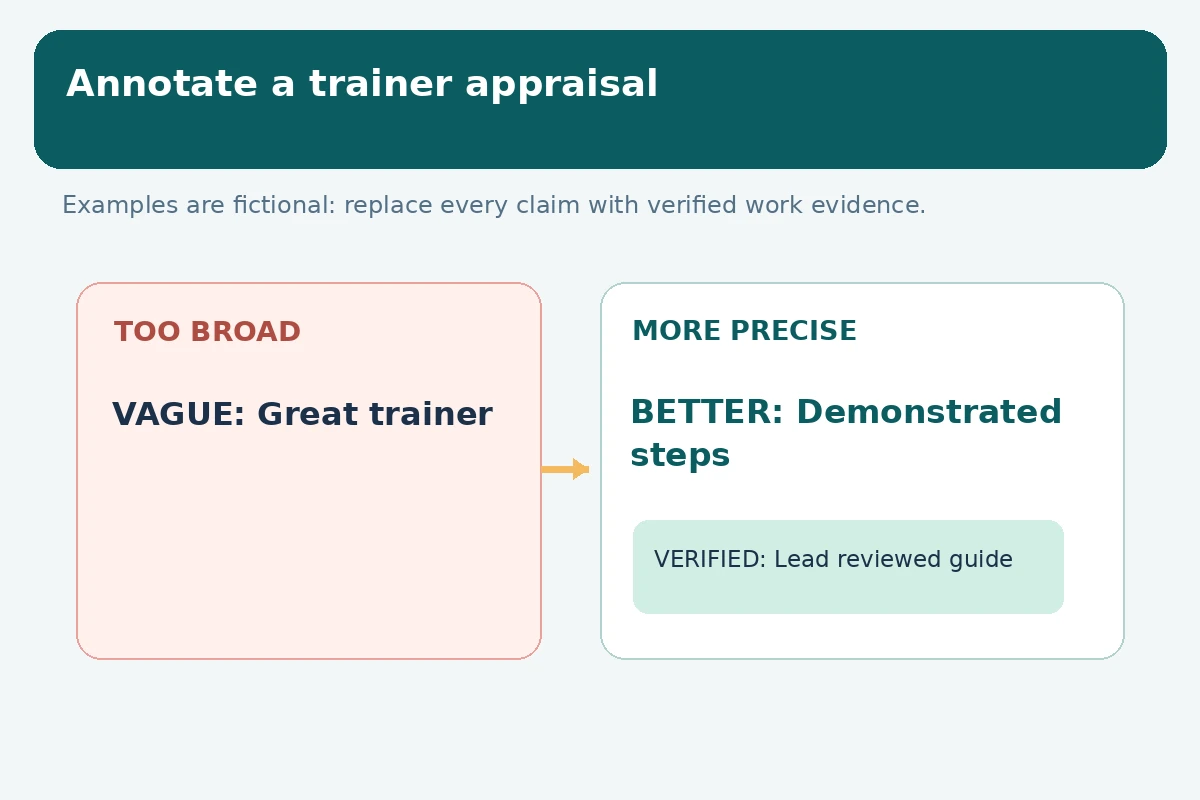
Use a three-level comments comparison
For stronger-than-expected work, cite a specific contribution beyond the stated routine, such as identifying a confusing step and coordinating its approved correction. For work meeting expectations, describe consistent preparation and clear instruction without adding an unearned superlative. When improvement is needed, state the observed gap and the practical support or checkpoint that would address it.
The organization’s actual rating labels and standards control the formal result. These examples are writing patterns, not universal scoring thresholds. If no training responsibilities were in the employee’s agreed job expectations, avoid quietly introducing a new requirement at year-end. Discuss whether this contribution belongs in a development conversation, a revised role description, or a future review goal.
| Review focus | Example evidence | Important limit |
|---|---|---|
| Demonstration | Observed walkthrough using approved materials | Do not call it formal certification |
| Practice | Trainee rehearsed steps with assigned supervision | Do not infer independent readiness |
| Guide updates | Trainer flagged confusing instructions | Owner must approve revisions |
Create a realistic next-cycle training action
Choose one action the trainer can own and one verification that the supervisor can observe. A useful next step could be to use the approved demonstration checklist in the next onboarding cycle, record confusing points for the document owner, and confirm with the training lead that updates were reviewed before reuse. This is narrower and more practical than a blanket demand to “improve communication.”
Ask the employee what obstacles affected instruction: missing access, overlapping assignments, conflicting documentation, or insufficient supervised practice time. Record any management support required. The action is not complete merely because it appears in a review form; the owner and follow-up date should be confirmed through the organization’s actual performance process.

Check confidentiality and authority before submission
Remove new hires’ private information, invented scores, and unsupported statements about capability. Use permitted training records, not copied personnel files. Where onboarding touches regulated, safety-sensitive, clinical, or financial work, describe the employee’s coaching activity without implying that they certified another person to perform restricted tasks.
Before finalizing, read the comment as if the employee and a neutral manager would both see it. Could each point to the behavior, verify the relevant task, and understand the next step? If the evidence is incomplete, ask for clarification rather than filling the gap with praise or criticism. The goal is accountable feedback that can improve the next onboarding cycle.
How We Research Fair Performance Reviews
We compared the U.S. Office of Personnel Management’s guidance on clear, verifiable standards and continuous performance conversations with the EEOC’s advice on consistent, factual evaluations. University of Wisconsin–Madison’s HR writing guide provides a useful model for observable behavior and balanced comments; it is institutional guidance rather than a rule for every employer. Each scenario on this page is hypothetical and must be adapted to verified facts and applicable workplace policies. We do not claim any particular rating, pay result, promotion, or legal outcome. For our website disclosure see affiliate disclosure.
Research sources: OPM performance standards; OPM supervisor roadmap; EEOC evaluations; UW–Madison writing guide. Review employment standards, confidentiality rules, and the actual task ownership with your employer before reusing any example.
Frequently Asked Questions About This Review
Explore Related Career Guides
Only when you can verify the employee’s contribution and the authorized qualification decision. Describe coaching separately from formal clearance.
Recognize the actual contribution while checking the role expectations. Do not retroactively claim they held a formal trainer title.
Use only information permitted for the appraisal. Avoid identifiable trainee details when a description of the workflow is sufficient.
Specify the observable moment, relevant expectation, and realistic change. Check whether inadequate materials or timing contributed.
No. Credit use, clarification, or proposed edits unless records show the employee created and owned the material.