
A good STAR answer does not require a percentage. If your result was a signed-off document, a completed handoff, a verified correction or an improvement you directly observed, explain that precisely. STAR ends with Result, but Result means what happened after your action—not what you wish you could claim. Numbers are useful only when you have a reliable basis for them and can explain their relationship to your work.
This guide focuses specifically on results when measurements are missing, confidential or not attributable to one person. University of Washington encourages concrete outcomes where possible, while USC and Harvard emphasize real examples and learning. Use an evidence ladder to choose the strongest result you actually know rather than estimating productivity, inventing praise or attributing a department-wide outcome solely to yourself.
Separate an Output From a Later Business Outcome
An output is the thing you directly produced: a clean handoff document, a corrected calendar, a tested change, a training checklist. A later outcome is the broader effect, such as fewer support requests or faster processing. Those are not automatically the same. A hypothetical assistant who updated appointment instructions may know the document was approved but have no evidence that no-shows declined. The approved document is still a legitimate Result.
Describe the level of evidence you possess. “I drafted revised instructions; the coordinator approved them for distribution” identifies a completed action and a verifiable approval. “Reduced missed appointments by half” would require an actual comparison, a date range and credible attribution. If you have not seen those records, omit the claim. Interviewers can evaluate useful behavior without a fabricated KPI.
Use a Four-Rung Evidence Ladder for the Result
Start with the most direct rung: what you personally delivered or handed off. Next, note confirmed acceptance or feedback you actually received. Third, include an observable later change only if it was recorded or directly witnessed. The fourth rung is a boundary, not a failure: name what you did not track or could not know. This keeps the story accurate even when impact measurement belonged to another team.
For example, a fictional volunteer might say the revised sign-in guide was used at the next event and that the volunteer lead confirmed it was easier to follow. If no such feedback existed, the story should stop at what the volunteer prepared and handed over. Do not recycle sample praise as a real quote. Specific, modest outcomes usually beat a big unexplained figure.
| Result type | Honest example | Do not claim |
|---|---|---|
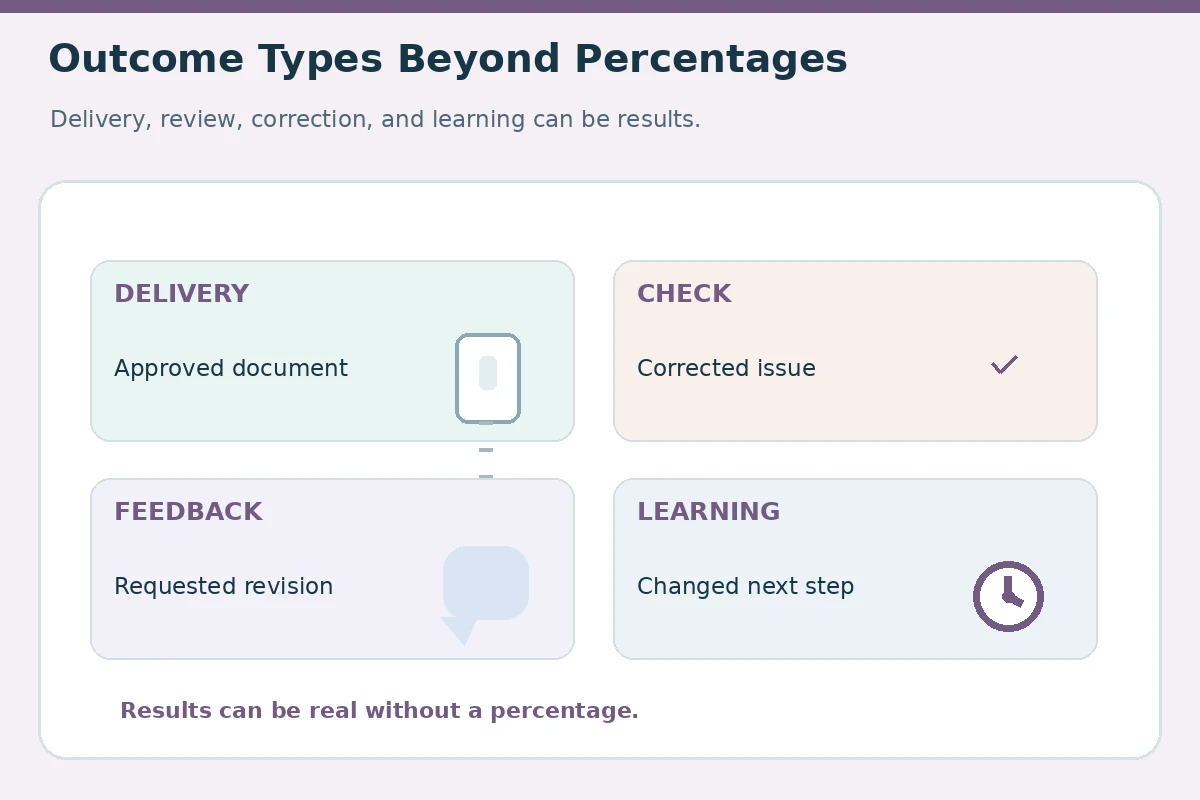
| Deliverable | Approved handoff checklist | Measured efficiency gains |
| Feedback | Reviewer requested a revision | Universal praise |
| Observed change | Corrected schedule was sent | Unknown downstream effects |
| Unknown result | Final impact not tracked | Estimated percentages |

Explain Quality Checks Instead of Pretending to Know Savings
Quality results can be described as checks completed, discrepancies found, a review passed or a mistake corrected, if those events truly occurred. A hypothetical office intern who compared two schedules and flagged a conflict could say, “The supervisor corrected the calendar before invites were sent.” That reveals a preventive action even if there is no valid estimate of hours saved.
Avoid absolute declarations such as “zero errors” or “perfect accuracy” unless a real audit supports them. If an issue was found after the fact, say what the review caught and how you responded. A useful answer traces what information you had, how you checked it, who had approval authority and what happened to the work. That is more concrete than a vague claim that everything ran smoothly.
Mention Feedback Only When It Was Actually Given
Real feedback can provide a result: the client accepted a draft, a teacher requested one revision, or a teammate confirmed receipt of the handoff. Name the source and context at an appropriate level without disclosing confidential identities. If the feedback was mixed, report that honestly. “The reviewer asked me to simplify the instructions, so I revised them” can show responsiveness and follow-through.
Do not invent a glowing review or paraphrase a neutral message as an award. Distinguish “someone thanked me” from “the project achieved its target.” Approval indicates a deliverable moved to the next step, not necessarily that the whole initiative succeeded. If a manager supplied the final result, you can credit them without claiming sole ownership. Precise feedback creates space for a thoughtful interviewer follow-up.
Handle an Incomplete or Negative Result Without Spin
Some real stories end with an unmet deadline, an unresolved issue or a rejected proposal. A STAR answer can still be informative when you name the consequence and what you changed afterward. Consider a fictional student whose survey plan received no responses: the first attempt did not generate usable data; the student met the instructor, revised the outreach wording and documented the limitation. That is not a hidden success, and it should not be sold as one.
USC career guidance advises discussing failures through what you learned and subsequently applied. If you changed a practice later, give a true second example or state clearly that the change is a plan rather than a verified result. Do not blame other people or conceal your role in the difficulty. An honest answer can demonstrate accountability even when the final outcome was not ideal.
Check the Link Between Your Action and the Claimed Result
Before telling the story, ask who else acted, when the result occurred and whether the outcome was measured. Perhaps your team deployed a new template, but several colleagues revised it and you only drafted the first version. In that case, explain your contribution and the team’s final result separately. If an interviewer asks whether you independently improved performance, you should be able to answer without speculation.
Use a short final sentence: “My part was the verified checklist; I did not track the downstream processing time.” That is not apologetic; it marks the boundary of your knowledge. Avoid sharing private dashboards, customer records or sensitive documents to demonstrate a metric. The useful proof is a credible narrative of how you worked and what can be verified, not an invented number with a precise decimal.

How We Research Interview Story Guidance
We reviewed the cited primary career-center and government sources on 2026-11-14: UW STAR career guide — University of Washington defines the four-part STAR framework and recommends putting the greatest emphasis on personal actions.; USC interview preparation — USC Career Center recommends preparing several real experiences and being ready for clarifying questions, including imperfect outcomes.; Harvard FAS interviewing — Harvard career guidance emphasizes concise specific experience, personal role, relevant results and learning, including examples outside paid work.. We also compared this narrow interview topic with the supplied WordPress post-title export and existing JobAsk STAR and behavioral-answer guides to reduce overlap. All candidate stories and suggested responses are fictional illustrations unless explicitly attributed to a cited source. The frameworks are coaching structures, not employer-wide scoring rules or hiring promises. Read our affiliate disclosure; no partnership or paid recommendation is claimed.
More Interview Preparation Guides
No. Numbers can help when real, but a specific observed outcome or legitimate lesson can also be useful.
State the deliverable, review or known handoff. Explain that later impact was not measured by you.
Only describe genuine feedback you actually remember; do not upgrade thanks into formal performance evidence.
Describe the consequence, your role, what you learned and any later change you can substantiate.
Separate your contribution from shared outcomes and mention others’ work when relevant.