
A team lead cover letter should show a real instance of helping colleagues, coordinating coverage or handling an escalation within your actual authority. Avoid simply saying “natural leader” or claiming you managed a team when your responsibility was peer support. The best example identifies the work problem, your assigned role, the specific action you took and the outcome you actually observed.
This page concentrates on the boundary between contributing to team success and holding formal supervisory authority. Penn and UW career advice recommends specific stories rather than adjectives; Michigan emphasizes connecting the example to the job requirements. Use that approach to distinguish training, handoffs, decision making and escalation. The examples here are fictional; your letter should use only facts from your own work.
Match the Level of Leadership in the Vacancy
Read the posting for whether the team lead schedules work, coaches new hires, checks quality, handles customer escalations, approves adjustments or reports to a manager. These powers are not automatically part of every job with “lead” in its title. If you have worked as a senior teammate without direct reports, say so. Your evidence may still show readiness, but do not invent personnel authority, performance ratings or responsibility for formal discipline.
Write down two requirements and one real example per requirement. For a fictional warehouse lead posting, a shift handoff and new-worker instruction could be relevant. For a customer support lead posting, queue prioritization and escalation documentation might be stronger. Choose examples that fit the actual operation. A statement about running every aspect of a team is less useful than one task with clear responsibilities, collaboration and limits.
Show Coaching Through Observable Actions
Coaching is not just being friendly or telling others what to do. Describe a specific support action you actually performed: demonstrated an approved procedure, checked that the colleague understood a checklist, answered questions and directed uncertain cases to a trainer or manager. A hypothetical example is: “Guided two new volunteers through the event check-in checklist and sent process questions to the coordinator.” Do not reuse it as your own story unless it truly happened.
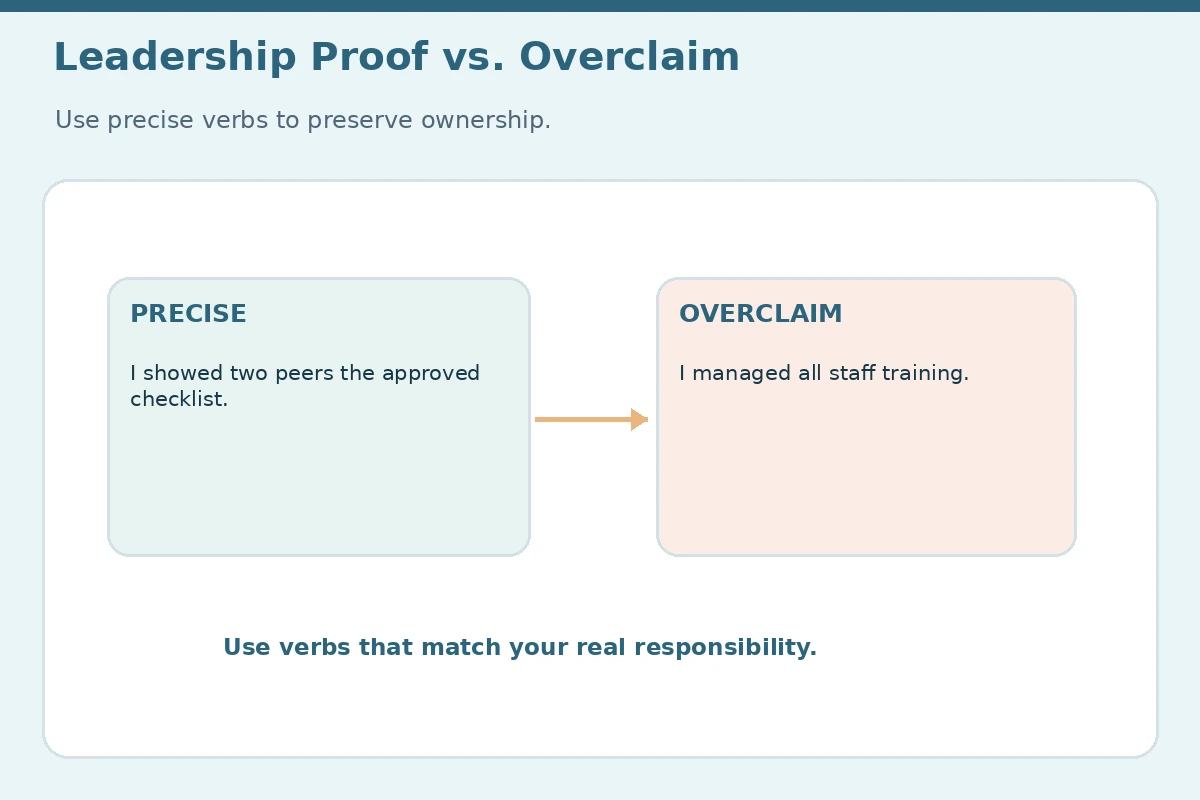
If you helped train new employees but were not the designated supervisor, write “supported onboarding” or “showed new teammates the approved workflow” rather than “managed employee training.” If an authorized manager signed off readiness, include that boundary. Avoid claiming that the people you helped later improved performance by a certain percentage unless reliable data exists and you can appropriately share it.
| Leadership area | What you did | Avoid claiming |
|---|---|---|
| Coaching | Demonstrated approved steps | Formal certification without authority |
| Coverage | Tracked gaps and notified owner | Unapproved schedule changes |
| Escalation | Routed exceptions with notes | Decisions held by a manager |
| Result | Confirmed handoff or review | Guessed team performance gains |

Explain Coverage and Handoff Decisions
Team leads may help distribute work across shifts or track coverage. Provide a real example of checking the roster, recording an absence, finding the designated backup or alerting the authorized scheduler. If you could not approve a schedule change, do not say you made one. A useful sentence is: “Maintained the shift handoff note and alerted the supervisor to an uncovered service window.” The result is clear even without a numerical claim.
Explain why the action mattered. A handoff note might give the next worker the open tasks, owner and due date. A queue review may identify requests that need escalation rather than guess at an appropriate resolution. Keep your letter free of employee names, private performance observations and other confidential team data. Describe the workflow, not individual coworkers’ personnel issues.
Clarify What You Could Decide and What You Escalated
A credible leadership example distinguishes day-to-day judgment from approval authority. Perhaps you prioritized a documented queue according to the supervisor’s rules but did not approve refunds, hiring decisions or safety exceptions. Say what you decided, on what basis and to whom you escalated an out-of-scope issue. This gives the interviewer a specific line of questioning and protects you from overclaiming.
Compare “resolved every complaint independently” with “reviewed the issue log, handled requests allowed by the service guidelines and referred exceptions to the duty manager.” The latter is more defensible when accurate. For regulated, hazardous or credentialed work, a cover letter should never imply that coaching or a lead title substitutes for training, licensing or independent authorization. State your true operational role.

Build the Opening Around a Leadership Need
Use the opening to name the team lead role and the most relevant kind of responsibility. Your middle paragraph can illustrate coaching, and a second paragraph can show coverage or escalation judgment if those are core requirements. Give one brief outcome you can confirm, such as a completed handoff, reviewed checklist or documented schedule adjustment. Do not turn a cover letter into a catalogue of every workplace anecdote.
A fictional opening is: “I am applying for the shift team lead role because my experience coordinating service handoffs and supporting new teammates aligns with the responsibilities in your posting.” The evidence paragraph must then make that statement true. Avoid “my leadership transformed the culture” unless you can explain what changed and how it was measured. A concise, accurate example gives the employer a stronger basis for discussion than an unsupported superlative.
Check Ownership, Results, and Team Privacy
Before submitting, underline every leadership verb: led, trained, approved, managed, improved, supervised. Ask whether you really held that responsibility and whether a colleague, manager or the whole team should receive credit for the result. Replace broad verbs when necessary. If your title was not team lead, do not rename it; explain the leadership-type task in a true role context instead.
Remove private performance records, staff names, shift access details and customer cases. Verify the vacancy title and employer, then check that the letter matches your resume’s actual dates and reporting level. Save and inspect the final file or pasted text. The goal is a clear case for readiness: you recognize the work, can point to a decision you really made and know when escalation belongs to someone with greater authority.
How We Research Cover Letter Advice
On 2026-11-14, we checked these primary career-center or federal consumer-information sources: Penn Career Services: Write a Cover Letter — Penn advises tailoring each cover letter to the organization and role, choosing concrete examples rather than copying the resume and avoiding unsupported superlatives.; UW Career Center: Cover Letters Getting Started — UW Career Center recommends connecting relevant work to the job in body paragraphs with specific examples, in a concise business-letter format.; Michigan Career Center: Cover Letters — University of Michigan describes using opening, evidence paragraphs and closing to connect skills and employer needs.. We compared this focused topic against the supplied WordPress title exports and the immediately preceding draft packages. Examples are clearly hypothetical and must not be claimed as personal history. Our example frameworks are editorial tools, not employers’ required formulas. Consult the relevant job posting for actual requirements. Read the affiliate disclosure; we make no claim of sponsored placement or affiliate approval.
More Resume and Cover Letter Guides
A posting may accept related experience. Describe your real peer-support, scheduling or escalation work and check the stated requirements.
It can be, if you explain what you taught, the approved process and whether a supervisor verified readiness.
Credit the team for shared outcomes and identify the work and decisions you personally handled.
Only if you actually had that authority. Otherwise say you identified the conflict and escalated it to the authorized decision-maker.
Use confirmed outputs such as a completed handoff, updated roster or reviewed onboarding checklist rather than inventing a rate.