
A CNC operator resume objective should show the shop what you can already verify: measurement practice, production records, relevant training, or experience following approved procedures. It should not blur the line between operating, setting up, and programming machines. That distinction matters because a person who has inspected parts or watched a machining demonstration may be a credible trainee without being qualified to edit code or change offsets. Name the target machine-operation role and one truthful form of evidence.
Decide whether an objective belongs at the top
An objective is optional, not an obligatory field or a magic signal to an applicant-tracking system. A University of Oregon career-center example treats the objective as a concise statement of the type of job sought. For CNC operator applicants it is most useful when a previous role looks different from the target, when you are entering an unfamiliar workplace, or when you need to specify the position rather than a broad industry. Put it below your contact information, keep it short enough to read quickly, and let the later experience section supply proof. If the resume already shows direct, substantial experience, a qualifications summary may work better.
Write the target as a real hiring position, not a personal life goal: CNC operator at a manufacturing or precision machining shop. Immediately connect it to a contribution you can already substantiate: measured inspection, production documentation, and trained machine operation. Avoid language such as ‘seeking a chance to improve myself’ because it does not tell the reviewer what work you can help perform. Also avoid invented outcomes, such as fabricated savings, flawless rates, or promises to pass screening software. A specific statement does not need a statistic; a modest, accurate description is more valuable than a dramatic unsupported number.
Separate real tasks from future responsibilities
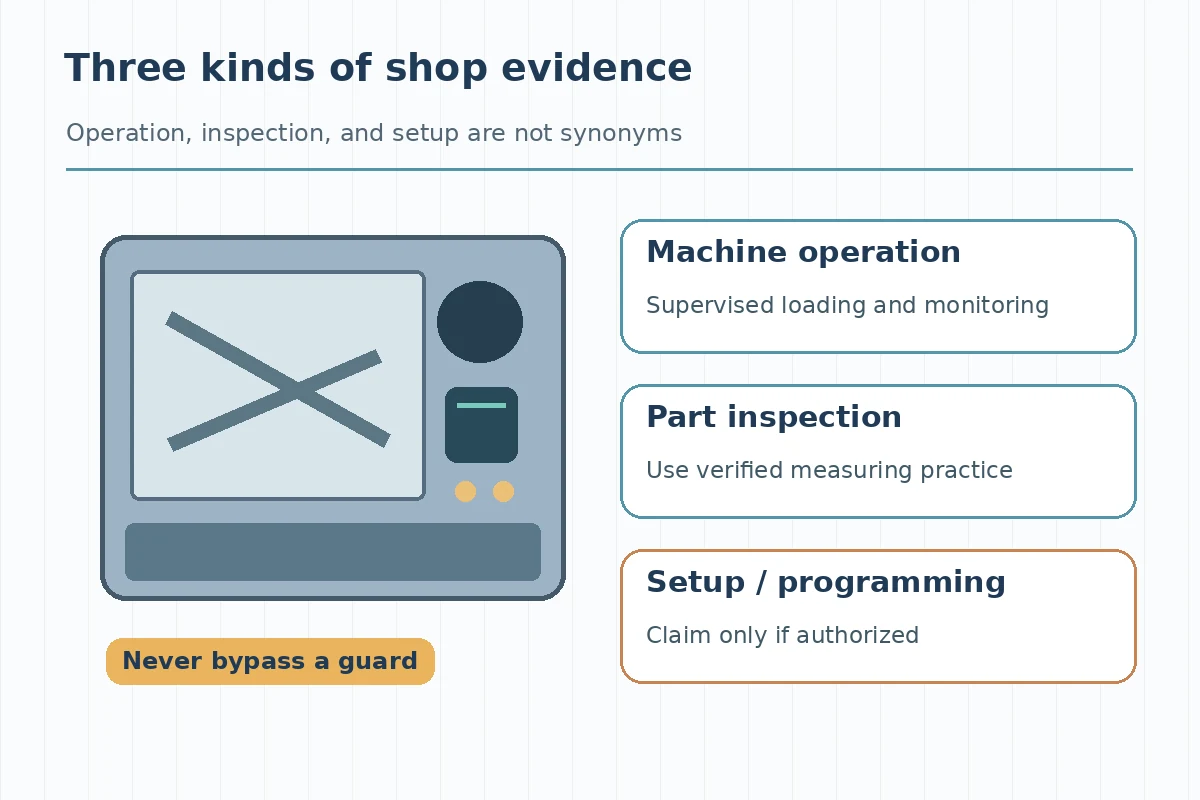
Watching CNC operations or completing coursework does not establish authorization to set offsets, edit programs, or bypass guards. Separate operation, setup, and programming experience. Read the precise posting: operator, setter, and programmer can be different jobs. Match requirements for measurement tools, drawings, inspection frequency, and shift records; verify whether an employer trains new operators. Safety language should describe trained procedures, not boast about bypassing a stop or adjusting guards.
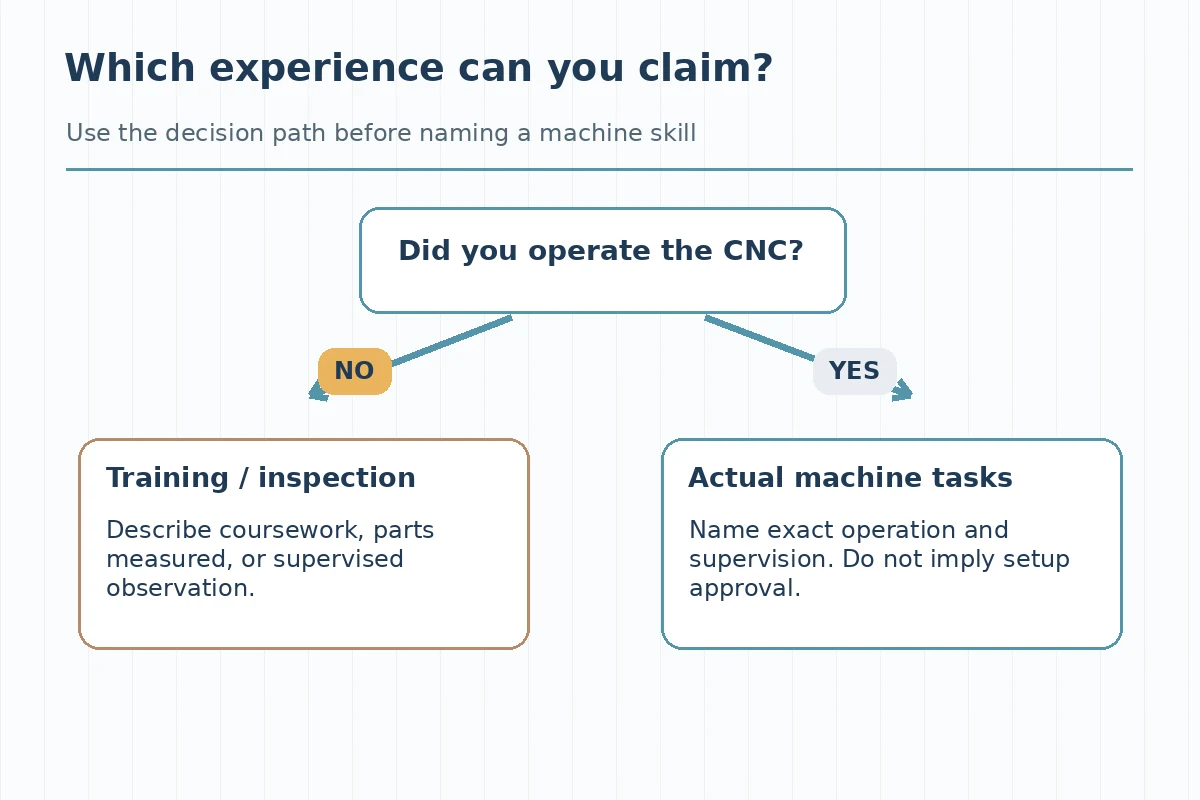
Start with a two-column note. On the left, copy the posting’s specific task words, such as caliper practice or first-piece inspection. On the right, record the setting in which you performed anything comparable and who verified it. If you have only watched someone complete a task, label the experience as observation or training. If you do not have evidence, remove the claim from the objective or recast it as an interest in learning the posted procedure. This distinction is especially important because a concise objective is often the first thing an employer notices.
Translate transferable experience without exaggerating
A quality inspector may understand measurement and inspection records without having set tools or changed machine offsets. Use that strength rather than upgrading inspection work to CNC setup experience.
A useful transfer statement pairs a familiar task with a new role rather than swapping one job title for another. For instance, someone who has genuinely performed caliper practice or job travelers can show the habits that matter: following instructions, recording information accurately, and telling the right person when something is outside scope. A professional does not need to pretend an earlier job was identical to the vacancy. Instead, explain which task was yours, what tool or document was involved, and how the next worker or customer received the result.
Compare weak and evidence-led objective statements
The following statements are hypothetical writing illustrations, not an employer endorsement and not a claim about your experience. The weak version is: “Expert CNC programmer who can run any machine, looking for a position to learn CNC.” It makes the candidate’s wishes or unverified authority the center of attention. A more precise first draft is: “Manufacturing trainee seeking a CNC operator role, with supervised caliper practice, blueprint-reading coursework, and careful production-record habits.” It identifies a target, relevant evidence, and a manageable contribution. Another valid starting point for a different background is: “Production associate with documented part-inspection and job-traveler experience seeking CNC operation training under established guarding and setup procedures.” Copy neither example blindly; change the words until each experience claim is literally true for you.
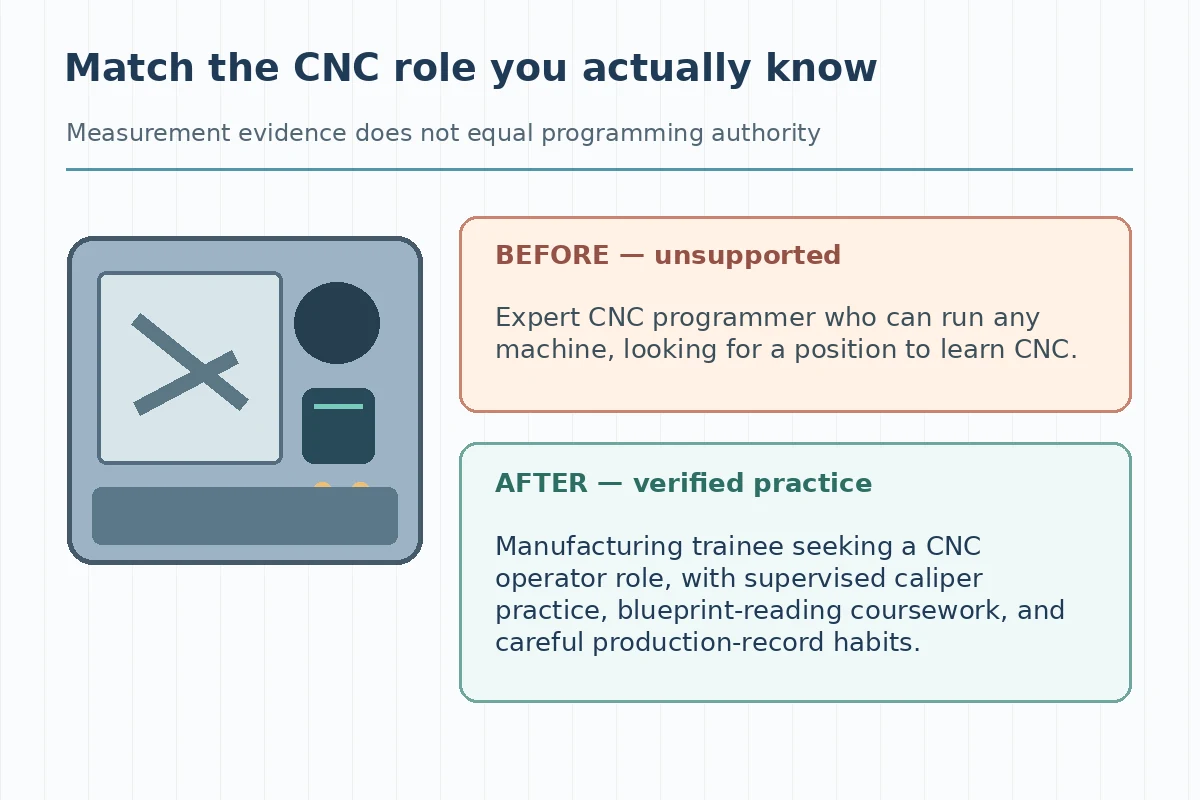
Consider a fictional shop helper who checked dimensions with a calibrated tool under supervision. That worker has relevant inspection exposure, but it does not make them a CNC programmer or an authorized setter. This is also a useful test for whether the objective should be written at all. If all available evidence is unrelated, you may do better with a short skills section and an honest training entry. Conversely, if the two most important abilities can be explained naturally in one sentence, you probably have enough for a targeted objective. Do not paste a large list of keywords into that sentence; make it readable aloud to someone who does not know your background.
| Overstated wording | More defensible alternative |
|---|---|
| Expert programmer | Read CNC basics in coursework |
| Set all machine offsets | Measured parts under supervision |
| Never need a safety check | Follow approved guarding checks |
Match the vacancy and keep the evidence consistent
Use the job advertisement as a filter. Highlight what is actually requested, then rank your verified evidence from closest to farthest: caliper practice, first-piece inspection, job travelers, machine-guard awareness. The objective should name only the strongest one or two. Put details such as work dates, actual systems used, coursework, supervision, and quantified results—if real—in the sections below. If the ad asks for a credential you do not hold, an objective should not imply that you already have it. If the vacancy is unclear about authority, save that question for the recruiter rather than guessing in the resume.
A training log, coursework outline, or non-proprietary sample measurement record can support a claim. Never include proprietary shop drawings, customer specifications, or control programs without permission. A resume is not the place for confidential operational records. You can describe the process in neutral language and still demonstrate a method. For example, name the checklist you followed or explain how you knew when a record was ready to hand off. Where a result can be verified from legitimate records, use a modest factual count; where it cannot, omit numbers completely. Never borrow a coworker’s outcome, use a fake certification, or claim a result simply because it is common in industry sample resumes.
Edit the objective in a short focused pass
First, write the exact position at the top of a scratch page: CNC operator. Second, circle one task from the posting for which you have direct evidence. Third, add one supporting skill such as caliper practice, first-piece inspection, or job travelers only if it reflects your actual work. Fourth, read the sentence aloud and delete soft adjectives that cannot be tested. Fifth, check that the work history and education sections support the claim. The objective should normally remain one to two sentences; a third is rarely necessary to clarify a manufacturing or precision machining shop.
Next, ask three practical questions: Which machine did I use? Was it supervised? Did I only measure parts, or did I actually perform approved setup steps? If any answer creates a contradiction, revise the sentence before applying. A credential, tool, or job title is not made true by repeating it in a headline. Consider asking someone familiar with your work to read the objective without the rest of the resume and tell you what duties they would assume you performed. If that assumption overstates your scope, rewrite with an exact verb such as assisted, recorded, checked, routed, or practiced.
Know when a different opening is stronger
Not every CNC operator resume needs an objective. If the first line would repeat a job title already visible immediately below, replace it with a brief qualification summary or begin with experience. If you are changing careers, use the objective to explain the direction once, then prove relevant tasks through work, volunteering, projects, or training. Do not manufacture a narrative about lifelong passion; the reader mainly needs to know whether you can perform useful parts of the advertised work, learn the rest through authorized training, and communicate reliably.
Before exporting, check the final file as the employer will see it. Keep the objective as ordinary selectable text, use an unambiguous heading if you keep one, and confirm that job titles and dates below do not contradict it. Read the PDF in order, especially if a template uses text boxes or side columns. Use the requested file format from the posting. An applicant does not need to claim that any particular format guarantees a passing score; a clean, truthful document is the goal.
How We Research These Resume Examples
This guide uses occupational task descriptions rather than fabricated employer outcomes. BLS distinguishes machine setters, operators, CNC programmers, inspections, and different training pathways. OSHA emphasizes safeguards and specific machine-operator training. The University of Oregon career-center example treats the objective as optional and specific. We checked the official sources on November 7, 2026; individual job postings, workplace procedures, and credential requirements still control your application. The sample lines are invented and explicitly illustrative. We do not claim to know whether a particular hiring system will shortlist you.
Sources checked: BLS occupational guidance · OSHA machine safety guidance · University career-center resume guidance. For editorial transparency, see JobAsk affiliate disclosure; no affiliate or employer relationship is implied here.
Frequently asked questions about this objective
More Resume and Cover Letter Guides
No. CNC operation and programming can be separate jobs. Match the specific posting and accurately identify training or hands-on exposure.
Yes, if it occurred. Identify it as coursework or supervised practice rather than an employer production result.
Only if you performed authorized adjustments. Otherwise state an interest in training and describe your existing measurement skills.
Use quality checks, records, blueprint familiarity, or safe production procedures from your actual work.
It can when relevant, but support it with real training and keep details of guards, setup, and maintenance responsibilities accurate.