
A manager does not have to remain at your former workplace to be a credible professional reference. If they directly supervised your work and agree to be contacted, you can list their current title and contact information while making it clear that they managed you at a different organization or during an earlier period. The main mistake to avoid is placing the manager’s new employer next to your old job in a way that implies you worked there. This guide provides a two-time-frame example and a verification workflow, not a claim that every employer accepts every type of reference.
Separate where the manager works now from where you worked together
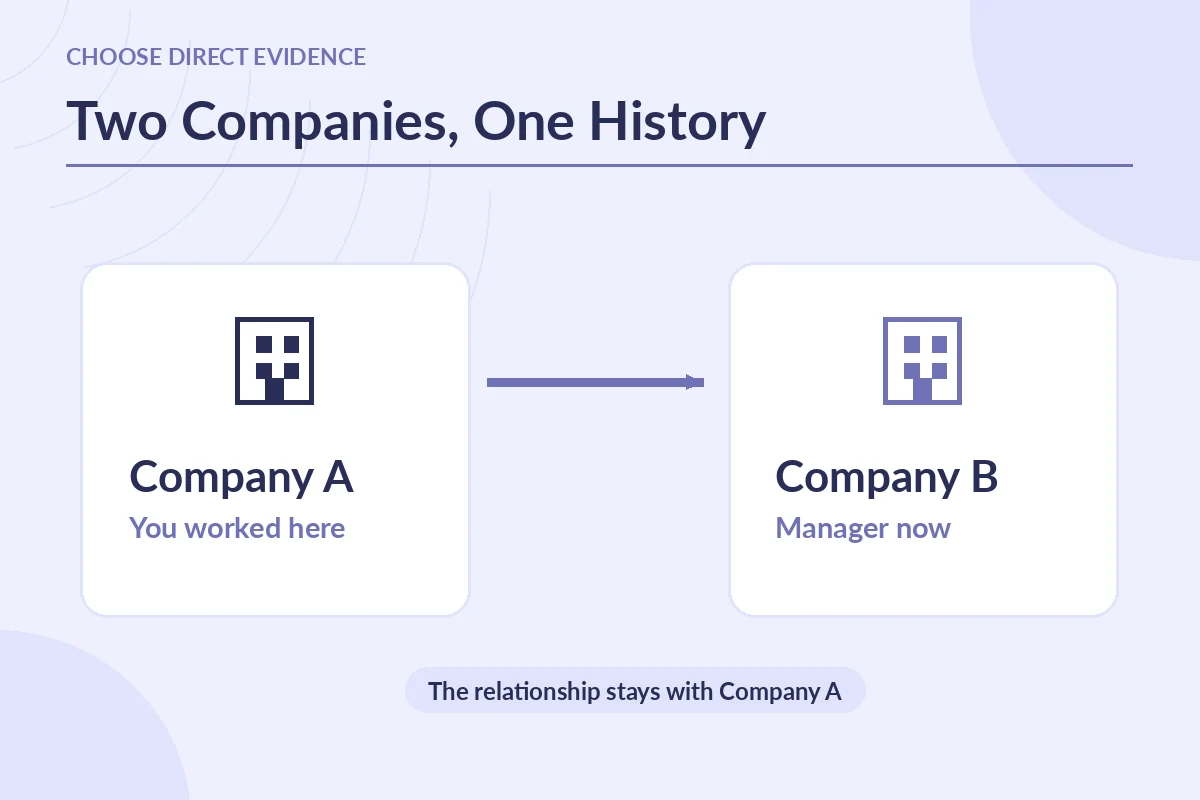
A reference entry contains two different facts: the person’s current professional identity and their relationship to you during a past job. If Elena, an invented supervisor, now works at Company B but managed you at Company A, do not write ‘supervisor at Company B’ without context. That makes the reporting connection ambiguous. Instead, identify ‘Current title at Company B’ and ‘Former manager at Company A, [actual dates].’ This gives the recruiter a usable name and a truthful history.
The historical role matters most for judging relevance. The manager might have watched you handle scheduling, client support, quality checks, or team coordination at the former workplace. Their new company has no reason to verify those events and should not be treated as your employer. Use the actual former company and title only when the facts are accurate; the example names here are fictional placeholders for illustrating a format.
Ask whether the person still feels able to serve
A former manager may be pleased to help, but a verbal offer years ago is not current consent. Send a short request naming the work you did together and the job type you are seeking. Ask whether they are still comfortable describing your performance and whether their present organization’s policies permit them to give references. Do not treat a connection request, public recommendation, or social-media ‘like’ as permission to distribute contact information.
If they reply that they only provide employment dates, clarify whether that is enough for the employer’s stated request. For a performance reference, consider someone else who knows the work more fully. A manager’s willingness to verify facts is not the same as agreeing to recommend you. Respect a decline without asking a person to invent observations they cannot recall.
Confirm a current contact method rather than guessing
The old company email may have been disabled when your manager left. Ask which email address and phone number they wish to use, and spell-check them before preparing your list. If the manager prefers a personal email, confirm that they are comfortable receiving recruiter messages there; it does not need to impersonate an organizational address. Never guess an email based on a new company domain or forward job applications to an outdated mailbox.
Make a note of when they granted permission and whether they want advance warning of calls. Some job portals expose reference details to several recruiters or providers, so share only through a legitimate secure channel. Do not publish a former manager’s phone number on your website or resume. Keep a private updated version of the reference sheet.

Write a clear two-line relationship description
A fictional example can be formatted like this: ‘Elena Rivera — Operations Lead, Company B (current position). Former direct supervisor, Company A, 2021–2023. Email and telephone: supplied with permission.’ This differentiates what is true today from what happened in the past. If a form allows just one ‘company’ field, use its help text to determine whether it asks for the referee’s current employer or the company where you worked together.
When the form cannot capture both, provide a truthful clarification in the relationship or notes field: ‘Managed me at Company A; now employed at Company B.’ If there is no notes field, ask the hiring team how to present the information rather than placing a knowingly misleading answer. A short accurate label is more useful than a visually sophisticated reference sheet that obscures who employed whom.
Match the reference to the claimed experience
Recruiters may ask how the manager knows you, what projects they oversaw, how long you worked together, or which results were personally verified. Make sure your resume lists employment dates and scope that the manager could actually recognize. If you have since gained new skills, do not expect a former supervisor to evaluate work that happened after you left their team. Choose another reference for recent work where necessary.
A useful preparation note identifies one relevant assignment the manager saw, an accurate deliverable, and a job requirement it may demonstrate. Share these details as reminders rather than instructions for a scripted statement. For instance, it is fair to mention a scheduling checklist you helped maintain; it is not fair to claim you supervised the entire department if the manager did not assign that responsibility.
Distinguish an employment verification contact
Some employers require official confirmation of your former job title or dates from HR records rather than personal judgment from a manager. A manager who moved firms may offer performance context but may no longer be the person authorized to verify official records. If a form asks for the employer’s verification contact, provide the appropriate authorized office when you know it; do not substitute an unrelated manager’s new workplace.
If the previous company closed, the hiring organization can explain what alternative evidence or verification approach it accepts. Do not fabricate a company phone line. A former manager’s recollection can be helpful, but it should be labeled as a personal professional reference, not an official company certificate.

Give the referee the role and the likely timeframe
After permission, send the posting or a concise summary of the target role, your current resume, and the anticipated timing. Tell the person if their name was shared with a particular hiring team. Keep your request focused on the responsibilities they witnessed. A referee should be free to give an honest assessment rather than repeat an applicant’s preferred adjectives.
If the contact information changes mid-search, notify only those hiring teams that already received the outdated information. Update your private master copy and ensure the former manager knows which employer may call. This reduces missed calls and helps them handle inquiries from unfamiliar recruiters responsibly.
Run a final accuracy check before sending the list
Read the entry from the recruiter’s perspective: Which company employs the referee today? Where did this person supervise you? What dates does your professional relationship cover? Which contact method did they authorize? If any answer is unclear, revise the label. Avoid fake titles, inflated reporting lines, and assumptions about whether former managers are permitted to speak for an employer they have left.
The reference list normally stays separate from the resume unless the application specifically requests otherwise. A consistent header and clean formatting help, but correctness is the main goal. You are not required to make every former employer appear current. An accurate historical relationship is exactly why a former manager can be relevant.
How We Research Professional Reference Advice
We checked guidance from careers.bu.edu; careerservices.cns.utexas.edu; ocs.yale.edu; hls.harvard.edu about selecting people who observed real work, requesting permission, describing professional relationships accurately, and limiting claims to what a reference can genuinely know. The sources describe general career practices rather than rules at every employer. Example names and events here are hypothetical and do not represent an actual reference check, legal conclusion, or hiring outcome. Follow the instructions of the specific hiring organization and use only approved contact information. For commercial relationships and links, review our affiliate disclosure.
More Resume and Cover Letter Guides
Yes, if they agree and can still discuss work they directly observed; follow the particular employer’s reference requirements.
Include the manager’s current organization if relevant, and separately name the former company where they supervised you.
Do not assume it still works. Ask for their current preferred contact details and permission to share them.
Not necessarily. Some verification requests must go through an authorized HR office; distinguish this from a performance reference.
Ask honestly whether they can provide useful observations. If not, choose another consenting reference who remembers your responsibilities.