
A GIS technician cover letter without professional experience should explain one real mapping project, the input data, the checks you performed, and the limitation of the result. A class map is useful proof, but not a professional survey. Start with the exact job title from a verified posting and choose one example you can defend if the interviewer asks a follow-up. No work experience in the target role does not mean you have no relevant evidence, but a school project, volunteer role, and professional job must be labeled differently. The sample letter below is hypothetical and should be adapted rather than copied as a claim about your history.
The University of Pennsylvania Career Services recommends matching a real story to specific job requirements instead of repeating the resume. University of Washington Bothell offers examples for applicants with minimal experience. For a first junior GIS mapping technician letter, that means two things: understand the role as advertised, and use a concise, truthful illustration of your relevant behavior. Do not promise hiring outcomes or invent numerical results.
Understand the actual duties before describing your fit
Surveying and mapping technicians can work from field notes, GPS data, imagery, existing maps, and geographic layers to help create or check maps. Exact responsibilities depend on the employer and qualified reviewers. A technician may be asked to fix an attribute or identify inconsistent coordinates without being empowered to establish legal boundaries. Read the employer’s posting twice: first for tasks, second for required permissions, credentials and tools. Mark which elements you have demonstrated, which you have only studied, and which you need supervised training to perform. Your cover letter should not quietly turn the third group into the first.
Choose one truthful example from outside the job title
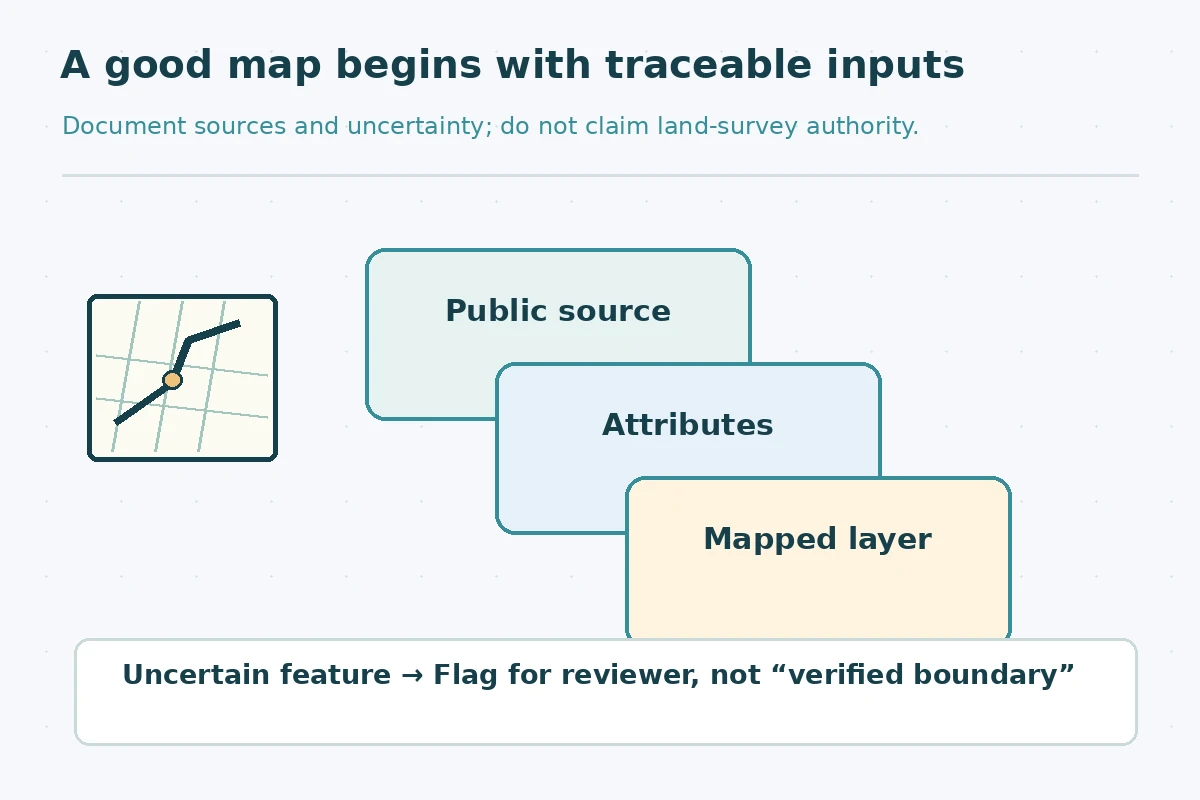
Relevant evidence could come from a class GIS map, a public-data mapping exercise, a supervised cartography project, or data cleanup practice. Describe what you personally did, not what the whole organization accomplished. Suppose you used publicly available park data for a classroom map. You kept the source link, checked whether the coordinate reference information was present, compared a few features against the original dataset, and flagged questionable labels for your instructor. That is meaningful beginning evidence; do not say that you verified legal property lines or performed a licensed survey. If your example included a supervisor or a team, say who reviewed the work. The reader should be able to separate observed work from skills you hope to develop.
Turn real evidence into a focused middle paragraph
Create a small project note that identifies dataset origin, date accessed, map purpose, layers, checks, and known limitations. If screenshots are permitted, show a redacted map excerpt with its legend and a note on uncertainty. Accuracy should be described as what you checked, not a sweeping claim that the entire map is correct. A strong paragraph moves from a specific task to the method you used and then to an observable result or reasonable limitation. A claim such as “I am detail-oriented” needs less attention than the exact check you performed. Avoid fabricated throughput percentages, customer ratings, time saved, or system permissions. If evidence is weak, consider doing a permitted practice project and labeling it clearly before you apply.
Sample entry-level cover letter to adapt carefully
The following example is fictional. Replace its volunteer or coursework experience with work you actually completed; delete any sentence that is not true. Replace “the position” with the employer’s exact title and confirm that the application method matches the posting. A short letter with one defensible example is more useful than a long list of imagined duties.
Illustrative letter: Dear Hiring Team, I am applying for the Junior GIS Mapping Technician position. In a coursework mapping project using public geographic data, I organized layers, checked attribute labels against the source table, and documented uncertain features for instructor review. I learned to record where data came from and to distinguish a clear-looking map from a verified result. Your posting emphasizes careful map updates and quality checks. I would bring that documentation habit to supervised assignments while learning your coordinate systems, field data standards, and review process. Thank you for considering my application.
Rewrite vague claims without inflating experience
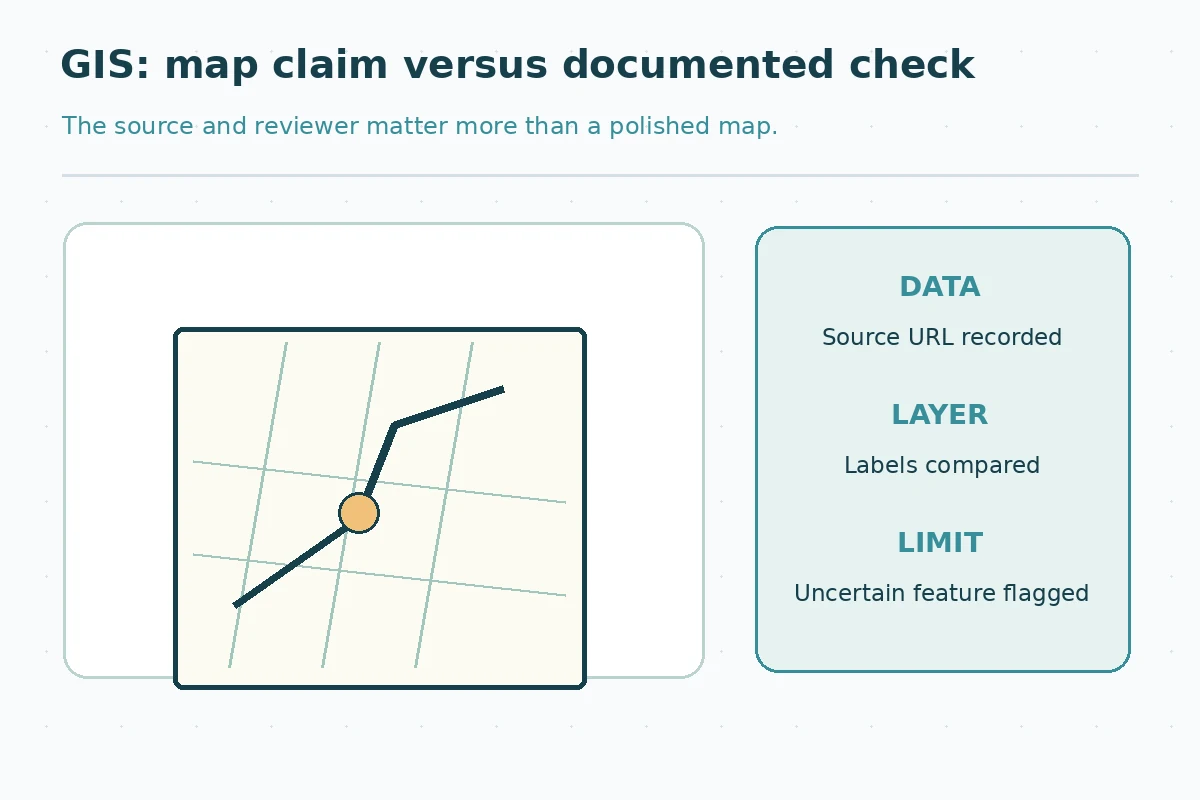
Avoid: “I have verified property boundaries and delivered professional GIS maps.” Better: “For a coursework map, I checked layer labels against public source data and marked uncertain features for instructor review.” The difference is that the second sentence tells the reader exactly where the skill came from and what happened. It does not ask the employer to infer a professional license or an advanced responsibility from beginner work. Replace an invented accomplishment with a real process, even if your role was small. A modest, well-supported sentence survives follow-up questions.
Match one verified skill to a specific vacancy
If a posting requests map editing, describe specific layer edits and the review they received. If it mentions field equipment, do not assume a classroom GIS task proves field-survey readiness. If the posting requires a license or specialized instrument training, state only credentials and hours you can document. The best letter connects a real data-quality decision to the employer’s workflow. Use the organization’s own posting as the reference for required and preferred qualifications. If a minimum qualification is stated as mandatory, do not treat enthusiasm as an alternative or imply credentials you lack. You may still seek an appropriate trainee vacancy or ask the employer which conditions apply. In every case, employer-specific rules override general examples in this guide.
| Posting requirement | Transferable example | Claim boundary |
|---|---|---|
| Layer editing | Course map of public facilities | Identify which layers you edited |
| Source checks | Compared attribute table to source | Document accuracy limits |
| Mapping tools | Actual software used in class | No invented vendor certification |
| Field responsibilities | Observed instructor demonstration | Do not claim surveying authority |
Explain authority, privacy, and training limits
Mapping software exposure does not make someone a licensed surveyor. Do not promise certified boundary accuracy or describe classroom GPS exercises as professional survey work. Name the dataset, purpose, and review status instead. A responsible letter does not list sensitive records, passwords, patient details, or private client information to prove that you were trusted. Instead it demonstrates discretion through an anonymized description of the process. In a regulated or safety-sensitive setting, refer unclear decisions to authorized staff. If you have never used a system, say you are prepared to learn rather than claiming immediate independent proficiency.
Check the draft against five evidence questions
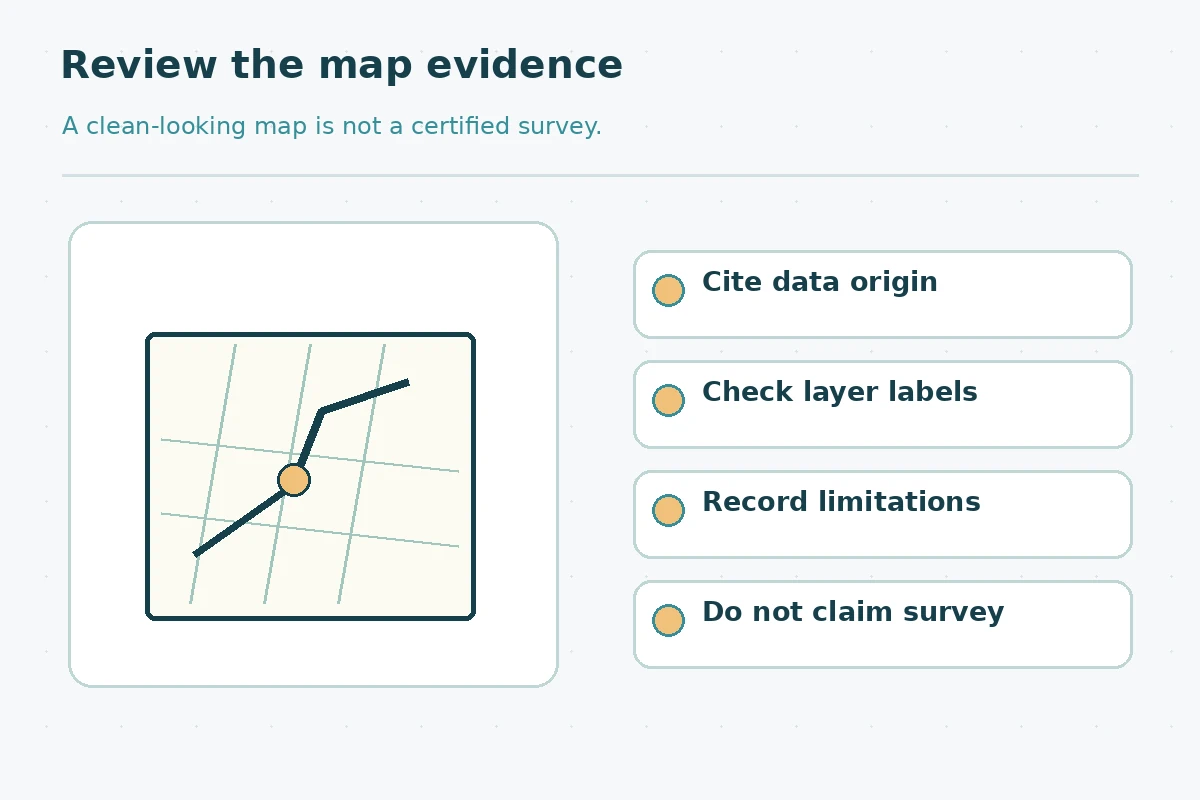
Ask whether the letter names the target job, describes a real task, explains your own action, preserves the boundary of that action, and gives a reason tied to the employer’s opening. For junior GIS mapping technician, useful keywords can include source attribution, layer alignment, attribute checks, and reviewer notes, but only when you have relevant evidence for them. Do not sprinkle vocabulary into the letter to mimic a technical resume. Read it aloud: if you would be uncomfortable explaining a sentence to a hiring manager, rewrite or remove it.
Send the letter with the correct documents and details
Proofread the organization name, role title, dates, attachment name, and contact details. Follow the employer’s instructions for file type and whether a cover letter is required; do not add unwanted private attachments or portfolio links. If a recruiter contacts you unexpectedly, verify the employer through an independently located official channel before sharing sensitive information. The FTC warns that job scammers may request personal or financial details before a legitimate interview. A cover letter ordinarily needs no Social Security number, banking information, or copy of an identity document.
A simple next step is to save the job requirements beside your draft, highlight the specific sentence addressing each important requirement, and delete unsupported material. Then check that the opening is particular to the employer and the closing is brief. The letter should explain the bridge from your actual experience to the work you want to learn; it is not a substitute for any formal credential, background check, onboarding process, or supervised practice required by the position.
How We Research Cover Letters for New Applicants
We compared cover-letter guidance from the University of Pennsylvania and University of Washington Bothell with a profession-specific source for the work of a junior GIS mapping technician. We treated occupational descriptions as examples of possible duties, not a promise that any individual employer offers training or permits the same scope. Examples were written as hypothetical scenarios; checked November 15, 2026.
Sources: University of Pennsylvania Career Services — Cover Letters; University of Washington Bothell — Cover Letters; profession-specific duties and role boundaries; FTC — Job Scams. These sources support the method and relevant role tasks, not a guarantee of employment.
For commercial relationships and reader disclosures, see the JobAsk affiliate disclosure.
More Resume and Cover Letter Guides
Yes. State the data source, tools you actually used, your edits and checks, and how the result was reviewed.
Only if the employer permits links and the project contains no restricted data; explain what the sample demonstrates.
Describe the exact coursework tasks. Do not claim legal land-survey authority or field practice that you did not perform.
Only when you used and understood it. A precise description of the check you performed is better than unexplained technical jargon.
Explain how you flagged the discrepancy and sought review. Do not claim you corrected the underlying source unless you actually did.