
Safety behavioral interview questions ask for a real moment when you noticed a risk, responded within your training, and told the right person. A strong answer does not need a dramatic accident or a claim that you personally certified an area as safe. Choose an honest example, describe the hazard without exposing anyone, state what you could safely do, and explain the report or handoff. If you lack workplace experience, use a genuine supervised school, volunteer, or training example and identify it as such.
Choose a real safety event, not a heroic rescue story
A safety question may sound like “Tell me about a time you noticed something unsafe” or “Describe a time you spoke up about a risk.” Both seek observable behavior. Select a situation you witnessed directly, where you can name the work setting and the specific concern without identifying a customer or coworker. A blocked walkway, damaged cord, missing warning sign, or unclear equipment instruction may be enough if it genuinely happened.
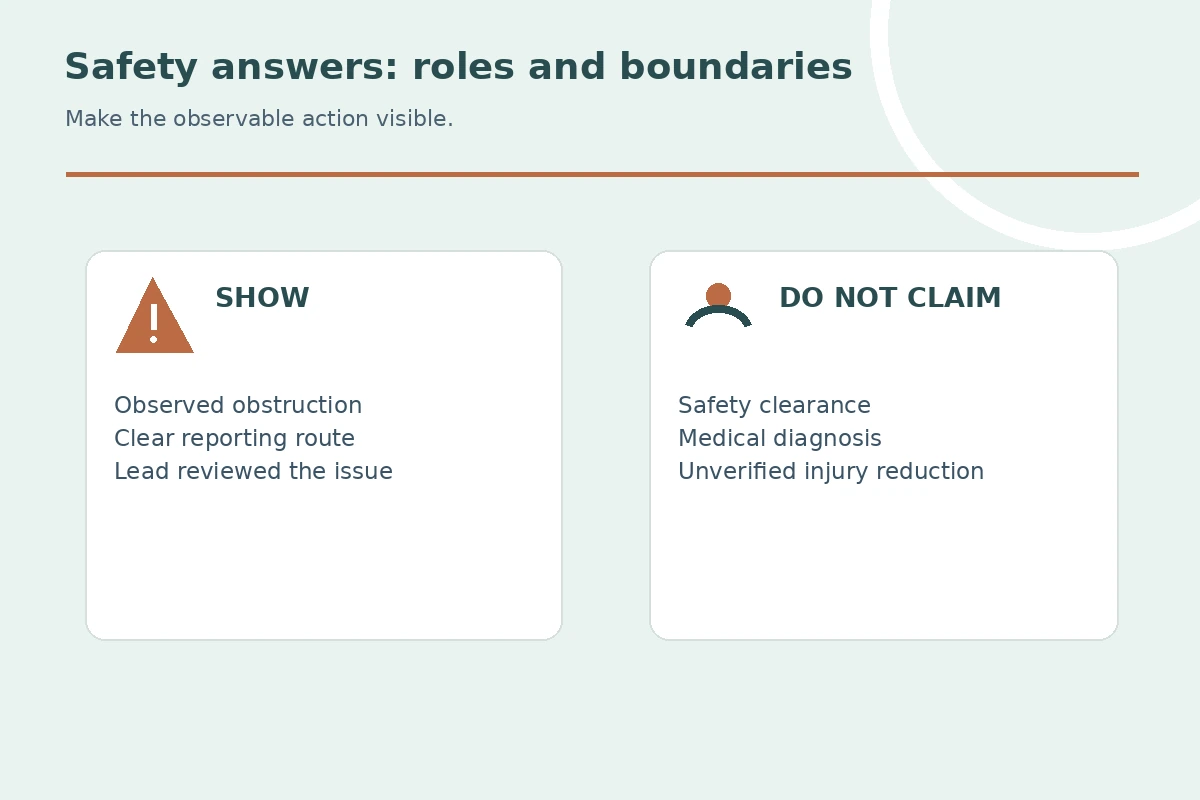
Do not claim that you diagnosed an electrical fault, performed a regulated inspection, or stopped an entire plant unless those were really your duties. A candidate who noticed a wet entrance mat and alerted the shift lead can show sound judgment. The important test is whether the example shows what you observed, what authority you had, whom you informed, and what followed.

Use STAR to show observation, action, and handoff
Set the situation in one sentence: where you were working, which task was underway, and why the risk mattered. Explain your task, such as keeping a public entrance clear or following an approved setup checklist. Under action, name your exact steps: avoid creating additional exposure, use the reporting route you were taught, and inform a responsible person. End with a factual result such as a supervisor taking over the issue.
Separate an observation from a diagnosis. “I saw a damaged cord near a walkway” is something you can verify; “I knew the circuit would start a fire” is a claim you may not be qualified to make. Keep the result modest if you do not know the final resolution. Say you recorded the issue and the designated person reviewed it, not that the situation was legally compliant afterward.
Compare routine caution with an urgent hazard
The answer should not prescribe one response for every workplace. A loose paper label, an unknown spill, and dangerous moving equipment require different procedures. Mention that you followed site instructions and current training. If a danger is immediate, emphasize avoiding exposure and using established emergency or hazard-reporting channels. Do not invent an all-purpose legal right to halt any task in any circumstance.
OSHA explains that workers can raise safety concerns and receive appropriate training; the details of emergency response, reporting, and work refusal depend on the situation and applicable rules. In the interview, concentrate on the actions you actually took. If you did not know what a substance was, say you kept clear and notified the designated contact rather than guessing its identity or handling it without authorization.

Practice an answer without overstating your role
Hypothetical example for a retail support worker: “During opening setup, I noticed boxes narrowing a customer route. My job was to prepare displays, not approve building safety. I stopped adding boxes, pointed out the obstruction to the floor lead, and helped move stock only after receiving instructions. The route was checked by the lead before we opened.” This sample is fictional; use it only as a model for organizing your own true event.
Notice what the sample does not say. It does not describe a perfect safety record, a reduced injury rate, or a new policy adopted companywide. It identifies an observable hazard and responsible escalation. If your real situation ended with a pending repair, the honest ending is that you made the report, kept the area outside your own task, and awaited authorization. Unfinished results can still demonstrate judgment.
Use this evidence and scope check before practicing
| Part of your story | What to verify | Boundary to keep |
|---|---|---|
| Observed hazard | What did you actually see? | Do not diagnose beyond training |
| Immediate action | How did you avoid added exposure? | Do not improvise a repair |
| Escalation | Who had responsibility? | Do not invent approval powers |
| Result | What did you personally confirm? | Do not invent injury statistics |
Answer follow-up questions about disagreement and timing
An interviewer might ask whether coworkers agreed with you, why you used a particular channel, or what you would change. Respond without blaming people. You can say you described the observed risk, consulted the written procedure, and used the supervisor or safety contact the workplace designated. Explain when you acted and what you knew at that point. Avoid revealing another employee’s disciplinary history or personal circumstances.
If you realize your response could have been faster, acknowledge it and explain what practice you learned. The goal is not to present yourself as incapable of error, but to describe proportionate action. Where training was missing, tell the interviewer that you sought clarification rather than independently operating equipment. Managers want evidence of risk awareness and dependable communication, not unlimited personal authority.
Match the example to the position without adding credentials
For a front-desk role, a genuine example might involve a blocked entrance or visitor concern. For warehouse work, an example could relate to a marked pedestrian route, but do not imply you can operate a lift truck without required training. For healthcare support, use a scenario from your actual scope and never disclose patient details. Choose the competency the posting asks for: observation, procedure compliance, or timely escalation.
A safety certificate or training course can be mentioned only if completed and current as claimed. A classroom demonstration is not proof that you are authorized to perform a regulated task at work. You may say “during a supervised simulation” when that is what happened. This precise framing lets the reader assess your judgment while leaving employer-specific licensing and authorization to the employer.
Review the answer for clarity and factual boundaries
After drafting, underline the parts that are firsthand observation, your own action, and a confirmed outcome. If one of those is missing, revise the story. Remove dramatic adjectives, names, and unverifiable injury counts. Practice saying the answer aloud in plain language. An interviewer should understand the hazard, the reporting route, and your role without needing a technical explanation you cannot support.
Check that you did not give the impression of ignoring an emergency, bypassing procedures, or concealing a problem to meet a deadline. There is no universal “best” answer for every facility. The strongest version shows that you know when to stop your own unsafe action, seek trained assistance, and preserve an accurate record. This is interview preparation, not a workplace emergency-response manual.
Try a safe, fictional practice scenario
Use a fictional community-event setup for practice: a volunteer finds an unsecured power cord across a walking path shortly before attendees arrive. List what the volunteer can observe, what they should avoid attempting without training, and who organizes the venue. Draft a 60- to 90-second STAR response that describes asking the event lead to assess the concern, following the approved instructions, and accurately recording the handoff. Then replace the practice story with an event you genuinely experienced. If you have no real example yet, prepare an honest answer that says you have not handled that hazard professionally and explains the safety approach you would follow under training.
How We Research Behavioral Interview Answers
For this guide, we reviewed interview-assessment resources and relevant professional or workplace guidance on November 7, 2026: www.opm.gov (OPM recommends open-ended competency-focused behavioral interview questions framed around situation, action and result.); www.osha.gov (OSHA describes worker rights to safety training and to report workplace hazards without retaliation.); mylehigh.lehigh.edu (The Lehigh career center includes example behavior-based interview prompts about actions and outcomes.). General guidance does not establish the procedures or authority of any particular employer. All example candidate stories and illustrative results in this article are fictional learning exercises, not personal testimonials. Adapt the framework only to genuine, shareable experiences and confirm applicable workplace procedures and job requirements.
This is independent interview preparation guidance; it does not promise interview performance, hiring, or any employer-specific outcome. Do not disclose private records or proprietary systems during an interview. See the JobAsk affiliate disclosure for site transparency.
More Interview Preparation Guides
Use a real supervised school, community, or volunteer safety-related example if relevant, and clearly identify the setting. Do not claim professional safety responsibility you did not have.
Only if you actually did and had a sound basis. Explain the particular action you took and the workplace reporting or emergency procedures rather than inventing a universal stop-work rule.
Yes when relevant and shareable, but avoid identifying individuals or claiming a medical diagnosis. Focus on what you personally observed and reported.
A timely, documented report and responsible handoff are genuine results; be clear that the supervisor made the subsequent safety decision.
No. The interview question asks for behavior. Mention a certification only if you truly earned it, and check the specific job requirements separately.