
For nonprofit program manager final interview, expect to go beyond the first conversation and explain what you personally did, how you made decisions, and which questions remain open about the work. A later-round invitation is not a promise of an offer. The format may include a manager, a panel, a work example or a practical case, depending on the employer. This guide focuses on community need, program delivery and outcome review rather than memorized confidence claims. Use only genuine employment history in answers about your background; any sample situation here is hypothetical and must be adapted to your real authority and evidence. Before participating, confirm the invitation, time zone, participants and any approved presentation or work-sample instructions.
Show that mission and operations must agree
In a nonprofit program manager final interview, enthusiasm for the mission is not enough. The hiring group may need to know whether you can plan services, support staff and volunteers, track participation and report credible results within available resources. O*NET lists budgets, records, program assessment and relationships with other organizations among the work of social and community service managers. Read the actual posting and identify which of those tasks the position includes. A role that coordinates two outreach sites is not identical to one with grant-approval authority or responsibility for clinical services. Clarify the real scope rather than claiming you can solve every community need.
Prepare a participant-needs example with privacy
Choose a real situation where the service team learned that a participant group faced a barrier, such as an inconvenient schedule or unclear enrollment information. Explain the type of evidence collected, the questions you asked and which changes were possible. If your previous role only gathered feedback, describe that contribution instead of saying you redesigned the program. Never reveal personal records, protected health information or identifiable stories simply to create an emotional interview answer. When metrics are unavailable, describe the review method and what the team would need to measure. A responsible manager does not confuse a moving anecdote with a verified outcome.
Connect staff capacity to realistic service promises
Program growth depends on trained staff, volunteer availability, materials and partnerships. A final-round scenario may ask what you would do if a funder requests more sessions while the schedule is already full. You can explain that you would check demand, coverage, training needs and the restrictions on resources before proposing a change. Do not promise unlimited access or treat volunteers as cost-free substitutes for licensed or trained professionals. Record whose approval is necessary for new spending, altered eligibility rules or expanded delivery. The goal is to demonstrate good judgment about capacity, not to offer an imaginary instant expansion.
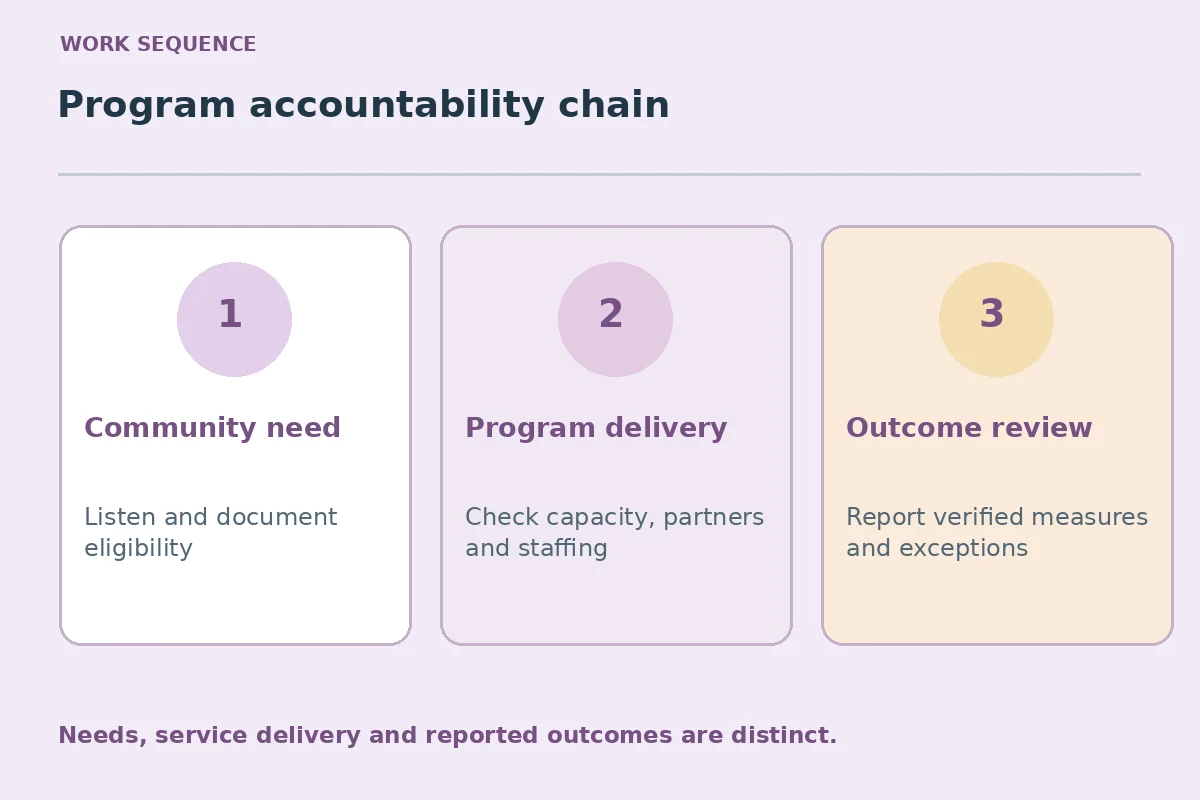
Follow the accountability chain in the diagram
The visual workflow moves from community need to delivery plan to evidence review. At each stage, different people may have different authority. The program team may document participation, finance may reconcile budget lines, and the authorized leader or funder may control a material change. Those are illustrative roles, not universal rules for every nonprofit. If the organization’s award has restricted funds, ask how staff check the permitted use before making a commitment. Explain which documents you would consult and whose review you would request. Do not invent grant conditions when none have been shown to you.
Describe outcomes without a promotional claim
A credible interview answer distinguishes activities, outputs and outcomes. Delivering a workshop is an activity; counting verified attendance is an output; demonstrating improved access or sustained change requires a suitable outcome measure and evidence. If a past initiative missed a target, describe the recorded variance, what you learned about the process and what corrective proposal was reviewed. Do not make up a before-and-after statistic or guarantee a funder result. Strong reporting can acknowledge limited data. You can discuss how to keep definitions consistent, reduce duplicate records and review results with staff who know what happened on the ground.
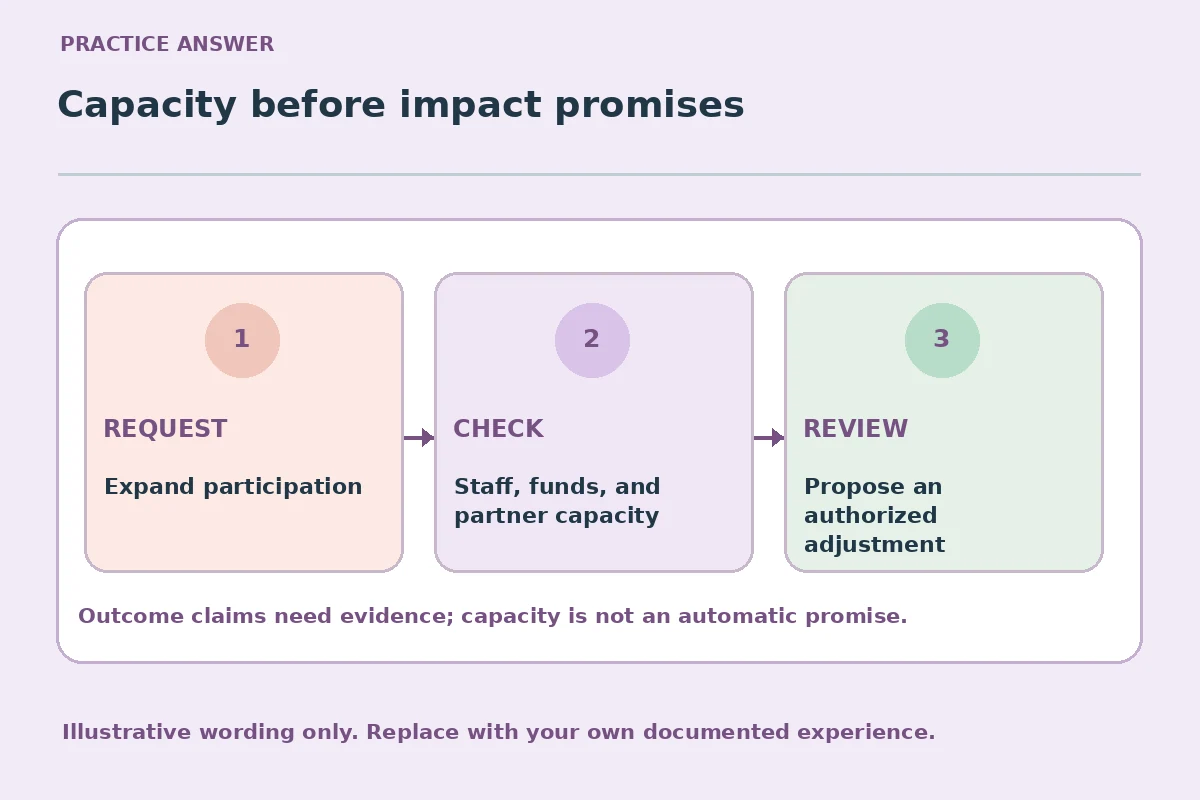
Discuss partners and volunteers with precise responsibilities
Community programs depend on relationships with partner agencies, volunteers and sometimes government offices. Prepare an example of a handoff in which you confirmed the receiving partner, documented the allowed information and followed up without exposing sensitive participant details. If you have not supervised volunteers formally, describe event coordination or training support honestly. A funder or executive director may care about whether the person in this role can maintain a useful relationship while respecting the partner’s separate procedures. Explain what you would do if a referral was declined or a volunteer lacked needed training. Escalation is a sign of accountability, not failure.
| Decision area | What to confirm |
|---|---|
| Participants | Needs, access and privacy |
| Capacity | Staff, volunteers and service limits |
| Resources | Restricted funds and approvals |
| Impact | Measures, limitations and reporting |
Practice a realistic short program case
Imagine attendance declines over several weeks and a partner suggests adding a new evening session. Your answer could start by checking that attendance was recorded consistently, consulting staff and participant feedback, and identifying safety, staffing and transportation constraints. Then propose options and name who would approve any schedule or budget change. This response is a hypothetical exercise, not evidence that you have managed a real grant. Use your actual examples when asked about past experience. Structured interview questions often probe the candidate’s specific actions and observed result; keep your own contribution separate from the whole organization’s accomplishments.
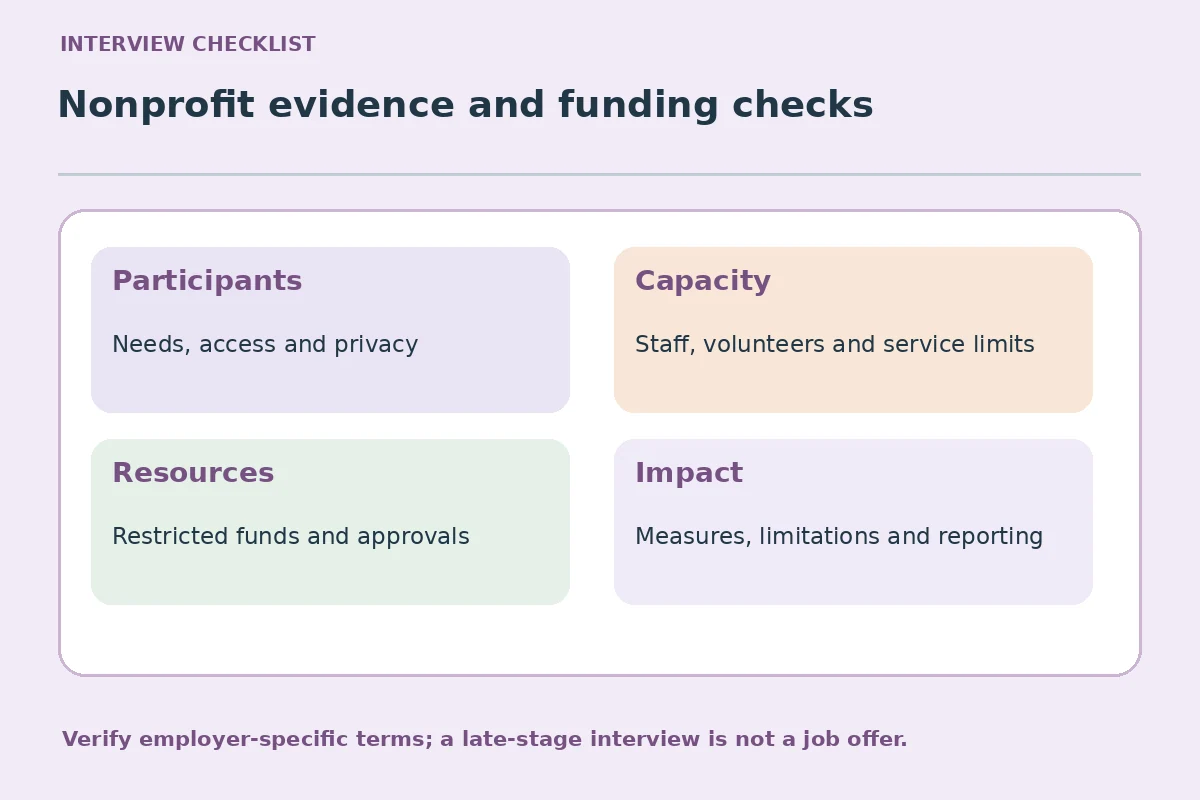
Ask what the program will measure and who decides
The final round is a reasonable time to ask about reporting cycles, available records, priority populations, supervision, partner commitments and the first review period. Questions such as “Who owns the definition of a successful outcome?” and “What change requests require finance or board approval?” can be more useful than an unfocused question about mission alignment. Ask where funder restrictions and privacy requirements are documented, without assuming particular grant terms. If the organization uses a metric you have not tracked before, ask how employees are trained rather than pretending to be an expert. Record the answer and reflect on whether the role matches your skills.
End with a feasible first-step proposal
A strong close summarizes what you would verify before proposing changes: actual participant needs, capacity, program requirements, funding restrictions and documented outcomes. It does not promise a new program launch or a funding increase by a specific date. Confirm how the employer will communicate a decision and whether another interview, reference check or work sample follows. Protect unpublished partner information after the interview. You may send a brief thank-you note referencing the role’s real challenges. Even if the discussion felt positive, an offer requires separate confirmation from the employer; do not resign from a current position based only on an encouraging conversation.
How We Research Second and Final Interview Advice
JobAsk reviewed these occupational, government and university sources on November 17, 2026: O*NET describes community-service managers as overseeing programs, records, staff, volunteers, budgets and partner relationships. U.S. OPM explains competency-based questions and the distinction between behavioral and situational interviewing. U.S. OPM describes clear job-related interview questions and the situation-task-action-result structure. University of Chicago explains that second-round interviews probe work experience and can involve supervisors, other staff, panels and assessments. These sources describe typical interview formats or real occupational duties; they do not establish what any individual employer will ask or how a hiring decision will end. We checked that this scenario answers a more specific reader question than general interview preparation, while the employer remains the final source for its own hiring process. Examples in this guide are hypothetical and must not be presented as actual employer results or client outcomes. No affiliate approval, employment offer, guaranteed interview score or hiring outcome is implied. Read the JobAsk affiliate disclosure.
More Interview Preparation Guides
It may; ask the organizer whether a case, presentation or panel is planned.
No. Use verified figures or clearly mark a fictional scenario rather than claiming unobserved impact.
Only with appropriate permission and anonymization; protect personal and sensitive records.
The actual organization’s delegation and award conditions control; ask which staff or board approvals apply.
Explain the verified variance, plausible causes, participant needs and a reviewable response without hiding the result.