
You can search for a first job without a college degree, but “no degree required” does not mean “no qualifications required.” Begin by comparing the actual entry route: no formal educational credential, high school diploma or equivalent, postsecondary nondegree training, or a paid apprenticeship. Then check what the specific employer expects, how work is supervised, and whether the position requires licensing or a separate credential. This article shows how to build a realistic shortlist without inventing salaries or promising that any occupation is automatically open to every applicant.
Use four education labels instead of one vague search
The Bureau of Labor Statistics uses separate categories for the typical education needed to enter an occupation. “No formal educational credential” is different from “high school diploma or equivalent,” and both differ from a postsecondary nondegree award. A certificate can represent completed education, but not every course completion makes you eligible for regulated work. Search using the actual occupation plus “training” or the level of credential you possess, rather than relying on “no degree jobs” alone. Write down the education category for each role and then confirm it in an active employer posting. BLS describes typical preparation nationally; local employers and laws may require more.
Compare daily duties before judging a job by its title
Make a two-column list: tasks you would perform and conditions under which you would perform them. A service counter role may involve communication, accurate transactions, and customer-facing shifts; a stockroom support role may involve counting goods, handling deliveries, and following site safety practices. Those are examples of possible tasks, not claims about a particular opening. Read the BLS “What They Do” and “Work Environment” sections to see what the occupation typically involves. Then ask whether the duties suit your abilities, schedule and interest. Never select hazardous or restricted tasks merely because a posting describes them as beginner-friendly.

Check whether training happens after hiring or before
On-the-job training is employer-provided learning associated with a role, while a separate training program may require admission and completion before employment. Look for the exact order: apply, interview, hired, training begins, supervised tasks, eventual independence. Do not equate a one-day orientation with qualification for a licensed occupation or operation of dangerous equipment. If an advertisement says “training available,” ask whether it is paid employment, classroom instruction, a prehire course, or something else. Confirm who provides the training, whether the job is guaranteed only after further selection, and what completion means. Details differ among employers and occupations.
Understand how a registered apprenticeship differs
The U.S. Department of Labor describes apprenticeship as paid on-the-job learning combined with classroom instruction. This is a specific training model, not a synonym for any entry-level position. Some apprenticeships are registered under state or federal frameworks and have defined sponsors and program requirements; check a program’s official listing and eligibility conditions. If you are interested in skilled work, compare the sponsor, length, classroom expectations, supervision, and credential path. Do not claim to be an apprentice before acceptance or assume that any advertised “apprentice” title has a registered program. The DOL’s Apprenticeship resources are a starting point for verification.

Build evidence from activities you actually completed
A first applicant may have useful evidence from supervised volunteering, school projects, sports team administration, household budgeting, or a community club. Choose examples with a genuine connection to the posted tasks. If you organized a school event, you might describe tracking supplies or confirming volunteer assignments, but do not call it paid operations management. If you practiced a trade skill in class, specify that the setting was a classroom and the work was supervised. A brief statement such as “Recorded supplies for a student event and reconciled the list after setup” is more credible than “expert inventory controller.” Accurate context matters as much as appealing verbs.
Screen costs and risky promises before enrolling anywhere
Some career routes require education or certifications; the existence of a fee does not by itself prove fraud. However, the FTC warns that paying someone for the promise of a job is a scam warning and describes fraudulent training and equipment schemes. Check school and program recognition, whether a credential is actually needed for the occupation, the total cost, and whether the employer or program is truly offering employment. If someone insists you must buy a starter package or send money before you can be hired, do not proceed. Use independent government or official program information rather than a recruiter-provided screenshot or testimonial.
Match a shortlist to your actual constraints
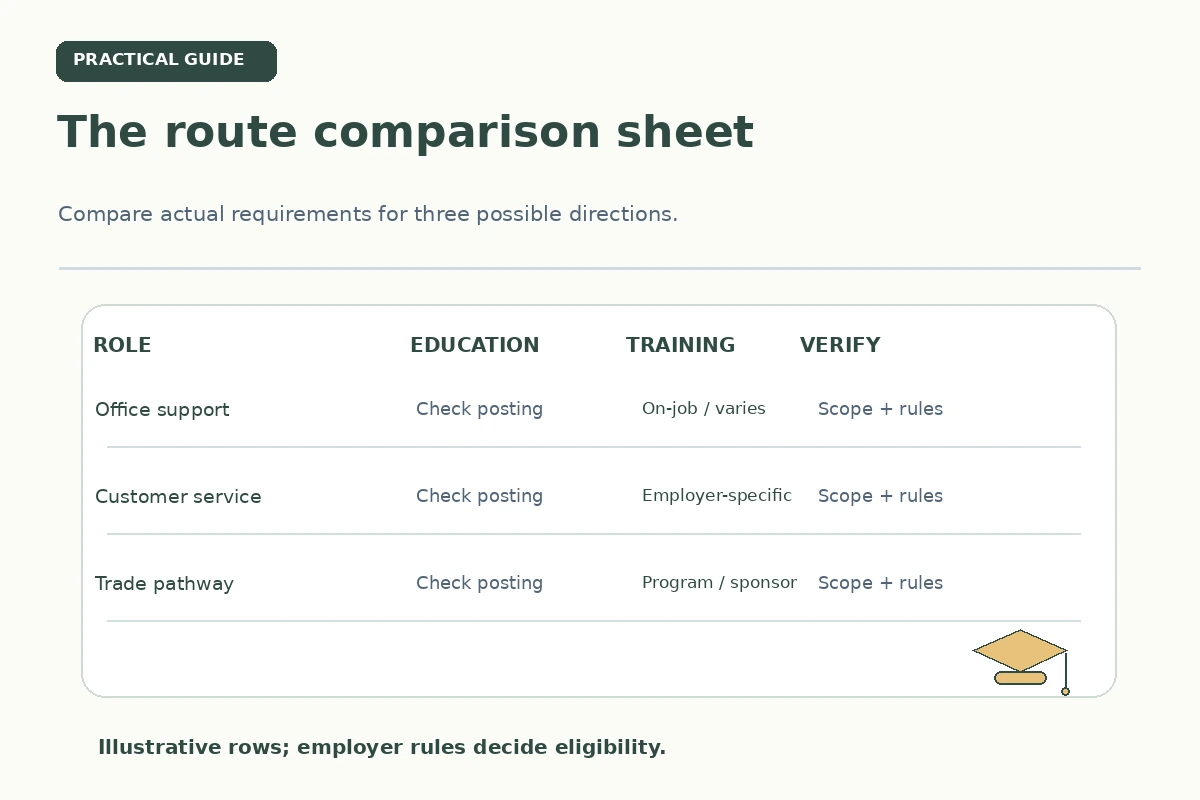
For each occupation, record education, required authorization, work environment, shift pattern, physical demands and potential training pathway. Do not copy wage figures from another year or state as if they are a local offer. The BLS occupation descriptions provide national context, but current employer advertisements determine what is open and what terms are offered. Compare only jobs that you can realistically reach and perform, including any required transportation or accommodations. When a listing is unclear, write a narrow question for the official hiring contact. This is more useful than sending dozens of identical applications to occupations whose entry rules you have not checked.
Choose the next learning step after testing job postings
After screening several genuine openings, look for recurring skill gaps you can close with a modest, relevant step. That might mean learning an approved office tool, practicing customer communication with a volunteer coordinator, or finding a recognized training program. Avoid buying an expensive course simply because a marketing page says it guarantees a job. Ask an American Job Center or school counselor what free services exist in your area. Set a review date to compare new evidence against actual job requirements, not against an influencer’s career ranking. A realistic entry route is one in which the work, training and prerequisites all make sense together.
A no-degree route comparison you can maintain
Create rows for three occupations you would genuinely consider. Record the BLS typical entry education, training category, actual credential named by the employer, main tasks, likely supervision, scheduling constraints, and a link to a live listing. Add one item of truthful evidence for each role and one uncertainty to investigate. Do not use the sheet to claim a universal salary or to treat national typical requirements as a substitute for local licensing rules. A useful decision is “verify state credential” or “explore this role,” not “guaranteed to qualify.”
How We Research Beginner Job Search Guidance
We review U.S. primary resources about occupation requirements, official job-search services and employer verification, then translate those into a practical worksheet. Sample scenarios are hypothetical; they do not represent actual openings, hiring decisions, employer commitments or universal legal rules. Check the current employer posting and applicable licensing or program requirements before relying on an example.
Sources reviewed November 11, 2026: www.bls.gov — The BLS Occupation Finder distinguishes occupations by typical entry education and training.; www.bls.gov — The BLS glossary distinguishes no formal educational credential, high-school or equivalent and postsecondary nondegree awards.; www.dol.gov — DOL describes apprenticeship as combining paid on-the-job training and classroom instruction.; consumer.ftc.gov — FTC warns against paying for the promise of a job or fake training placements..
This guide offers general U.S. job-search information, not legal advice, job placement, an employment promise or proof that a particular opening exists. Review the JobAsk affiliate disclosure. The internal category links here are informational, not paid endorsements.
Related Job Search Guides
Yes, many occupations have other typical entry-education categories. Check individual employer requirements and any applicable licensing rules.
No. BLS uses separate categories for high school or equivalent, postsecondary awards and college degrees.
Not always. Ask whether a listing describes employee training after hire or a separate pre-employment program.
Registered apprenticeships combine paid work and classroom instruction, but exact expenses, eligibility and program terms need to be checked with the sponsor.
First verify whether real employers or regulators require that credential and whether the program is recognized; avoid anyone selling a guaranteed job.