
An office supervisor development plan should help you coordinate people fairly while staying inside the powers of your actual role. First-line supervisors may organize schedules, review records, coach employees, and handle escalations. That does not mean every supervisor can independently decide pay, discipline, privacy exceptions, or policy changes. Begin by mapping which actions you may take, which must be documented, and which require an HR or manager decision.
The examples here are planning tools, not legal advice or replacements for workplace policies. Supervisory responsibilities vary widely. If a situation involves safety, harassment, protected information, or employment action, use the employer’s approved escalation process.
Define the Supervisor Role by Decisions, Not the Title
Use the duties in your actual job description as the starting point. O*NET describes office and administrative support supervisors as coordinating staff, reviewing work, providing guidance, scheduling, and handling difficult issues. Your employer may restrict staffing decisions, disciplinary action, budgets, or confidential records to other roles. Identify the limits before setting leadership goals, because doing more is not always a sign of better supervision.
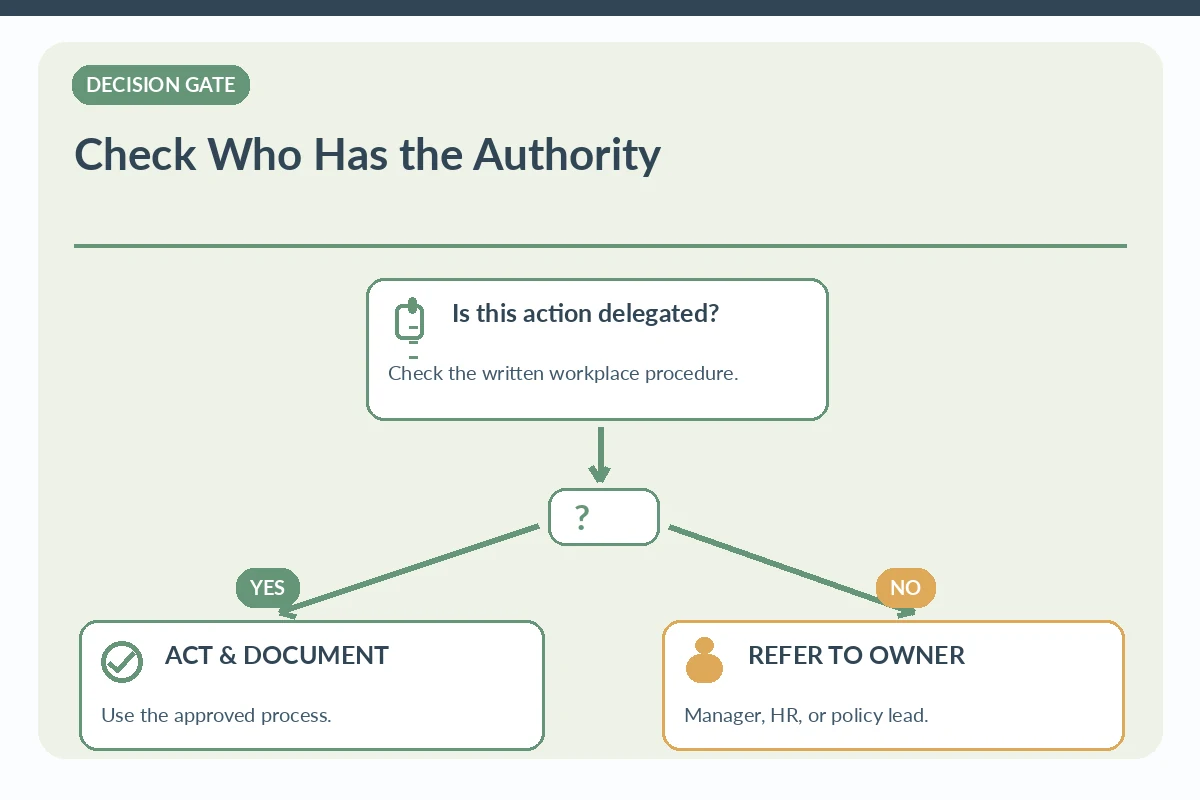
Make a three-column decision table: can act, can recommend, must escalate. For example, you may be allowed to allocate daily work within an approved schedule but only recommend overtime or approve leave under specific rules. If permission is unclear, ask your manager for a written explanation. Do not treat an article or training checklist as authorization to make employment decisions.
| Development stage | Useful activity | Evidence or boundary |
|---|---|---|
| Coach | Give process feedback and ask questions | Use approved performance procedure |
| Coordinate | Draft coverage and track handoffs | Confirm schedule authority |
| Escalate | Record facts and notify the correct owner | Refer personnel and policy exceptions |
Practice Coaching Through Observable Work
A useful coaching goal focuses on evidence that an employee can understand and discuss. Identify the relevant procedure, a concrete observation, the impact on the workflow, and a next step. Ask the employee for their perspective before drawing conclusions. Avoid making personality judgments or promises about promotions. Where formal performance processes apply, use only approved documentation and involve the designated manager or HR partner.
A hypothetical coaching conversation might address missing handoff details on a shared calendar. The supervisor can point to the required fields, ask what made completion difficult, and offer a supervised practice. They should not publish a colleague’s mistakes, disclose private employee details, or invent a performance score. Good development evidence is a clear method and feedback from the appropriate reviewer.

Improve Quality Checks Without Micromanaging
Select one high-impact process: an intake queue, document routing, a schedule handoff, or record completeness. Agree on what counts as a valid record and what exceptions require review. A quality check should help detect a problem early, not create an unofficial surveillance program. Document the standard and the person who owns it, and respect any existing privacy or labor-management requirements.
When you find an exception, distinguish a correctable record error from a potential policy or compliance issue. Routine corrections may be allowed; other findings should be referred. Avoid claiming that a new checklist guarantees error-free work. Assess whether the check is accurate, fair across shifts, and feasible for employees rather than merely increasing the number of fields they must complete.
Make Scheduling and Shift Handoffs Transparent
Administrative supervision often means balancing requests, coverage, training, and deadlines. Learn which constraints are contractual, policy-based, or manager-approved before making a schedule. Record the owners of open items and planned coverage changes. When someone is unexpectedly absent, consult the applicable process rather than assuming you can cancel leave, require extra hours, or reveal personal reasons for absence.
For a practice assignment, prepare a draft coverage map that shows roles needed and known handoff points, without sensitive employee data. Have the authorized person review it. The value of the exercise is to show competing constraints and decisions that still need approval. It is not proof that you independently managed payroll, labor compliance, or emergency staffing.
Escalate Employee, Customer, and Policy Problems Correctly
Front-line supervisors may receive complex complaints or employee questions, but they do not necessarily have the authority or training to resolve every issue. Map common triggers: account information requests, allegations involving coworkers, disputed policy exceptions, and safety concerns. Write who receives each type, which facts to document, and what information must stay confidential.
Use neutral notes about the event, without speculation about motives or health. When a complaint involves a coworker, follow established reporting and anti-retaliation procedures; do not promise confidentiality you cannot guarantee. Your career-development evidence can show that you recognized the boundary, preserved appropriate documentation, and contacted the authorized resource promptly.
Review Leadership Progress With the Manager and Team
Set a plan covering one coaching skill, one quality process, and one coordination task. Give each a specific practice opportunity and evidence such as an approved checklist, feedback on a conversation, or a reviewed schedule. OPM describes individual development plans as ongoing conversations aligning learning objectives with job goals; they are not automatic promotion guarantees.
At each review, ask whether the process became clearer for employees, whether exceptions went to the right owner, and whether your own decisions stayed within scope. Adjust goals when responsibilities or workplace policy change. A supervisor’s next role should be evaluated through reliable execution and accountable judgment, not unsupported claims about team productivity or morale.

Check Whether a Development Goal Is Fair to the Team
Before adopting a new checklist or coaching routine, ask whether employees understand the standard, have access to necessary tools, and know where exceptions go. Observe whether it adds unnecessary administrative work or places sensitive information in shared documents. Bring a proposed adjustment to the manager or policy owner instead of quietly imposing a new requirement. Ask a teammate for process feedback without pressuring them to evaluate a colleague publicly. Evidence of effective supervision includes transparent instructions, reasonable review points, and accurate escalation—not merely a larger number of monitored tasks. Record the date of the review and the person responsible for approving changes, so a future employee does not mistake a draft practice for an official policy.
How We Research Career Development Guidance
Checked 2026-11-15: www.onetonline.org (front-line office supervisors coordinate work, scheduling, training and complex complaints); www.onetonline.org (office supervisors review performance and records, coordinate procedures and escalate issues); www.opm.gov (how individual development plans connect employee goals, activities, and supervisor feedback). These occupational descriptions identify common work, not automatic permission to perform regulated tasks or decide for an employer. Career plans and examples are illustrative, not real personal or organizational outcomes. Verify the specific job posting, current training requirements, workplace policies, and authorized reviewers before acting. No paid endorsement is confirmed in this guide; see the JobAsk affiliate disclosure.
Explore Related Career Guides
Include a defined decision scope, coaching practice, review tasks, evidence, and feedback dates.
Only if explicitly authorized under employer policy and applicable requirements; do not assume such authority.
Describe observable work feedback, active listening, and follow-up performed through approved procedures.
No. Follow approved confidentiality and personnel-record rules; minimize sensitive details.
An approved process for clearer shift handoffs or consistent quality feedback is more defensible than an unsupported team performance target.